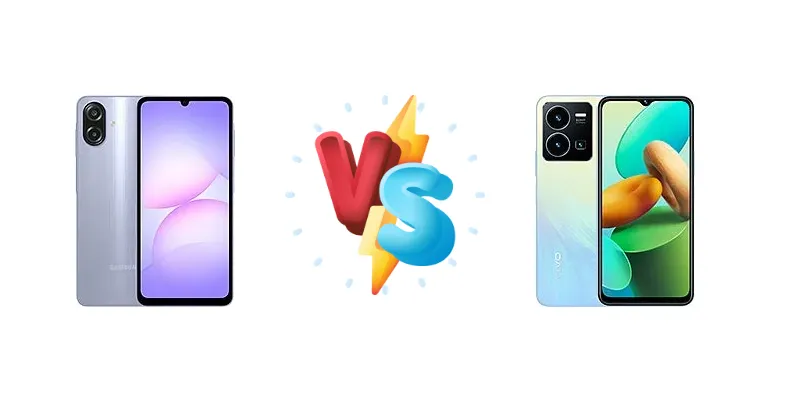
The Samsung Galaxy A07 4G and the vivo Y22s (Europe) represent compelling options in the ultra-budget smartphone segment. While both aim to deliver essential smartphone functionality at an accessible price, they diverge in their core hardware choices, particularly in chipset and charging capabilities. This comparison dissects these differences to determine which device offers the best value for your money.
🏆 Quick Verdict
For most users, the Samsung Galaxy A07 4G emerges as the slightly stronger choice. Its Mediatek Helio G99 chipset, while not a powerhouse, offers a performance edge over the Snapdragon 680, and its longer measured battery life of 12:44h in active use provides greater peace of mind. However, the vivo Y22s' reverse wired charging is a unique feature.
| Network |
|---|
| 2G bands | GSM 850 / 900 / 1800 / 1900 | GSM 850 / 900 / 1800 / 1900 |
| 3G bands | HSDPA 850 / 900 / 2100 | HSDPA 850 / 900 / 1700(AWS) / 1900 / 2100 |
| 4G bands | 1, 3, 5, 7, 8, 20, 28, 38, 40, 41 | 1, 2, 3, 4, 5, 7, 8, 20, 28, 38, 40, 41 |
| Speed | HSPA, LTE | HSPA, LTE |
| Technology | GSM / HSPA / LTE | GSM / HSPA / LTE |
| Launch |
|---|
| Announced | 2025, August 25 | 2022, November 17 |
| Status | Available. Released 2025, August 25 | Available. Released 2022, November 17 |
| Body |
|---|
| Build | Glass front, plastic back, plastic frame | Glass front, plastic frame, plastic back |
| Dimensions | 167.4 x 77.4 x 7.6 mm (6.59 x 3.05 x 0.30 in) | 164.3 x 76.1 x 8.4 mm (6.47 x 3.00 x 0.33 in) |
| SIM | Nano-SIM + Nano-SIM | Nano-SIM + Nano-SIM |
| Weight | 184 g (6.49 oz) | 192 g (6.77 oz) |
| Display |
|---|
| Resolution | 720 x 1600 pixels, 20:9 ratio (~262 ppi density) | 720 x 1612 pixels, 20:9 ratio (~270 ppi density) |
| Size | 6.7 inches, 108.4 cm2 (~83.6% screen-to-body ratio) | 6.55 inches, 103.1 cm2 (~82.4% screen-to-body ratio) |
| Type | PLS LCD, 90Hz | IPS LCD, 90Hz |
| Platform |
|---|
| CPU | Octa-core (2x2.2 GHz Cortex-A76 & 6x2.0 GHz Cortex-A55) | Octa-core (4x2.4 GHz Kryo 265 Gold & 4x1.9 GHz Kryo 265 Silver) |
| Chipset | Mediatek Helio G99 (6 nm) | Qualcomm SM6225 Snapdragon 680 4G (6 nm) |
| GPU | Mali-G57 MC2 | Adreno 610 |
| OS | Android 15, up to 6 major Android upgrades, One UI 8 | Android 12, Funtouch 12 |
| Memory |
|---|
| Card slot | microSDXC (dedicated slot) | microSDXC (dedicated slot) |
| Internal | 64GB 4GB RAM, 128GB 4GB RAM, 128GB 6GB RAM, 256GB 8GB RAM | 128GB 6GB RAM |
| Main Camera |
|---|
| Dual | 50 MP, f/1.8, (wide), 1/2.76", 0.64µm, PDAF
Auxiliary lens | - |
| Features | LED flash | Dual LED flash |
| Triple | - | 50 MP, f/1.8, (wide), PDAF
2 MP (macro)
Auxiliary lens |
| Video | 1080p@30/60fps | 1080p@30fps |
| Selfie camera |
|---|
| Single | 8 MP, f/2.0, (wide), 1/4.0", 1.12µm | 8 MP, f/2.0, (wide) |
| Video | Yes | 1080p@30fps |
| Sound |
|---|
| 35mm jack | Yes | Yes |
| Loudspeaker | Yes | Yes |
| Comms |
|---|
| Bluetooth | 5.3, A2DP, LE | 5.0, A2DP, LE |
| NFC | No | Yes |
| Positioning | GPS, GLONASS, GALILEO, BDS | GPS, GALILEO, GLONASS, BDS, QZSS |
| Radio | FM radio | FM radio |
| USB | USB Type-C 2.0 | USB Type-C 2.0, OTG |
| WLAN | Wi-Fi 802.11 a/b/g/n/ac, dual-band, Wi-Fi Direct | Wi-Fi 802.11 a/b/g/n/ac, dual-band |
| Features |
|---|
| Sensors | Fingerprint (side-mounted), accelerometer, proximity | Fingerprint (side-mounted), accelerometer, proximity, compass |
| Battery |
|---|
| Charging | 25W wired | 18W wired, 70% in 70 min
Reverse wired |
| Type | 5000 mAh | 5000 mAh |
| Misc |
|---|
| Colors | Gray, Light Violet, Dark Green | Summer Cyan, Starlit Blue |
| Models | SM-A075B, SM-A075B/DS, SM-A075F, SM-A075F/DS, SM-A075M, SM-A075M/DS | - |
| Price | $ 139.99 / £ 73.89 | About 250 EUR |
| SAR | 0.33 W/kg (head) 1.18 W/kg (body) | - |
| SAR EU | 0.19 W/kg (head) 1.33 W/kg (body) | 0.98 W/kg (head) 1.17 W/kg (body) |
Samsung Galaxy A07 4G
- Longer measured battery life (12:44h active use)
- Faster 25W wired charging
- Potentially better CPU performance with Helio G99
- Lacks reverse wired charging
- Display details beyond brightness and contrast are unknown
vivo Y22s (Europe)
- Reverse wired charging capability
- Snapdragon 680 offers good power efficiency
- Modern chipset architecture
- Slower charging speed (18W)
- Likely lower CPU performance compared to Helio G99
Display Comparison
Both devices likely feature LCD panels, common in this price bracket. However, the Samsung Galaxy A07 4G boasts a measured peak brightness of 468 nits and a 1128:1 contrast ratio, suggesting a more vibrant and visible display, especially outdoors. While the vivo Y22s’ display specifications are unavailable, Samsung’s measured figures indicate a superior viewing experience. The lack of high refresh rate panels on either device is expected at this price point, but the A07’s brightness gives it an edge.
Camera Comparison
Without detailed camera specifications beyond the presence of a 2MP macro lens on both, a direct comparison is difficult. The image quality will largely depend on the main sensor resolution (not provided) and image processing algorithms. The 2MP macro lens on both devices is unlikely to deliver significant detail and is primarily a marketing feature. The aperture and sensor size of the main cameras will be the determining factors, but without that data, we can only assume similar performance in good lighting conditions.
Performance
The core difference lies in the chipsets. The Samsung Galaxy A07 4G utilizes the Mediatek Helio G99 (6nm), featuring an octa-core configuration with 2x2.2 GHz Cortex-A76 and 6x2.0 GHz Cortex-A55 cores. The vivo Y22s employs the Qualcomm Snapdragon 680 4G (6nm) with 4x2.4 GHz Kryo 265 Gold and 4x1.9 GHz Kryo 265 Silver cores. While both are 6nm chips, the Helio G99’s Cortex-A76 cores offer a performance advantage in CPU-intensive tasks. The Snapdragon 680’s architecture is optimized for efficiency, but the A07’s CPU configuration is likely to translate to snappier app loading and multitasking. Neither chipset is geared towards demanding gaming, but the G99 will likely handle lighter titles more smoothly.
Battery Life
The Samsung Galaxy A07 4G demonstrates superior battery performance with a measured active use score of 12:44h. The vivo Y22s, while offering 18W wired charging with a claimed 70% charge in 70 minutes, doesn’t have a comparable active use battery test result. The A07’s 25W charging is faster, but the longer runtime suggests a more efficient power draw overall. The Y22s’ inclusion of reverse wired charging is a unique advantage, allowing it to function as a power bank for other devices, a feature absent on the A07.
Buying Guide
Buy the Samsung Galaxy A07 4G if you prioritize sustained performance for everyday tasks and longer battery life. This phone is ideal for users who frequently browse the web, use social media, and occasionally play less demanding games. Buy the vivo Y22s (Europe) if you value the convenience of reverse wired charging – the ability to top up other devices – and prefer a slightly more modern chipset architecture, even if it doesn't translate to a significant real-world performance boost.
Frequently Asked Questions
❓ Does the Mediatek Helio G99 in the Samsung Galaxy A07 4G overheat during prolonged gaming sessions?
While the Helio G99 isn't a flagship chipset, its 6nm process and efficient core design mitigate overheating concerns. Expect some thermal throttling during extended gaming, but it shouldn't lead to significant performance drops or discomfort. It's designed for casual gaming, not demanding titles at maximum settings.
❓ How useful is the 2MP macro camera on either the Samsung Galaxy A07 4G or the vivo Y22s?
The 2MP macro camera on both devices is largely a marketing feature. Due to the low resolution and lack of autofocus, the resulting images will lack detail and sharpness. It's best to rely on the main camera for most photography needs.
❓ Can the vivo Y22s charge a Samsung Galaxy S23 using its reverse wired charging feature?
Yes, the vivo Y22s can charge other devices via its reverse wired charging feature. However, the charging speed will be limited by the Y22s’ 18W output and the receiving device’s charging capabilities. It’s a convenient emergency feature, but not a replacement for a dedicated power bank.