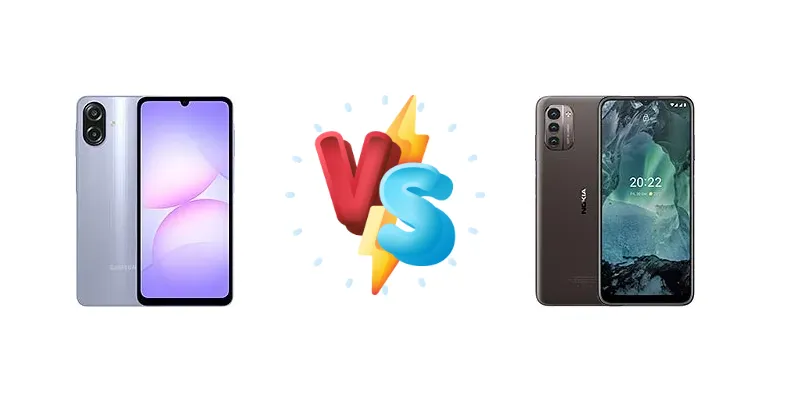
The Samsung Galaxy A07 4G and Nokia G21 represent two distinct approaches to the ultra-budget smartphone market. The A07 4G prioritizes processing power with a newer chipset, while the G21 focuses on longevity and a potentially more refined software experience. This comparison dissects their key differences to determine which device delivers the best value.
🏆 Quick Verdict
For most users, the Samsung Galaxy A07 4G emerges as the stronger choice. Its Mediatek Helio G99 chipset offers significantly better performance than the Unisoc T606 in the Nokia G21, translating to a smoother user experience and better app responsiveness. While the Nokia G21 boasts a slightly brighter display, the A07’s performance advantage is more impactful for daily use.
| Network |
|---|
| 2G bands | GSM 850 / 900 / 1800 / 1900 | GSM 850 / 900 / 1800 / 1900 |
| 3G bands | HSDPA 850 / 900 / 2100 | HSDPA 850 / 900 / 2100 - International |
| 4G bands | 1, 3, 5, 7, 8, 20, 28, 38, 40, 41 | 1, 3, 5, 7, 8, 20, 28, 38, 40, 41 - International |
| Speed | HSPA, LTE | HSPA 42.2/5.76 Mbps, LTE Cat4 150/50 Mbps |
| Technology | GSM / HSPA / LTE | GSM / HSPA / LTE |
| | - | 1, 2, 3, 4, 5, 7, 8, 12, 17, 28, 40, 66 - LATAM |
| Launch |
|---|
| Announced | 2025, August 25 | 2022, February 14 |
| Status | Available. Released 2025, August 25 | Available. Released 2022, February 15 |
| Body |
|---|
| Build | Glass front, plastic back, plastic frame | Glass front, plastic frame, plastic back |
| Dimensions | 167.4 x 77.4 x 7.6 mm (6.59 x 3.05 x 0.30 in) | 164.6 x 75.9 x 8.5 mm (6.48 x 2.99 x 0.33 in) |
| SIM | Nano-SIM + Nano-SIM | · Nano-SIM· Nano-SIM + Nano-SIM |
| Weight | 184 g (6.49 oz) | 190 g (6.70 oz) |
| Display |
|---|
| Resolution | 720 x 1600 pixels, 20:9 ratio (~262 ppi density) | 720 x 1600 pixels, 20:9 ratio (~270 ppi density) |
| Size | 6.7 inches, 108.4 cm2 (~83.6% screen-to-body ratio) | 6.5 inches, 102.0 cm2 (~81.6% screen-to-body ratio) |
| Type | PLS LCD, 90Hz | IPS LCD, 90Hz, 400 nits (typ) |
| Platform |
|---|
| CPU | Octa-core (2x2.2 GHz Cortex-A76 & 6x2.0 GHz Cortex-A55) | Octa-core (2x1.6 GHz Cortex-A75 & 6x1.6 GHz Cortex-A55) |
| Chipset | Mediatek Helio G99 (6 nm) | Unisoc T606 (12 nm) |
| GPU | Mali-G57 MC2 | Mali-G57 MP1 |
| OS | Android 15, up to 6 major Android upgrades, One UI 8 | Android 11, upgradable to Android 13 |
| Memory |
|---|
| Card slot | microSDXC (dedicated slot) | microSDXC (dedicated slot) |
| Internal | 64GB 4GB RAM, 128GB 4GB RAM, 128GB 6GB RAM, 256GB 8GB RAM | 64GB 3GB RAM, 64GB 4GB RAM, 128GB 4GB RAM, 128GB 6GB RAM |
| | - | eMMC 5.1 |
| Main Camera |
|---|
| Dual | 50 MP, f/1.8, (wide), 1/2.76", 0.64µm, PDAF
Auxiliary lens | - |
| Features | LED flash | LED flash, HDR, panorama |
| Single | - | 8 MP, f/2.0, (wide) |
| Triple | - | 50 MP, f/1.8, 28mm (wide), 1/2.76", 0.64µm, PDAF
2 MP (macro)
Auxiliary lens |
| Video | 1080p@30/60fps | 1080p@30fps |
| Selfie camera |
|---|
| Single | 8 MP, f/2.0, (wide), 1/4.0", 1.12µm | 8 MP, f/2.0, (wide) |
| Video | Yes | 1080p@30fps |
| Sound |
|---|
| 3.5mm jack | - | Yes |
| 35mm jack | Yes | Yes |
| Loudspeaker | Yes | Yes |
| Comms |
|---|
| Bluetooth | 5.3, A2DP, LE | 5.0, A2DP, LE |
| NFC | No | Yes (market/region dependent) |
| Positioning | GPS, GLONASS, GALILEO, BDS | GPS, GLONASS, GALILEO |
| Radio | FM radio | FM radio, RDS |
| USB | USB Type-C 2.0 | USB Type-C 2.0, OTG |
| WLAN | Wi-Fi 802.11 a/b/g/n/ac, dual-band, Wi-Fi Direct | Wi-Fi 802.11 a/b/g/n/ac, dual-band, Wi-Fi Direct |
| Features |
|---|
| Sensors | Fingerprint (side-mounted), accelerometer, proximity | Fingerprint (side-mounted), accelerometer, proximity |
| Battery |
|---|
| Charging | 25W wired | 18W wired, PD3.0 |
| Type | 5000 mAh | Li-Po 5050 mAh |
| Misc |
|---|
| Colors | Gray, Light Violet, Dark Green | Nordic Blue, Dusk |
| Models | SM-A075B, SM-A075B/DS, SM-A075F, SM-A075F/DS, SM-A075M, SM-A075M/DS | TA-1418, TA-1477, TA-1415, TA-1405, TA-1404, TA-1412 |
| Price | $ 139.99 / £ 73.89 | About 90 EUR |
| SAR | 0.33 W/kg (head) 1.18 W/kg (body) | 1.00 W/kg (head) 1.10 W/kg (body) |
| SAR EU | 0.19 W/kg (head) 1.33 W/kg (body) | 0.34 W/kg (head) 1.05 W/kg (body) |
| Tests |
|---|
| Battery life | - |
Endurance rating 126h
|
| Camera | - |
Photo / Video |
| Display | - |
Contrast ratio: 1631:1 (nominal) |
| Loudspeaker | - |
-30.7 LUFS (Below average)
|
| Performance | - |
AnTuTu: 171299 (v9)
GeekBench: 1193 (v5.1)
GFXBench: 8.9fps (ES 3.1 onscreen) |
Samsung Galaxy A07 4G
- Significantly faster processor for smoother performance
- Faster 25W charging for quicker top-ups
- More responsive user experience
- Lower peak display brightness
- Lower contrast ratio compared to Nokia G21
Nokia G21
- Brighter display for better outdoor visibility
- Higher contrast ratio for potentially deeper blacks
- Potentially longer standby time
- Slower processor leading to lag and stutter
- Slower 18W charging
- Less capable for demanding apps and games
Display Comparison
The Nokia G21 features a display with a measured peak brightness of 500 nits and a 1631:1 contrast ratio, exceeding the Samsung Galaxy A07 4G’s 468 nits and 1128:1 contrast ratio. While the G21 is brighter, the difference isn’t massive and both displays are adequate for indoor use. The G21’s contrast ratio suggests deeper blacks, but without panel technology details (like IPS or TFT) it’s hard to assess color accuracy. Both phones likely utilize standard LCD panels, meaning viewing angles and color shift will be present. The A07’s lower brightness may be more noticeable outdoors in direct sunlight.
Camera Comparison
Both phones list 'Photo / Video' capabilities, but lack specific details. Without sensor size or aperture information, a direct comparison is difficult. Given the price point, expect both to feature basic camera systems. The Nokia G21’s marketing often highlights its camera, but this is likely focused on software enhancements rather than superior hardware. The A07 4G’s stronger processing power *could* translate to slightly faster image processing, but the overall image quality will likely be similar – acceptable for casual snapshots but not competitive with higher-end devices. Avoid expecting exceptional low-light performance from either.
Performance
The performance gap between these two devices is substantial. The Samsung Galaxy A07 4G’s Mediatek Helio G99 (6nm) is a far more capable chipset than the Nokia G21’s Unisoc T606 (12nm). The G99’s Cortex-A76 cores, clocked at 2.2 GHz, provide a significant uplift in CPU performance compared to the G21’s Cortex-A75 cores at 1.6 GHz. The smaller 6nm process node of the G99 also translates to improved power efficiency and reduced thermal throttling during sustained workloads. This means the A07 4G will handle gaming and demanding apps with greater ease. The G21’s Unisoc T606 is adequate for basic tasks, but will struggle with more intensive applications.
Battery Life
The Nokia G21 boasts an 'Endurance rating' of 126 hours, while the Samsung Galaxy A07 4G achieves 12:44h of active use. While these metrics aren’t directly comparable, they both indicate excellent battery life. The G21’s endurance rating suggests a focus on minimizing standby power consumption. However, the A07 4G’s 25W wired charging is significantly faster than the G21’s 18W charging with PD3.0. This means the A07 4G can replenish its battery much quicker, mitigating any potential difference in overall runtime. A full charge on the A07 4G will take less time, offering more convenience.
Buying Guide
Buy the Samsung Galaxy A07 4G if you need a phone that can handle multitasking, moderate gaming, and demanding apps without significant lag. Buy the Nokia G21 if you prioritize extended battery life and a potentially cleaner Android experience, and your usage primarily consists of basic tasks like calls, texts, and light social media browsing.
Frequently Asked Questions
❓ Will the Unisoc T606 in the Nokia G21 struggle with popular games like PUBG Mobile?
Yes, the Unisoc T606 is a low-end chipset and will likely struggle to run PUBG Mobile smoothly, even on low settings. Expect significant frame drops and lag. The Samsung Galaxy A07 4G’s Helio G99 is much better suited for gaming, offering a more playable experience.
❓ Does the Samsung Galaxy A07 4G’s Mediatek Helio G99 chipset tend to overheat during prolonged gaming sessions?
The Helio G99 is generally well-managed, and the 6nm process helps with thermal efficiency. While some throttling is possible during extended gaming, it’s unlikely to be severe enough to cause significant performance degradation. The Nokia G21’s Unisoc T606 is less likely to overheat, but that’s primarily because it’s less powerful to begin with.
❓ Is the 18W charging on the Nokia G21 slow compared to other phones?
18W charging is relatively slow by today’s standards, but it’s adequate for a phone in this price range. However, the Samsung Galaxy A07 4G’s 25W charging is noticeably faster and will significantly reduce charging times. Expect a full charge to take considerably longer on the Nokia G21.