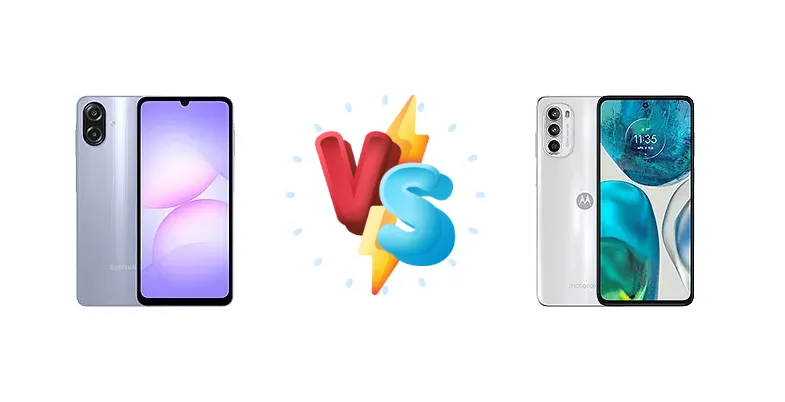
The Samsung Galaxy A07 4G and Motorola Moto G52 represent compelling options in the ultra-budget smartphone space. While both aim to deliver essential functionality at an accessible price, they diverge in their core hardware choices, particularly in chipset and charging capabilities. This comparison dissects these differences to determine which device offers the best value for your money.
🏆 Quick Verdict
For most users, the Motorola Moto G52 emerges as the slightly better choice. Its Qualcomm Snapdragon 680 chipset, while not a performance powerhouse, offers a more refined and efficient experience than the MediaTek Helio G99 in the A07. The 30W charging also provides a significant convenience advantage, offsetting the A07's longer battery life in active use.
| Network |
|---|
| 2G bands | GSM 850 / 900 / 1800 / 1900 | GSM 850 / 900 / 1800 / 1900 |
| 3G bands | HSDPA 850 / 900 / 2100 | HSDPA 850 / 900 / 1700(AWS) / 1900 / 2100 |
| 4G bands | 1, 3, 5, 7, 8, 20, 28, 38, 40, 41 | LTE |
| Speed | HSPA, LTE | HSPA, LTE |
| Technology | GSM / HSPA / LTE | GSM / HSPA / LTE |
| Launch |
|---|
| Announced | 2025, August 25 | 2022, April 12 |
| Status | Available. Released 2025, August 25 | Available. Released 2022, April 20 |
| Body |
|---|
| Build | Glass front, plastic back, plastic frame | - |
| Dimensions | 167.4 x 77.4 x 7.6 mm (6.59 x 3.05 x 0.30 in) | 160.1 x 74.5 x 8 mm (6.30 x 2.93 x 0.31 in) |
| SIM | Nano-SIM + Nano-SIM | Nano-SIM + Nano-SIM |
| Weight | 184 g (6.49 oz) | 169 g (5.96 oz) |
| | - | Water-repellent design |
| Display |
|---|
| Resolution | 720 x 1600 pixels, 20:9 ratio (~262 ppi density) | 1080 x 2400 pixels, 20:9 ratio (~402 ppi density) |
| Size | 6.7 inches, 108.4 cm2 (~83.6% screen-to-body ratio) | 6.6 inches, 103.6 cm2 (~86.9% screen-to-body ratio) |
| Type | PLS LCD, 90Hz | AMOLED, 90Hz |
| Platform |
|---|
| CPU | Octa-core (2x2.2 GHz Cortex-A76 & 6x2.0 GHz Cortex-A55) | Octa-core (4x2.4 GHz Kryo 265 Gold & 4x1.9 GHz Kryo 265 Silver) |
| Chipset | Mediatek Helio G99 (6 nm) | Qualcomm SM6225 Snapdragon 680 4G (6 nm) |
| GPU | Mali-G57 MC2 | Adreno 610 |
| OS | Android 15, up to 6 major Android upgrades, One UI 8 | Android 12, planned upgrade to Android 13 |
| Memory |
|---|
| Card slot | microSDXC (dedicated slot) | microSDXC (uses shared SIM slot) |
| Internal | 64GB 4GB RAM, 128GB 4GB RAM, 128GB 6GB RAM, 256GB 8GB RAM | 64GB 4GB RAM, 128GB 4GB RAM, 128GB 6GB RAM, 256GB 6GB RAM |
| Main Camera |
|---|
| Dual | 50 MP, f/1.8, (wide), 1/2.76", 0.64µm, PDAF
Auxiliary lens | - |
| Features | LED flash | LED flash, HDR, panorama |
| Triple | - | 50 MP, f/1.8 (wide), 1/2.76", 0.64µm, PDAF
8 MP, f/2.2, 118˚ (ultrawide), 1/4.0", 1.12µm
2 MP (macro) |
| Video | 1080p@30/60fps | 1080p@30fps |
| Selfie camera |
|---|
| Single | 8 MP, f/2.0, (wide), 1/4.0", 1.12µm | 16 MP, f/2.5, (wide), 1.0µm |
| Video | Yes | 1080p@30fps |
| Sound |
|---|
| 3.5mm jack | - | Yes |
| 35mm jack | Yes | Yes |
| Loudspeaker | Yes | Yes, with stereo speakers |
| Comms |
|---|
| Bluetooth | 5.3, A2DP, LE | 5.0, A2DP, LE |
| NFC | No | Yes (market/region dependent) |
| Positioning | GPS, GLONASS, GALILEO, BDS | GPS, GLONASS, GALILEO |
| Radio | FM radio | Unspecified |
| USB | USB Type-C 2.0 | USB Type-C 2.0 |
| WLAN | Wi-Fi 802.11 a/b/g/n/ac, dual-band, Wi-Fi Direct | Wi-Fi 802.11 a/b/g/n/ac, dual-band, Wi-Fi Direct |
| Features |
|---|
| Sensors | Fingerprint (side-mounted), accelerometer, proximity | Fingerprint (side-mounted), accelerometer, gyro, proximity, compass |
| Battery |
|---|
| Charging | 25W wired | 30W wired |
| Type | 5000 mAh | Li-Po 5000 mAh |
| Misc |
|---|
| Colors | Gray, Light Violet, Dark Green | Charcoal Gray, Porcelain White |
| Models | SM-A075B, SM-A075B/DS, SM-A075F, SM-A075F/DS, SM-A075M, SM-A075M/DS | XT2221-1, XT2221-2 |
| Price | $ 139.99 / £ 73.89 | About 470 EUR |
| SAR | 0.33 W/kg (head) 1.18 W/kg (body) | - |
| SAR EU | 0.19 W/kg (head) 1.33 W/kg (body) | - |
Samsung Galaxy A07 4G
- Longer battery life in active use (12:44h)
- Slightly more powerful CPU cores (Cortex-A76)
- Established Samsung brand reputation
- Slower charging speed (25W)
- Potentially less efficient chipset architecture
- Display brightness may be lower than competitors
Motorola Moto G52
- Faster charging (30W)
- More efficient Snapdragon 680 chipset
- Potentially smoother multitasking experience
- Likely shorter battery life in active use
- CPU cores have lower peak clock speeds
- Motorola's software update support can be inconsistent
Display Comparison
The Motorola Moto G52 and Samsung Galaxy A07 4G both feature displays adequate for their price point, but differ in key metrics. The Galaxy A07 4G boasts a measured peak brightness of 468 nits and a 1128:1 contrast ratio. While respectable, this doesn't necessarily translate to a superior viewing experience in bright sunlight compared to what we'd expect from Motorola's offerings. Details regarding the Moto G52's display are missing, but given Motorola's typical approach in this segment, it likely prioritizes color accuracy and viewing angles over absolute peak brightness. The absence of information on PWM dimming frequency for either device makes it difficult to assess suitability for users sensitive to flicker.
Camera Comparison
Detailed camera specifications are lacking for both devices. However, given their price bracket, it's safe to assume both rely on primary sensors with modest resolutions. The absence of information regarding sensor size and aperture makes a direct comparison difficult. It's likely both phones include a suite of secondary cameras (depth, macro) of limited utility. Image processing will be a key differentiator, with Samsung typically favoring vibrant, saturated colors, while Motorola often aims for a more natural look. Without sample images, it's impossible to definitively declare a winner.
Performance
The core difference between these two phones lies in their chipsets. The Samsung Galaxy A07 4G utilizes the MediaTek Helio G99, a 6nm chip with an octa-core configuration featuring two Cortex-A76 cores clocked at 2.2 GHz and six Cortex-A55 cores at 2.0 GHz. The Motorola Moto G52, conversely, employs the Qualcomm Snapdragon 680 4G, also built on a 6nm process, but with a different core arrangement: four Kryo 265 Gold cores at 2.4 GHz and four Kryo 265 Silver cores at 1.9 GHz. While the G99's A76 cores offer higher peak performance, the Snapdragon 680's architecture is generally considered more efficient and optimized for sustained workloads. This translates to potentially better thermal management and smoother multitasking on the Moto G52, despite the slightly lower clock speeds.
Battery Life
The Samsung Galaxy A07 4G demonstrates impressive battery life, achieving 12:44 hours of active use. The Motorola Moto G52's battery capacity is unknown, but its 30W wired charging capability provides a significant advantage over the A07's 25W charging. While the A07's longer runtime is beneficial for users who prioritize longevity, the G52's faster charging mitigates the impact of a potentially smaller battery, allowing for quicker top-ups throughout the day. A full charge on the A07 will take longer, impacting convenience.
Buying Guide
Buy the Samsung Galaxy A07 4G if maximizing talk time and overall battery endurance is your absolute priority, and you're willing to accept slightly slower performance and charging. Buy the Motorola Moto G52 if you prioritize a smoother, more responsive user experience, faster charging speeds, and a generally more modern chipset architecture, even if it means slightly less battery life in demanding scenarios.
Frequently Asked Questions
❓ Does the MediaTek Helio G99 in the Galaxy A07 4G tend to overheat during prolonged gaming sessions?
While the Helio G99 is a capable chip, its thermal efficiency isn't its strongest suit. Expect some throttling during extended gaming, potentially leading to frame rate drops. The Snapdragon 680 in the Moto G52 is generally better at maintaining consistent performance under load.
❓ How significant is the difference in charging speed between 25W and 30W charging on these phones?
While a 5W difference may not seem substantial, it translates to a noticeably faster top-up time for the Moto G52. Expect a 0-100% charge to take approximately 30-60 minutes less on the Moto G52 compared to the Galaxy A07 4G.
❓ Is the lack of 5G connectivity a major drawback for these devices?
For users in areas with limited 5G coverage, or those who primarily use Wi-Fi, the absence of 5G is unlikely to be a significant issue. Both phones offer reliable 4G LTE connectivity, sufficient for most everyday tasks.
❓ Which phone is better for running multiple apps simultaneously?
The Motorola Moto G52, with its Snapdragon 680 chipset, is likely to handle multitasking more smoothly. The Snapdragon's architecture is optimized for efficient background task management, preventing slowdowns when switching between apps.