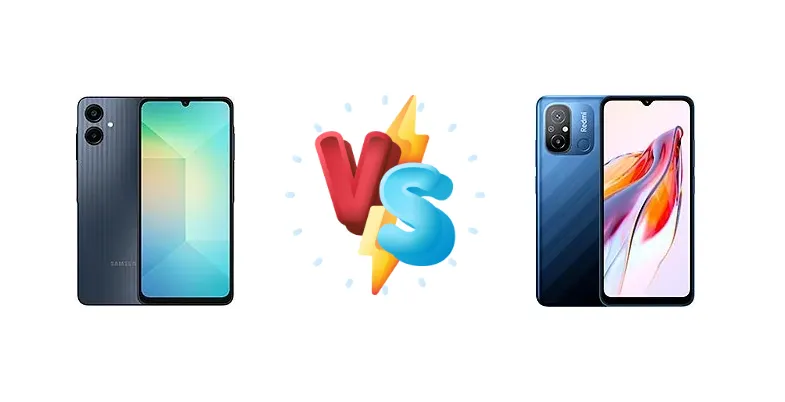
The Samsung Galaxy A06 and Xiaomi Redmi 12C represent the fiercely competitive sub-$150 smartphone market. Both devices aim to deliver essential smartphone functionality at an accessible price point, but they take different approaches. This comparison dissects their key specifications to determine which offers the best overall experience for budget-conscious consumers.
🏆 Quick Verdict
For most users, the Samsung Galaxy A06 emerges as the slightly better choice. While both phones share the same Mediatek Helio G85 chipset, the A06’s significantly brighter display (564 nits vs. an estimated lower value for the Redmi 12C) and faster 25W charging provide a more polished and convenient user experience.
| Network |
|---|
| 2G bands | GSM 850 / 900 / 1800 / 1900 | GSM 850 / 900 / 1800 / 1900 |
| 3G bands | HSDPA 850 / 900 / 2100 | HSDPA 850 / 900 / 2100 |
| 4G bands | 1, 3, 5, 7, 8, 20, 28, 38, 40, 41 | 1, 3, 5, 7, 8, 20, 28, 38, 40, 41 - International |
| Speed | HSPA, LTE | HSPA, LTE |
| Technology | GSM / HSPA / LTE | GSM / CDMA / HSPA / EVDO / LTE |
| | - | CDMA2000 1xEV-DO |
| Launch |
|---|
| Announced | 2024, August 16 | 2022, December 31 |
| Status | Available. Released 2024, August 22 | Available. Released 2023, January 01 |
| Body |
|---|
| Build | Glass front, plastic back, plastic frame | - |
| Dimensions | 167.3 x 77.3 x 8 mm (6.59 x 3.04 x 0.31 in) | 168.8 x 76.4 x 8.8 mm (6.65 x 3.01 x 0.35 in) |
| SIM | · Nano-SIM· Nano-SIM + Nano-SIM | Nano-SIM + Nano-SIM |
| Weight | 189 g (6.67 oz) | 192 g (6.77 oz) |
| Display |
|---|
| Resolution | 720 x 1600 pixels, 20:9 ratio (~262 ppi density) | 720 x 1650 pixels (~268 ppi density) |
| Size | 6.7 inches, 108.4 cm2 (~83.8% screen-to-body ratio) | 6.71 inches, 106.5 cm2 (~82.6% screen-to-body ratio) |
| Type | PLS LCD | IPS LCD, 500 nits (typ) |
| Platform |
|---|
| CPU | Octa-core (2x2.0 GHz Cortex-A75 & 6x1.8 GHz Cortex-A55) | Octa-core (2x2.0 GHz Cortex-A75 & 6x1.8 GHz Cortex-A55) |
| Chipset | Mediatek Helio G85 (12 nm) | Mediatek MT6769Z Helio G85 (12 nm) |
| GPU | Mali-G52 MC2 | Mali-G52 MC2 |
| OS | Android 14, up to 2 major Android upgrades, One UI 8 | Android 12, MIUI 13 |
| Memory |
|---|
| Card slot | microSDXC (dedicated slot) | microSDXC (dedicated slot) |
| Internal | 64GB 4GB RAM, 128GB 4GB RAM, 128GB 6GB RAM | 32GB 2GB RAM, 32GB 3GB RAM, 32GB 4GB RAM, 64GB 3GB RAM, 64GB 4GB RAM, 128GB 3GB RAM, 128GB 4GB RAM, 128GB 6GB RAM |
| | - | eMMC 5.1 |
| Main Camera |
|---|
| Dual | 50 MP, f/1.8, (wide), 1/2.76", 0.64µm, PDAF
Auxiliary lens | 50 MP, (wide), PDAF
0.08 MP (depth) |
| Features | LED flash | LED flash, HDR |
| Single | - | 50 MP, f/1.8, (wide), 1/2.76", PDAF
Auxiliary lens |
| Video | 1080p@30/60fps | 1080p@30fps |
| Selfie camera |
|---|
| Single | 8 MP, f/2.0, (wide), 1/4.0", 1.12µm | 5 MP, f/2.2, (wide) |
| Video | Yes | 1080p@30fps |
| Sound |
|---|
| 3.5mm jack | - | Yes |
| 35mm jack | Yes | Yes |
| Loudspeaker | Yes | Yes |
| Comms |
|---|
| Bluetooth | 5.3, A2DP, LE | 5.1, A2DP, LE |
| NFC | No | Yes (market/region dependent) |
| Positioning | GPS, GLONASS, GALILEO, BDS | GPS, GLONASS, BDS, GALILEO |
| Radio | FM radio | FM radio |
| USB | USB Type-C 2.0 | microUSB 2.0 |
| WLAN | Wi-Fi 802.11 a/b/g/n/ac, dual-band, Wi-Fi Direct | Wi-Fi 802.11 a/b/g/n/ac, dual-band, Wi-Fi Direct |
| Features |
|---|
| Sensors | Fingerprint (side-mounted), accelerometer, proximity | Fingerprint (rear-mounted), accelerometer |
| | - | Virtual proximity sensing |
| Battery |
|---|
| Charging | 25W wired | 10W wired |
| Type | Li-Po 5000 mAh | Li-Po 5000 mAh |
| Misc |
|---|
| Colors | Blue, Gold, White | Graphite Gray, Ocean Blue, Mint Green, Lavender Purple |
| Models | SM-A065F, SM-A065F/DS, SM-A065M, SM-A065M/DS | 22120RN86G, 22120RN86I, 22126RN91Y, 2212ARNC4L |
| Price | € 81.90 / $ 99.99 / £ 66.89 / ₹ 7,749 | £ 132.99 / € 107.41 |
| SAR | - | 1.08 W/kg (head) 0.64 W/kg (body) |
| SAR EU | 0.44 W/kg (head) 1.08 W/kg (body) | 0.98 W/kg (head) 0.99 W/kg (body) |
Samsung Galaxy A06
- Brighter display for better outdoor visibility
- Faster 25W charging for quicker power-ups
- Strong active use battery performance (13:50h)
- Camera specifications are limited
- May be slightly more expensive than the Redmi 12C
Xiaomi Redmi 12C
- Highly affordable price point
- Same Helio G85 chipset as the A06
- Decent performance for basic tasks
- Slower 10W charging
- Likely lower display brightness and contrast
Display Comparison
The Samsung Galaxy A06 boasts a measured peak brightness of 564 nits, a substantial advantage over the Redmi 12C, which likely falls below this figure given its market positioning. This difference translates to significantly better visibility in direct sunlight. While both displays likely utilize LCD technology, the A06’s higher contrast ratio of 1484:1 suggests deeper blacks and a more vibrant image. The Redmi 12C’s display specifications are less readily available, but it’s reasonable to assume a lower peak brightness and contrast ratio, impacting outdoor readability and overall visual fidelity.
Camera Comparison
Detailed camera specifications for both devices are limited. However, given the price point, it’s safe to assume both rely on primary sensors with modest resolutions. The focus should be on image processing rather than sensor size. Without detailed aperture information, it’s difficult to assess low-light performance. The inclusion of a 2MP macro camera on both devices is largely a marketing tactic, offering limited practical benefit due to the low resolution and fixed focus. Real-world image quality will likely depend more on software optimization than hardware prowess.
Performance
Both the Samsung Galaxy A06 and Xiaomi Redmi 12C are powered by the Mediatek Helio G85 (12 nm) chipset, featuring an identical CPU configuration: an octa-core setup with 2x2.0 GHz Cortex-A75 and 6x1.8 GHz Cortex-A55 cores. This means performance in everyday tasks and light gaming will be largely comparable. However, the lack of detailed RAM specifications for the Redmi 12C raises a potential concern; if it utilizes slower RAM than the A06, it could experience slight performance hiccups during multitasking. Thermal management is also likely similar, as both chips share the same fabrication process and core architecture.
Battery Life
The Samsung Galaxy A06 offers a significant advantage in charging speed with its 25W wired charging capability, compared to the Redmi 12C’s slower 10W charging. While battery capacity isn’t specified for either device, the faster charging of the A06 translates to a quicker turnaround time from 0-100%. The A06 also achieves an impressive 13:50h active use score, suggesting efficient power management. The Redmi 12C will likely require considerably longer to fully charge, potentially impacting usability for users who need a quick power boost.
Buying Guide
Buy the Samsung Galaxy A06 if you prioritize a brighter, more visible display for outdoor use and faster charging speeds to minimize downtime. This phone is ideal for users who frequently consume media on the go or need a quick power boost. Buy the Xiaomi Redmi 12C if your primary concern is absolute affordability and you’re willing to compromise on display brightness and charging speed. It’s a solid option for basic communication and light usage.
Frequently Asked Questions
❓ Does the Mediatek Helio G85 in either phone struggle with demanding games like PUBG Mobile?
The Helio G85 is a capable chipset for casual gaming, but it will likely require reduced graphics settings and frame rates to achieve smooth gameplay in demanding titles like PUBG Mobile. Expect playable performance at medium settings, but don't anticipate a high-end gaming experience on either device.
❓ How significant is the difference in charging time between the 25W and 10W charging on the A06 and Redmi 12C respectively?
The difference is substantial. 25W charging on the A06 will significantly reduce the time it takes to reach a full charge compared to the 10W charging on the Redmi 12C. Expect the A06 to charge from 0-100% in approximately 1.5-2 hours, while the Redmi 12C could take 3+ hours.
❓ Is the display on the Redmi 12C suitable for watching videos outdoors?
Due to the likely lower peak brightness of the Redmi 12C’s display, viewing videos outdoors in direct sunlight will be challenging. The screen may appear washed out and difficult to see. The Samsung Galaxy A06 is a much better choice for outdoor media consumption.