
Google Pixel 7a vs Samsung Galaxy A06 5G: A Detailed Comparison
| Phones Images | |||||
|---|---|---|---|---|---|
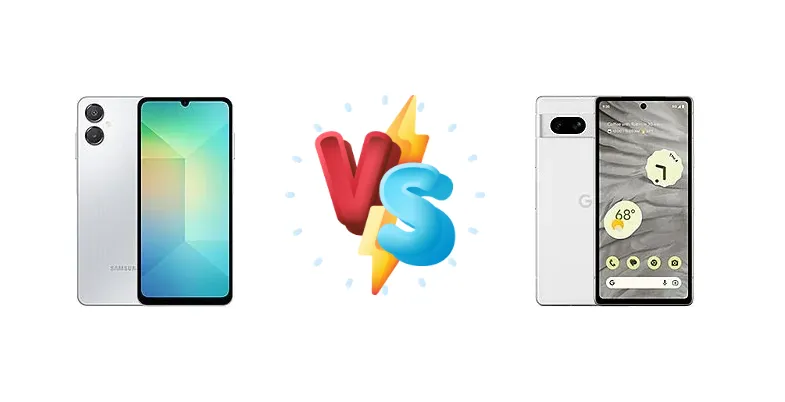
|
🏆 Quick Verdict
For most users, the Google Pixel 7a is the superior choice. Its Tensor G2 chipset delivers significantly better performance, and its camera system is in a different league. However, the Galaxy A06 5G offers compelling value for those prioritizing 5G access and a lower upfront cost.
| PHONES | ||
|---|---|---|
| Phone Names | Samsung Galaxy A06 5G | Google Pixel 7a |
| Network | ||
|---|---|---|
| 2G bands | GSM 850 / 900 / 1800 / 1900 | GSM 850 / 900 / 1800 / 1900 |
| 3G bands | HSDPA 850 / 900 / 1700(AWS) / 1900 / 2100 | HSDPA 800 / 850 / 900 / 1700(AWS) / 1900 / 2100 |
| 4G bands | 1, 2, 3, 4, 5, 7, 8, 12, 17, 20, 26, 28, 38, 40, 41, 66 | 1, 2, 3, 4, 5, 7, 8, 12, 13, 14, 17, 20, 25, 26, 28, 29, 30, 38, 40, 41, 48, 66, 71 - GWKK3, G0DZQ |
| 5G bands | 1, 3, 5, 7, 8, 26, 28, 40, 41, 66, 77, 78 SA/NSA/Sub6 | 1, 2, 3, 5, 7, 8, 12, 14, 20, 25, 28, 30, 38, 41, 48, 66, 71, 77, 78 SA/NSA/Sub6 - GWKK3 |
| Speed | HSPA, LTE, 5G | HSPA, LTE, 5G |
| Technology | GSM / HSPA / LTE / 5G | GSM / HSPA / LTE / 5G |
| - | 1, 2, 3, 5, 7, 8, 12, 20, 25, 28, 38, 40, 41, 66, 75, 76, 77, 78, 79 SA/NSA/Sub6 - GHL1X, G82U8 | |
| Launch | ||
|---|---|---|
| Announced | 2025, February 19 | 2023, May 10 |
| Status | Available. Released 2025, February 19 | Available. Released 2023, May 10 |
| Body | ||
|---|---|---|
| Build | Glass front, plastic back, plastic frame | Glass front (Gorilla Glass 3), aluminum frame, plastic back |
| Dimensions | 167.3 x 77.3 x 8 mm (6.59 x 3.04 x 0.31 in) | 152 x 72.9 x 9 mm (5.98 x 2.87 x 0.35 in) |
| SIM | Nano-SIM + Nano-SIM | Nano-SIM + eSIM |
| Weight | 191 g (6.74 oz) | 193.5 g (6.84 oz) |
| - | IP67 dust/water resistant (up to 1m for 30 min) | |
| Display | ||
|---|---|---|
| Protection | - | Corning Gorilla Glass 3 |
| Resolution | 720 x 1600 pixels, 20:9 ratio (~262 ppi density) | 1080 x 2400 pixels, 20:9 ratio (~429 ppi density) |
| Size | 6.7 inches, 108.4 cm2 (~83.8% screen-to-body ratio) | 6.1 inches, 90.7 cm2 (~81.8% screen-to-body ratio) |
| Type | PLS LCD, 90Hz | OLED, HDR, 90Hz |
| - | Always-on display | |
| Platform | ||
|---|---|---|
| CPU | Octa-core (2x2.4 GHz Cortex-A76 & 6x2.0 GHz Cortex-A55) | Octa-core (2x2.85 GHz Cortex-X1 & 2x2.35 GHz Cortex-A78 & 4x1.80 GHz Cortex-A55) |
| Chipset | Mediatek Dimensity 6300 (6 nm) | Google Tensor G2 (5 nm) |
| GPU | Mali-G57 MC2 | Mali-G710 MP7 |
| OS | Android 15, up to 4 major Android upgrades, One UI 7 | Android 13, upgradable to Android 15, up to 5 major Android upgrades |
| Memory | ||
|---|---|---|
| Card slot | microSDXC (uses shared SIM slot) | No |
| Internal | 64GB 4GB RAM, 128GB 4GB RAM, 128GB 6GB RAM | 128GB 8GB RAM |
| - | UFS 3.1 | |
| Main Camera | ||
|---|---|---|
| Dual | 50 MP, f/1.8, 26mm (wide), 1/2.75", 0.64µm, PDAF Auxiliary lens | 64 MP, f/1.9, 26mm (wide), 1/1.73", 0.8µm, dual pixel PDAF, OIS 13 MP, f/2.2, 120˚ (ultrawide), 1.12µm |
| Features | LED flash | Dual-LED flash, Pixel Shift, Auto-HDR, panorama |
| Video | 1080p@30/60fps | 4K@30/60fps, 1080p@30/60/120/240fps, OIS |
| Selfie camera | ||
|---|---|---|
| Features | - | HDR, panorama |
| Single | 8 MP, f/2.0, 26mm (wide), 1/4.0", 1.12µm | 13 MP, f/2.2, 20mm (ultrawide), 1.12µm |
| Video | 1080p@30fps | 4K@30fps, 1080p@30fps |
| Sound | ||
|---|---|---|
| 3.5mm jack | - | No |
| 35mm jack | Yes | No |
| Loudspeaker | Yes | Yes, with stereo speakers |
| Comms | ||
|---|---|---|
| Bluetooth | 5.3, A2DP, LE | 5.3, A2DP, LE |
| NFC | No | Yes |
| Positioning | GPS, GLONASS, GALILEO, BDS | GPS, GLONASS, GALILEO, BDS, QZSS, NavIC |
| Radio | FM radio | No |
| USB | USB Type-C 2.0 | USB Type-C 3.2 |
| WLAN | Wi-Fi 802.11 a/b/g/n/ac, dual-band, Wi-Fi Direct | Wi-Fi 802.11 a/b/g/n/ac/6e, tri-band |
| Features | ||
|---|---|---|
| Sensors | Fingerprint (side-mounted), accelerometer, gyro, proximity, compass | Fingerprint (under display, optical), accelerometer, gyro, proximity, compass, barometer |
| Battery | ||
|---|---|---|
| Charging | 25W wired | 18W wired, PD3.0 7.5W wireless |
| Type | Li-Ion 5000 mAh | Li-Po 4385 mAh |
| Misc | ||
|---|---|---|
| Colors | Black, Gray, Light Green | Charcoal, Snow, Sea, Coral |
| Models | SM-A066B, SM-A066B/DS | GWKK3, GHL1X, G0DZQ, G82U8 |
| Price | C$ 159.00 / £ 103.89 / ₹ 9,773 | € 179.90 / $ 150.00 / £ 170.00 / ₹ 25,980 |
| SAR | 1.05 W/kg (head) | - |
| SAR EU | 1.30 W/kg (head) 1.30 W/kg (body) | - |
Samsung Galaxy A06 5G
- Faster and more efficient processor (Tensor G2)
- Superior camera quality and image processing
- Wireless charging support
- Slower wired charging (18W)
- Higher price point
Google Pixel 7a
- More affordable price
- Faster wired charging (25W)
- 5G connectivity
- Significantly weaker performance
- Inferior camera quality
Display Comparison
The Pixel 7a boasts a significantly brighter display, reaching a measured peak of 1070 nits, compared to an assumed lower brightness on the A06 5G (typical of its price bracket). While the A06 5G likely has a larger screen size, the Pixel 7a’s superior brightness ensures better visibility outdoors. The Pixel 7a’s OLED panel also offers superior contrast and color accuracy, crucial for photo and video editing. We expect the A06 5G to utilize a standard LCD panel.
Camera Comparison
The Pixel 7a’s camera system is a clear standout. While specific sensor details are missing for the A06 5G, it’s reasonable to expect a more basic setup. The Pixel 7a leverages Google’s renowned computational photography algorithms, delivering exceptional image quality in various lighting conditions. The Tensor G2’s image signal processor (ISP) plays a crucial role in this, enabling features like Super Res Zoom and Magic Eraser. The A06 5G will likely struggle to match the Pixel 7a’s dynamic range, detail, and low-light performance. We anticipate the A06 5G will focus on providing basic photography functionality, while the Pixel 7a aims for near-flagship quality.
Performance
The performance gap between these devices is substantial. The Google Tensor G2 (5nm) features a prime Cortex-X1 core clocked at 2.85 GHz, alongside Cortex-A78 cores, offering a significant advantage over the Mediatek Dimensity 6300 (6nm) in the A06 5G. The Dimensity 6300’s Cortex-A76 cores, while capable, are a generation behind and clocked lower at 2.4 GHz. This translates to faster app loading, smoother multitasking, and a more responsive user experience on the Pixel 7a. The Tensor G2’s integrated machine learning capabilities also enhance features like voice recognition and image processing. The 5nm process node of the Tensor G2 also contributes to better thermal efficiency, reducing the likelihood of throttling during sustained workloads.
Battery Life
The Pixel 7a has an endurance rating of 76 hours, indicating solid battery life. While the A06 5G’s battery capacity is unknown, its 25W wired charging is faster than the Pixel 7a’s 18W charging. However, the Pixel 7a also supports 7.5W wireless charging, a feature absent on the A06 5G. The Tensor G2’s efficiency, despite its power, helps offset the slower charging speed, providing a competitive real-world battery experience. The A06 5G’s faster charging will be beneficial for users who frequently need to top up their battery quickly.
Buying Guide
Buy the Samsung Galaxy A06 5G if you need a reliable 5G connection on a tight budget and prioritize a large screen for media consumption. Buy the Google Pixel 7a if you value camera quality, smooth performance for demanding apps, and a more refined software experience, even if it means spending a bit more.