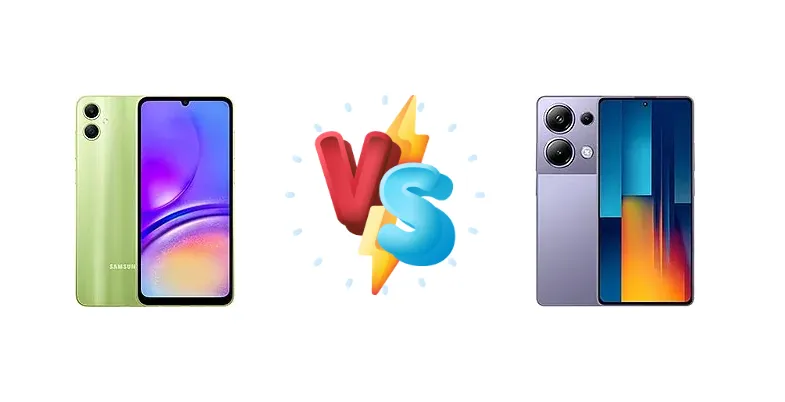
The Samsung Galaxy A05 and Xiaomi Poco M6 Pro 4G represent two compelling options in the ultra-budget smartphone space. While both aim to deliver essential features at an accessible price, they diverge significantly in their approach, particularly regarding performance and charging speed. This comparison dissects these differences to help you determine which device best suits your needs.
🏆 Quick Verdict
For most users, the Xiaomi Poco M6 Pro 4G emerges as the superior choice. Its significantly faster 67W charging, coupled with the more powerful Mediatek Helio G99 Ultra chipset, provides a smoother and more responsive user experience. While the A05 offers a familiar Samsung interface, it can't match the Poco's overall value.
| Network |
|---|
| 2G bands | GSM 850 / 900 / 1800 / 1900 | GSM 850 / 900 / 1800 / 1900 |
| 3G bands | HSDPA 850 / 900 / 2100 | HSDPA 800 / 850 / 900 / 1700(AWS) / 1900 / 2100 |
| 4G bands | 1, 3, 5, 7, 8, 20, 28, 38, 40, 41 | 1, 2, 3, 4, 5, 7, 8, 12, 13, 17, 18, 19, 20, 26, 28, 38, 40, 41, 66 |
| Speed | HSPA, LTE | HSPA, LTE |
| Technology | GSM / HSPA / LTE | GSM / HSPA / LTE |
| Launch |
|---|
| Announced | 2023, September 25 | 2024, January 11 |
| Status | Available. Released 2023, October 15 | Available. Released 2024, January 12 |
| Body |
|---|
| Build | Glass front, plastic back, plastic frame | Glass front (Gorilla Glass 5), plastic frame |
| Dimensions | 168.8 x 78.2 x 8.8 mm (6.65 x 3.08 x 0.35 in) | 161.1 x 75 x 8 mm (6.34 x 2.95 x 0.31 in) |
| SIM | · Nano-SIM· Nano-SIM + Nano-SIM | Nano-SIM + Nano-SIM |
| Weight | 195 g (6.88 oz) | 179 g (6.31 oz) |
| Display |
|---|
| Protection | - | Corning Gorilla Glass 5 |
| Resolution | 720 x 1600 pixels, 20:9 ratio (~262 ppi density) | 1080 x 2400 pixels, 20:9 ratio (~395 ppi density) |
| Size | 6.7 inches, 108.4 cm2 (~82.1% screen-to-body ratio) | 6.67 inches, 107.4 cm2 (~88.9% screen-to-body ratio) |
| Type | PLS LCD | AMOLED, 120Hz, 1000 nits (HBM), 1300 nits (peak) |
| Platform |
|---|
| CPU | Octa-core (2x2.0 GHz Cortex-A75 & 6x1.8 GHz Cortex-A55) | Octa-core (2x2.2 GHz Cortex-A76 & 6x2.0 GHz Cortex-A55) |
| Chipset | Mediatek Helio G85 (12 nm) | Mediatek Helio G99 Ultra |
| GPU | Mali-G52 MC2 | Mali-G57 MC2 |
| OS | Android 13, up to 2 major Android upgrades, One UI 7 | Android 13, MIUI 14, planned upgrade to Android 14, HyperOS |
| Memory |
|---|
| Card slot | microSDXC | microSDXC (uses shared SIM slot) |
| Internal | 32GB 3GB RAM, 64GB 4GB RAM, 128GB 4GB RAM, 128GB 6GB RAM | 256GB 8GB RAM, 512GB 12GB RAM |
| Main Camera |
|---|
| Dual | 50 MP, f/1.8, (wide), 1/2.8", 0.64µm, AF
Auxiliary lens | - |
| Features | LED flash | LED flash, HDR, panorama |
| Triple | - | 64 MP, f/1.8, 25mm (wide), 1/2.0", 0.7µm, PDAF, OIS
8 MP, f/2.2, (ultrawide)
2 MP (macro) |
| Video | 1080p@30/60fps | 1080p@30/60fps, gyro-EIS |
| Selfie camera |
|---|
| Single | 8 MP, f/2.0, (wide), 1/4.0", 1.12µm | 16 MP, f/2.5, (wide) |
| Video | Yes | 1080p@30/60fps |
| Sound |
|---|
| 35mm jack | Yes | Yes |
| Loudspeaker | Yes | Yes, with dual speakers |
| Comms |
|---|
| Bluetooth | 5.3, A2DP, LE | 5.2, A2DP, LE |
| Infrared port | - | Yes |
| NFC | No | Yes (market/region dependent) |
| Positioning | GPS, GLONASS, GALILEO, BDS | GPS, GALILEO, GLONASS, BDS |
| Radio | Unspecified | FM radio |
| USB | USB Type-C 2.0 | USB Type-C 2.0, OTG |
| WLAN | Wi-Fi 802.11 a/b/g/n/ac, dual-band, Wi-Fi Direct | Wi-Fi 802.11 a/b/g/n/ac, dual-band |
| Features |
|---|
| Sensors | Accelerometer, proximity | Fingerprint (under display, optical), accelerometer, gyro, compass |
| Battery |
|---|
| Charging | 25W wired | 67W wired, 100% in 44 min |
| Type | Li-Po 5000 mAh | 5000 mAh |
| Misc |
|---|
| Colors | Black, Silver, Light Green | Black, Blue, Purple |
| Models | SM-A055F, SM-A055F/DS, SM-A055M, SM-A055M/DS | 2312FPCA6G |
| Price | $ 100.00 / C$ 119.94 / £ 67.98 / € 96.07 | $ 170.00 |
| SAR | - | 1.09 W/kg (head) 1.09 W/kg (body) |
| SAR EU | 0.41 W/kg (head) 1.19 W/kg (body) | 0.99 W/kg (head) 0.99 W/kg (body) |
Samsung Galaxy A05
- Familiar Samsung One UI software
- Reliable brand reputation
- Potentially more software updates (Samsung's track record)
- Slower processor (Helio G85)
- Significantly slower charging (25W)
- Likely dimmer display
Xiaomi Poco M6 Pro 4G
- Faster processor (Helio G99 Ultra)
- Ultra-fast 67W charging
- Brighter display (1053 nits)
- Longer battery life (11:46h active use)
- MIUI software can be polarizing
- Xiaomi's update policy can be inconsistent
Display Comparison
The Poco M6 Pro 4G boasts a notably brighter display, reaching a measured peak brightness of 1053 nits. This is a substantial advantage over what we’d expect from the A05, making the Poco far more usable outdoors under direct sunlight. While both likely utilize LCD panels (given the price point), the higher brightness of the Poco translates to a more vibrant and readable viewing experience. Bezels are likely comparable, but the brightness difference is the key differentiator.
Camera Comparison
Without detailed camera specs beyond 'Photo/Video', a direct comparison is limited. However, given the price bracket, both phones likely feature a primary sensor paired with depth and macro lenses. The Poco M6 Pro 4G’s image processing, leveraging the G99 Ultra’s ISP, is likely to produce more detailed and dynamic images. The A05 will likely focus on Samsung’s established image processing style, which tends towards more saturated colors. The usefulness of the 2MP macro lens on both devices is questionable, offering limited detail.
Performance
The core difference lies in the chipsets. The Poco M6 Pro 4G’s Mediatek Helio G99 Ultra, with its 2x2.2 GHz Cortex-A76 cores, represents a clear step up from the Galaxy A05’s Helio G85 (2x2.0 GHz Cortex-A75). The Cortex-A76 architecture is more efficient and powerful than the A75, resulting in faster app loading times and smoother multitasking. The G99 Ultra’s improved GPU also provides a better gaming experience. While both phones likely feature similar RAM configurations, the chipset advantage firmly favors the Poco.
Battery Life
The Poco M6 Pro 4G shines in battery and charging. While the exact battery capacity isn’t specified for the A05, the Poco’s 67W wired charging, capable of a full charge in just 44 minutes, is a game-changer. The A05’s 25W charging is considerably slower. Furthermore, the Poco M6 Pro 4G achieves an impressive 11:46h of active use, suggesting excellent power efficiency from the Helio G99 Ultra. This combination of fast charging and good battery life gives the Poco a significant edge.
Buying Guide
Buy the Samsung Galaxy A05 if you prioritize brand familiarity and a simple, streamlined software experience, and your usage is primarily focused on basic tasks like calls, messaging, and light social media. Buy the Xiaomi Poco M6 Pro 4G if you value performance for gaming and multitasking, demand rapid charging, and are comfortable with Xiaomi’s MIUI software, which offers more customization options.
Frequently Asked Questions
❓ Does the Poco M6 Pro 4G's MIUI software come with a lot of bloatware?
MIUI is known for including pre-installed apps, often referred to as bloatware. However, many of these can be uninstalled or disabled, allowing you to customize the software to your preferences. Recent versions of MIUI have reduced the amount of pre-installed software.
❓ Is the Helio G99 Ultra in the Poco M6 Pro 4G capable of running demanding games like PUBG Mobile?
Yes, the Helio G99 Ultra is capable of running PUBG Mobile at medium to high settings with playable frame rates. While it won't deliver the same performance as flagship chipsets, it provides a solid gaming experience for the price point. Expect to adjust graphics settings for optimal performance.
❓ How does the 25W charging on the Samsung Galaxy A05 compare to typical smartphone charging speeds?
25W charging is relatively slow by today's standards. While it will still charge the phone overnight, it will take significantly longer than the Poco M6 Pro 4G's 67W charging. Expect a full charge to take well over 2 hours with the A05.
❓ Will the Samsung Galaxy A05 receive long-term software support and security updates?
Samsung generally provides better software support than many other Android manufacturers in this price range. While the A05 is a budget device, it's likely to receive at least a couple of major Android updates and several years of security patches, though the exact duration is not guaranteed.