
Samsung Galaxy A05 vs. Motorola Moto G Stylus 5G (2023): Which Budget Phone Reigns Supreme?
| Phones Images | |||||
|---|---|---|---|---|---|
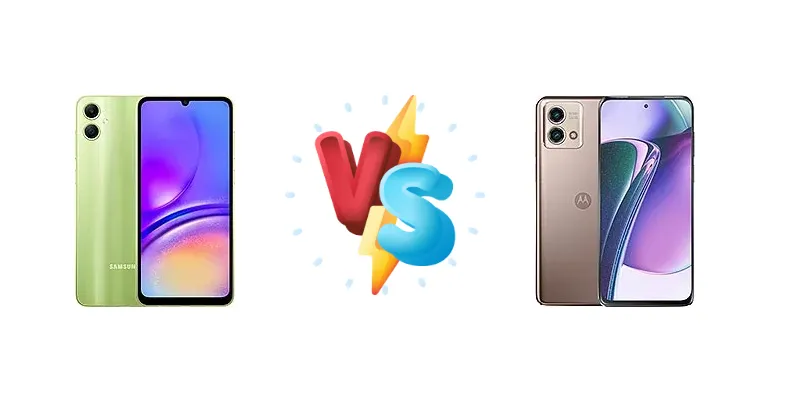
|
🏆 Quick Verdict
For most users, the Motorola Moto G Stylus 5G (2023) is the superior choice. Its Snapdragon 6 Gen 1 chipset, built on a 4nm process, provides a noticeable performance advantage and improved power efficiency over the Galaxy A05’s Helio G85. While the A05 offers a slightly faster 25W charging, the Moto G Stylus 5G’s overall refinement and 5G connectivity make it a more compelling package.
| PHONES | ||
|---|---|---|
| Phone Names | Samsung Galaxy A05 | Motorola Moto G Stylus 5G (2023) |
| Network | ||
|---|---|---|
| 2G bands | GSM 850 / 900 / 1800 / 1900 | GSM 850 / 900 / 1800 / 1900 |
| 3G bands | HSDPA 850 / 900 / 2100 | HSDPA 850 / 900 / 1700(AWS) / 1900 / 2100 |
| 4G bands | 1, 3, 5, 7, 8, 20, 28, 38, 40, 41 | 1, 2, 3, 4, 5, 7, 8, 12, 13, 14, 17, 18, 19, 20, 25, 26, 29, 30, 38, 39, 40, 41, 48, 66, 71 |
| 5G bands | - | 1, 2, 3, 5, 7, 12, 13, 14, 25, 26, 29, 30, 38, 41, 48, 66, 70, 71, 77, 78 SA/NSA |
| Speed | HSPA, LTE | HSPA, LTE, 5G |
| Technology | GSM / HSPA / LTE | GSM / HSPA / LTE / 5G |
| Launch | ||
|---|---|---|
| Announced | 2023, September 25 | 2023, May 30 |
| Status | Available. Released 2023, October 15 | Available. Released 2023, June 02 |
| Body | ||
|---|---|---|
| Build | Glass front, plastic back, plastic frame | Glass front, plastic frame, plastic back |
| Dimensions | 168.8 x 78.2 x 8.8 mm (6.65 x 3.08 x 0.35 in) | 162.8 x 73.8 x 9.2 mm (6.41 x 2.91 x 0.36 in) |
| SIM | · Nano-SIM· Nano-SIM + Nano-SIM | Nano-SIM |
| Weight | 195 g (6.88 oz) | 202 g (7.13 oz) |
| Display | ||
|---|---|---|
| Resolution | 720 x 1600 pixels, 20:9 ratio (~262 ppi density) | 1080 x 2400 pixels, 20:9 ratio (~399 ppi density) |
| Size | 6.7 inches, 108.4 cm2 (~82.1% screen-to-body ratio) | 6.6 inches, 105.2 cm2 (~87.5% screen-to-body ratio) |
| Type | PLS LCD | IPS LCD, 120Hz |
| Platform | ||
|---|---|---|
| CPU | Octa-core (2x2.0 GHz Cortex-A75 & 6x1.8 GHz Cortex-A55) | Octa-core (4x2.2 GHz Cortex-A78 & 4x1.8 GHz Cortex-A55) |
| Chipset | Mediatek Helio G85 (12 nm) | Qualcomm SM6450 Snapdragon 6 Gen 1 (4 nm) |
| GPU | Mali-G52 MC2 | Adreno 710 |
| OS | Android 13, up to 2 major Android upgrades, One UI 7 | Android 13, planned upgrade to Android 14 |
| Memory | ||
|---|---|---|
| Card slot | microSDXC | microSDXC (dedicated slot) |
| Internal | 32GB 3GB RAM, 64GB 4GB RAM, 128GB 4GB RAM, 128GB 6GB RAM | 64GB 4GB RAM, 128GB 4GB RAM, 128GB 6GB RAM, 256GB 6GB RAM |
| Main Camera | ||
|---|---|---|
| Dual | 50 MP, f/1.8, (wide), 1/2.8", 0.64µm, AF Auxiliary lens | 50 MP, f/1.9, (wide), 1.0µm, PDAF 8 MP, f/2.2, (ultrawide), 1/4.0", 1.12µm, AF |
| Features | LED flash | LED flash, HDR, panorama |
| Video | 1080p@30/60fps | 4K@30fps, 1080p@30/60fps |
| Selfie camera | ||
|---|---|---|
| Features | - | HDR |
| Single | 8 MP, f/2.0, (wide), 1/4.0", 1.12µm | 16 MP, f/2.5, (wide), 1.0µm |
| Video | Yes | 1080p@30fps |
| Sound | ||
|---|---|---|
| 35mm jack | Yes | Yes |
| Loudspeaker | Yes | Yes, with stereo speakers |
| Comms | ||
|---|---|---|
| Bluetooth | 5.3, A2DP, LE | 5.1, A2DP, LE |
| NFC | No | Yes |
| Positioning | GPS, GLONASS, GALILEO, BDS | GPS (L1+L5), GALILEO |
| Radio | Unspecified | FM radio |
| USB | USB Type-C 2.0 | USB Type-C 2.0 |
| WLAN | Wi-Fi 802.11 a/b/g/n/ac, dual-band, Wi-Fi Direct | Wi-Fi 802.11 a/b/g/n/ac, dual-band |
| Features | ||
|---|---|---|
| Sensors | Accelerometer, proximity | Fingerprint (side-mounted), accelerometer, gyro, proximity, compass, barometer |
| Battery | ||
|---|---|---|
| Charging | 25W wired | 20W wired |
| Type | Li-Po 5000 mAh | Li-Po 5000 mAh |
| Misc | ||
|---|---|---|
| Colors | Black, Silver, Light Green | Cosmic Black, Rose Champagne |
| Models | SM-A055F, SM-A055F/DS, SM-A055M, SM-A055M/DS | XT2315-1, XT2315-4 |
| Price | $ 100.00 / C$ 119.94 / £ 67.98 / € 96.07 | $ 93.43 |
| SAR EU | 0.41 W/kg (head) 1.19 W/kg (body) | - |
Samsung Galaxy A05
- Faster 25W wired charging
- Potentially lower price point
- Samsung’s One UI software (preference-based)
- Less powerful Helio G85 chipset
- Less efficient 12nm fabrication process
- No 5G connectivity
Motorola Moto G Stylus 5G (2023)
- More powerful Snapdragon 6 Gen 1 chipset
- More efficient 4nm fabrication process
- 5G connectivity for faster data speeds
- Integrated stylus for enhanced productivity
- Slower 20W wired charging
- Motorola’s software update track record is less consistent than Samsung’s
Display Comparison
Neither device boasts a standout display. Both likely utilize LCD panels, a common cost-saving measure in this segment. The key difference lies under the hood. While specific display specs are unavailable, the Moto G Stylus 5G’s processor allows for potentially more efficient display management. The A05’s Helio G85 may struggle to drive a high-resolution or high-refresh-rate panel smoothly, impacting visual fluidity. Bezels are expected to be substantial on both devices, reflecting their budget positioning.
Camera Comparison
Camera performance is likely to be similar in real-world usage, given the focus on affordability. Both phones will likely feature a primary camera accompanied by basic auxiliary lenses (depth or macro). The Moto G Stylus 5G may benefit from Qualcomm’s image signal processor (ISP), which generally offers superior noise reduction and dynamic range compared to MediaTek’s offerings. However, without specific sensor size and aperture information, it’s difficult to declare a definitive winner. The inclusion of a stylus on the Moto G Stylus 5G could also be leveraged for creative photo editing, offering a unique advantage.
Performance
The performance gap is the most significant differentiator. The Motorola Moto G Stylus 5G’s Qualcomm Snapdragon 6 Gen 1 (4nm) is a clear upgrade over the Samsung Galaxy A05’s MediaTek Helio G85 (12nm). The Snapdragon 6 Gen 1 features a more modern CPU architecture – 4x2.2 GHz Cortex-A78 cores versus the A05’s 2x2.0 GHz Cortex-A75 cores – resulting in faster application loading and smoother multitasking. The 4nm fabrication process also translates to better thermal efficiency, reducing the likelihood of performance throttling during sustained workloads. Gamers will find the Moto G Stylus 5G noticeably more capable, even at medium settings.
Battery Life
The Samsung Galaxy A05 supports 25W wired charging, slightly faster than the Motorola Moto G Stylus 5G’s 20W. However, the Snapdragon 6 Gen 1’s superior power efficiency could offset this difference. The A05’s less efficient Helio G85 will likely consume more power during typical usage, potentially requiring more frequent charging. Real-world battery life will depend heavily on usage patterns, but the Moto G Stylus 5G is expected to deliver comparable, if not better, endurance despite the lower charging wattage.
Buying Guide
Buy the Samsung Galaxy A05 if you prioritize a slightly faster charging speed and are primarily focused on basic smartphone tasks like calling, texting, and light social media use. Buy the Motorola Moto G Stylus 5G (2023) if you value smoother performance, 5G connectivity for faster data speeds, and a more modern chipset architecture that promises better long-term software support and efficiency.