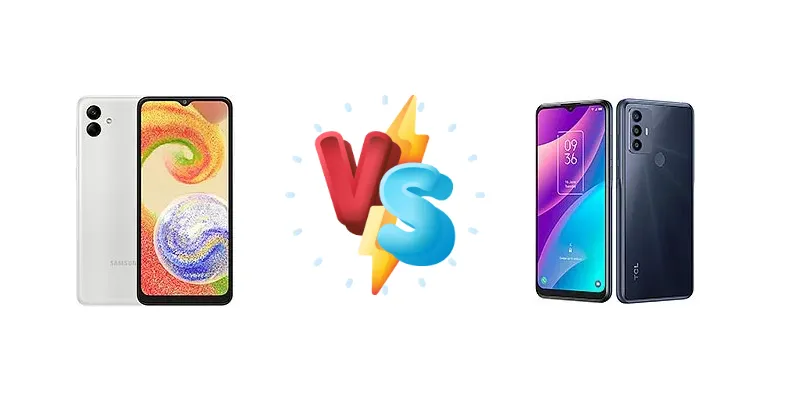
The Samsung Galaxy A04 and TCL 30 SE represent the fiercely competitive entry-level smartphone market. Both aim to deliver essential smartphone functionality at an accessible price point, but they achieve this with different approaches to chipset selection and feature prioritization. This comparison dissects their core specifications to determine which device offers the best value for budget-conscious consumers.
🏆 Quick Verdict
For the average user prioritizing a slightly smoother experience and faster charging, the TCL 30 SE is the better choice. While the Samsung Galaxy A04 offers brand recognition, the TCL 30 SE’s Helio G25 chipset provides a modest performance advantage and the inclusion of 15W charging is a significant benefit.
| Network |
|---|
| 2G bands | GSM 850 / 900 / 1800 / 1900 | GSM 850 / 900 / 1800 / 1900 |
| 3G bands | HSDPA 850 / 900 / 2100 | HSDPA 850 / 900 / 1900 / 2100 - EMEA/APAC |
| 4G bands | 1, 3, 5, 7, 8, 20, 28, 38, 40, 41 | 1, 3, 5, 7, 8, 20, 28, 38, 40, 41 - EMEA |
| Speed | HSPA 42.2/5.76 Mbps, LTE Cat4 150/50 Mbps | HSPA 42.2/11.5 Mbps, LTE Cat4 150/50 Mbps |
| Technology | GSM / HSPA / LTE | GSM / HSPA / LTE |
| | - | 2, 3, 4, 5, 7, 8, 12, 13, 17, 26, 28, 66 - LATAM |
| Launch |
|---|
| Announced | 2022, August 24 | 2022, February 27 |
| Status | Available. Released 2022, October 10 | Available. Released 2022, April 20 |
| Body |
|---|
| Build | Glass front, plastic back, plastic frame | Glass front, plastic frame, plastic back |
| Dimensions | 164.4 x 76.3 x 9.1 mm (6.47 x 3.00 x 0.36 in) | 165.2 x 75.5 x 8.9 mm (6.50 x 2.97 x 0.35 in) |
| SIM | · Nano-SIM· Nano-SIM + Nano-SIM | · Nano-SIM· Nano-SIM + Nano-SIM |
| Weight | 192 g (6.77 oz) | 190 g (6.70 oz) |
| Display |
|---|
| Resolution | 720 x 1600 pixels, 20:9 ratio (~270 ppi density) | 720 x 1600 pixels, 20:9 ratio (~269 ppi density) |
| Size | 6.5 inches, 102.0 cm2 (~81.3% screen-to-body ratio) | 6.52 inches, 102.6 cm2 (~82.3% screen-to-body ratio) |
| Type | PLS LCD | IPS LCD, 450 nits (typ) |
| Platform |
|---|
| CPU | Octa-core (4x2.3 GHz Cortex-A53 & 4x1.8 GHz Cortex-A53) | Octa-core (4x2.0 GHz Cortex-A53 & 4x1.5 GHz Cortex-A53) |
| Chipset | Mediatek MT6765 Helio P35 (12 nm) | Mediatek MT6762G Helio G25 (12 nm) |
| GPU | PowerVR GE8320 | PowerVR GE8320 |
| OS | Android 12, upgradable to Android 13, One UI Core 5.0 | Android 12, TCL UI 4.0 |
| Memory |
|---|
| Card slot | microSDXC (dedicated slot) | microSDXC (dedicated slot) |
| Internal | 32GB 3GB RAM, 32GB 4GB RAM, 64GB 3GB RAM, 64GB 4GB RAM, 64GB 6GB RAM, 128GB 4GB RAM, 128GB 8GB RAM | 64GB 4GB RAM, 128GB 4GB RAM |
| | eMMC 5.1 | eMMC 5.1 |
| Main Camera |
|---|
| Dual | 50 MP, f/1.8, 25mm (wide), 1/2.51", 0.7µm, AF
Auxiliary lens | - |
| Features | LED flash | LED flash, HDR, panorama |
| Single | 5 MP, f/2.2 | 8 MP, f/2.0, 26mm (wide), 1/4", 1.12µm |
| Triple | - | 50 MP, f/1.9, 28mm (wide), 1/2.76", 0.64µm, PDAF
2 MP (macro)
Auxiliary lens |
| Video | 1080p@30fps | 1080p@30fps |
| Selfie camera |
|---|
| Features | - | HDR |
| Single | 5 MP, f/2.2, 28mm (wide), 1/5", 1.12µm | 8 MP, f/2.0, 26mm (wide), 1/4.0", 1.12µm |
| Video | Yes | 1080p@30fps |
| Sound |
|---|
| 3.5mm jack | Yes | Yes |
| 35mm jack | Yes | Yes |
| Loudspeaker | Yes | Yes |
| Comms |
|---|
| Bluetooth | 5.0, A2DP, LE | 5.0, A2DP, LE |
| NFC | No | Yes (6165H/6165H1 only) |
| Positioning | GPS, GLONASS, GALILEO, BDS | GPS, GLONASS, GALILEO, BDS |
| Radio | Unspecified | Unspecified |
| USB | USB Type-C 2.0 | USB Type-C 2.0 |
| WLAN | Wi-Fi 802.11 a/b/g/n/ac, dual-band, Wi-Fi Direct | Wi-Fi 802.11 b/g/n, Wi-Fi Direct |
| Features |
|---|
| Sensors | Accelerometer, proximity | Fingerprint (rear-mounted), accelerometer, proximity, compass |
| Battery |
|---|
| Charging | - | 15W wired |
| Type | Li-Po 5000 mAh | Li-Po 5000 mAh |
| Misc |
|---|
| Colors | Black, Green, White, Copper | Atlantic Blue, Space Gray, Glacial Blue |
| Models | SM-A045F, SM-A045F/DS, SM-A045M | 6165H, 6156H1, 6165A, 6165A1, 6165S |
| Price | About 70 EUR | - |
| SAR EU | 0.32 W/kg (head) 1.10 W/kg (body) | - |
Samsung Galaxy A04
- Established Samsung brand reputation
- Potential for wider accessory availability
- Familiar One UI software experience
- Older Helio P35 chipset
- Likely slower charging speeds
- Potentially less efficient performance
TCL 30 SE
- More efficient Helio G25 chipset
- Faster 15W wired charging
- Potentially smoother user experience
- Less brand recognition
- Software updates may be less frequent
- Potentially limited accessory ecosystem
Display Comparison
Neither device boasts a standout display. Both utilize standard LCD panels, and detailed specifications like brightness nits and color gamut coverage are unavailable. However, the focus here isn't on visual fidelity, but basic usability. Expect similar viewing experiences in typical indoor lighting conditions. Bezels are likely comparable, given the price bracket, and neither phone is expected to feature high refresh rate technology.
Camera Comparison
Camera performance on both devices will be limited. Detailed sensor information is lacking, but it’s safe to assume both rely on basic image sensors. The focus should be on capturing acceptable photos in good lighting conditions. The presence of a 2MP macro camera on both is largely a marketing tactic, offering minimal practical benefit due to the low resolution. Image processing will likely be basic, prioritizing speed over detail. Expect similar results in terms of dynamic range and low-light performance.
Performance
The core difference lies in the chipsets. The Samsung Galaxy A04 features the Mediatek Helio P35, an older 12nm chip with a CPU configuration of 4x2.3 GHz Cortex-A53 cores and 4x1.8 GHz Cortex-A53 cores. The TCL 30 SE, conversely, utilizes the Mediatek Helio G25, also a 12nm chip, but with a slightly tweaked CPU arrangement of 4x2.0 GHz Cortex-A53 cores and 4x1.5 GHz Cortex-A53 cores. While the A04 has higher clocked cores, the G25 is generally considered more efficient for everyday tasks. This translates to a potentially smoother experience with app switching and basic multitasking on the TCL 30 SE. Both phones will struggle with graphically demanding games, but the G25’s slightly improved GPU may offer marginally better performance. RAM configurations are likely similar, further minimizing the performance gap.
Battery Life
Battery capacity is not specified for either device, but given the market segment, both likely house batteries in the 4000-5000 mAh range. The TCL 30 SE gains a significant advantage with its 15W wired charging support. The Samsung Galaxy A04’s charging speed is not specified, but is likely limited to 10W or slower. This means the TCL 30 SE will recharge considerably faster, a crucial benefit for users who dislike long charging times. While a larger battery capacity on the A04 *could* offset this, the faster charging of the 30 SE is a more tangible benefit.
Buying Guide
Buy the Samsung Galaxy A04 if you prioritize brand familiarity and a potentially wider ecosystem of accessories. Its strength lies in the Samsung name and established software support. Buy the TCL 30 SE if you prefer a slightly more responsive user experience and faster charging capabilities, making it ideal for users who frequently top up their battery throughout the day and need a phone that keeps pace with basic tasks.
Frequently Asked Questions
❓ Will the TCL 30 SE handle popular social media apps like TikTok and Instagram smoothly?
Yes, the Mediatek Helio G25 in the TCL 30 SE is sufficient for running most social media applications without significant lag. While it won't offer a high-end experience, it should provide a usable experience for browsing feeds, recording short videos, and basic editing.
❓ Is the Samsung Galaxy A04 a good choice for someone upgrading from a very old phone (e.g., Android 7)?
Yes, the Samsung Galaxy A04 represents a significant upgrade in terms of software and features for users coming from older Android versions. It will offer access to the latest apps, security updates, and a more modern user interface, even if performance isn't flagship-level.
❓ Can either of these phones run two apps simultaneously (split-screen)?
Both phones *can* technically run split-screen, but performance will be limited. The TCL 30 SE with its Helio G25 will likely handle this slightly better than the Samsung A04, but don't expect a seamless experience with demanding apps. Stick to lighter apps like messaging and web browsing.
❓ How long will software updates be supported on the TCL 30 SE?
TCL's software update commitment for the 30 SE is limited. Expect one major Android update and a few security patches. Samsung generally offers longer software support, but even the A04 is unlikely to receive updates for more than two years.