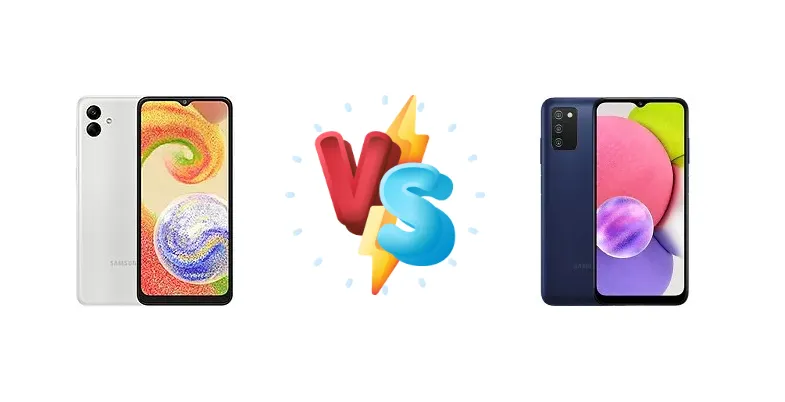
Samsung's A-series continues to dominate the ultra-budget smartphone space. The Galaxy A04 and A03s represent iterative updates within this segment, both aiming to deliver essential smartphone functionality at a low price point. This comparison dives deep into the nuances between these two devices, revealing whether the A04 justifies an upgrade from the A03s, or if the older model remains a compelling value.
🏆 Quick Verdict
For most users, the Samsung Galaxy A03s remains the better value. While the A04 offers a marginally faster CPU clock speed, the differences are negligible in real-world use. Both phones share the same Helio P35 chipset, battery endurance, and display characteristics, making the A03s a smarter purchase given its likely lower price.
| Network |
|---|
| 2G bands | GSM 850 / 900 / 1800 / 1900 | GSM 850 / 900 / 1800 / 1900 |
| 3G bands | HSDPA 850 / 900 / 2100 | HSDPA 850 / 900 / 2100 |
| 4G bands | 1, 3, 5, 7, 8, 20, 28, 38, 40, 41 | 1, 3, 5, 7, 8, 20, 28, 38, 40, 41 |
| Speed | HSPA 42.2/5.76 Mbps, LTE Cat4 150/50 Mbps | HSPA 42.2/5.76 Mbps, LTE Cat4 150/50 Mbps |
| Technology | GSM / HSPA / LTE | GSM / HSPA / LTE |
| | - | 2, 4, 5, 7, 12, 13, 14, 25, 26, 41, 66, 71 - SM-A037U |
| Launch |
|---|
| Announced | 2022, August 24 | 2021, August 18 |
| Status | Available. Released 2022, October 10 | Available. Released 2021, August 18 |
| Body |
|---|
| Build | Glass front, plastic back, plastic frame | Glass front, plastic frame, plastic back |
| Dimensions | 164.4 x 76.3 x 9.1 mm (6.47 x 3.00 x 0.36 in) | 164.2 x 75.9 x 9.1 mm (6.46 x 2.99 x 0.36 in) |
| SIM | · Nano-SIM· Nano-SIM + Nano-SIM | Nano-SIM + Nano-SIM |
| Weight | 192 g (6.77 oz) | 196 g (6.91 oz) |
| Display |
|---|
| Resolution | 720 x 1600 pixels, 20:9 ratio (~270 ppi density) | 720 x 1600 pixels, 20:9 ratio (~270 ppi density) |
| Size | 6.5 inches, 102.0 cm2 (~81.3% screen-to-body ratio) | 6.5 inches, 102.0 cm2 (~81.8% screen-to-body ratio) |
| Type | PLS LCD | PLS LCD |
| Platform |
|---|
| CPU | Octa-core (4x2.3 GHz Cortex-A53 & 4x1.8 GHz Cortex-A53) | Octa-core (4x2.35 GHz Cortex-A53 & 4x1.8 GHz Cortex-A53) |
| Chipset | Mediatek MT6765 Helio P35 (12 nm) | Mediatek MT6765 Helio P35 (12 nm) |
| GPU | PowerVR GE8320 | PowerVR GE8320 |
| OS | Android 12, upgradable to Android 13, One UI Core 5.0 | Android 11, upgradable to Android 13, One UI 5.1 Core |
| Memory |
|---|
| Card slot | microSDXC (dedicated slot) | microSDXC (dedicated slot) |
| Internal | 32GB 3GB RAM, 32GB 4GB RAM, 64GB 3GB RAM, 64GB 4GB RAM, 64GB 6GB RAM, 128GB 4GB RAM, 128GB 8GB RAM | 32GB 2GB RAM, 32GB 3GB RAM, 32GB 4GB RAM, 64GB 3GB RAM, 64GB 4GB RAM |
| | eMMC 5.1 | eMMC 5.1 |
| Main Camera |
|---|
| Dual | 50 MP, f/1.8, 25mm (wide), 1/2.51", 0.7µm, AF
Auxiliary lens | - |
| Features | LED flash | LED flash |
| Single | 5 MP, f/2.2 | 5 MP, f/2.2 |
| Triple | - | 13 MP, f/2.2, (wide), AF
2 MP (macro)
Auxiliary lens |
| Video | 1080p@30fps | 1080p@30fps |
| Selfie camera |
|---|
| Single | 5 MP, f/2.2, 28mm (wide), 1/5", 1.12µm | 5 MP, f/2.2 |
| Video | Yes | 1080p@30fps |
| Sound |
|---|
| 3.5mm jack | Yes | Yes |
| 35mm jack | Yes | Yes |
| Loudspeaker | Yes | Yes |
| Comms |
|---|
| Bluetooth | 5.0, A2DP, LE | 5.0, A2DP |
| NFC | No | Yes (market/region dependent) |
| Positioning | GPS, GLONASS, GALILEO, BDS | GPS, GLONASS, GALILEO, BDS |
| Radio | Unspecified | No |
| USB | USB Type-C 2.0 | USB Type-C 2.0 |
| WLAN | Wi-Fi 802.11 a/b/g/n/ac, dual-band, Wi-Fi Direct | Wi-Fi 802.11 b/g/n, Wi-Fi Direct |
| Features |
|---|
| Sensors | Accelerometer, proximity | Fingerprint (side-mounted), accelerometer, proximity |
| Battery |
|---|
| Charging | - | 15W wired |
| Type | Li-Po 5000 mAh | Li-Po 5000 mAh |
| Misc |
|---|
| Colors | Black, Green, White, Copper | Black, Blue, White |
| Models | SM-A045F, SM-A045F/DS, SM-A045M | SM-A037F, SM-A037F/DS, SM-A037M, SM-A037G, SM-A037U, SM-S134DL, SM-A037W, SM-A037U1, SM-S135DL |
| Price | About 70 EUR | $ 65.65 / £ 82.99 / ₹ 10,800 |
| SAR EU | 0.32 W/kg (head) 1.10 W/kg (body) | 0.36 W/kg (head) 1.09 W/kg (body) |
| Tests |
|---|
| Battery life | - |
Endurance rating 122h
|
| Camera | - |
Photo / Video |
| Display | - |
Contrast ratio: 1718:1 (nominal) |
| Loudspeaker | - |
-27.4 LUFS (Good)
|
| Performance | - |
AnTuTu: 103465 (v8), 101299 (v9)
GeekBench: 889 (v5.1)
GFXBench: 5.5fps (ES 3.1 onscreen) |
Samsung Galaxy A04
- Slightly faster CPU clock speed (potentially marginal gains)
- Latest model in the series
- May receive longer software support
- Likely higher price than the A03s
- Minimal performance difference compared to A03s
- Shared chipset and battery life
Samsung Galaxy A03s
- Lower price point
- Identical performance to A04 in most scenarios
- Excellent battery endurance (122h)
- Older model
- Potentially shorter software support lifespan
- May be harder to find in retail
Display Comparison
Both the Galaxy A04 and A03s feature displays with a 1718:1 contrast ratio, indicating similar visual quality in terms of blacks and whites. The A03s was measured at 488 nits of peak brightness, and while the A04’s brightness isn’t explicitly stated, it’s reasonable to assume it’s within a similar range given the shared target market. This brightness level is adequate for indoor use but may struggle in direct sunlight. Neither device boasts high refresh rates or advanced panel technologies like AMOLED, focusing instead on affordability.
Camera Comparison
Both the A04 and A03s are equipped with 'Photo / Video' capabilities, but detailed camera specifications are lacking. Given their price point, it’s safe to assume both rely on basic image sensors and software processing. The inclusion of a 2MP macro camera on both devices is largely a marketing tactic, as the image quality from such sensors is typically subpar. The primary camera sensor size and aperture are unknown, but are likely similar, resulting in comparable photo and video quality in good lighting conditions. Expect struggles in low-light scenarios.
Performance
The core of both devices is the Mediatek Helio P35 (12 nm) chipset. The A03s features an octa-core CPU clocked at 4x2.35 GHz Cortex-A53 & 4x1.8 GHz Cortex-A53, while the A04 has a slightly faster 4x2.3 GHz Cortex-A53 & 4x1.8 GHz Cortex-A53 configuration. This 50MHz difference in the high-performance cores is unlikely to translate into a noticeable performance boost in everyday tasks or even most games. Both phones will likely exhibit similar levels of responsiveness and app loading times. The shared chipset suggests similar thermal limitations, meaning neither device is suited for sustained, demanding workloads.
Battery Life
Both the Galaxy A04 and A03s achieve an endurance rating of 122 hours, indicating identical battery life performance. The A03s supports 15W wired charging, and while the A04’s charging speed isn’t specified, it’s likely similar. This charging speed is relatively slow compared to modern standards, meaning a full charge will take a considerable amount of time. The shared endurance rating suggests similar battery capacity and power efficiency, despite any minor CPU clock speed differences.
Buying Guide
Buy the Samsung Galaxy A04 if you absolutely need the latest model and are willing to pay a small premium for a potentially slightly snappier experience. Buy the Samsung Galaxy A03s if you prioritize value and are content with a reliable, functional smartphone that delivers a similar experience at a lower cost. Both are ideal for first-time smartphone users, seniors, or those needing a secondary device.
Frequently Asked Questions
❓ Will I notice a difference in gaming performance between the A04 and A03s?
Given that both phones utilize the same Mediatek Helio P35 chipset, the difference in gaming performance will be minimal. Both are capable of handling casual games, but will struggle with graphically demanding titles. Expect similar frame rates and potential for lag in more intensive games.
❓ Does the Galaxy A04 offer any improvements in software updates compared to the A03s?
The Galaxy A04, being a newer model, is likely to receive longer software support from Samsung, including security patches and potentially one major Android version update. However, given the budget nature of both devices, don't expect extensive or long-term software support.
❓ Is the 15W charging on the A03s slow compared to other phones?
Yes, 15W charging is relatively slow by today's standards. Expect a full charge to take over two hours. While not ideal, it's typical for phones in this price range, and the shared battery endurance means you won't need to charge it multiple times a day with typical usage.