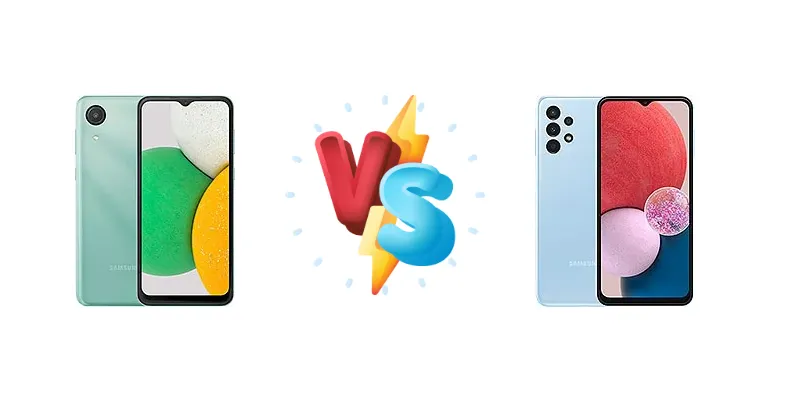
Samsung's A-series caters to the value-conscious consumer, but navigating the options can be tricky. The Galaxy A04 Core and A13 represent distinct approaches to affordability. The A04 Core prioritizes a newer chipset fabrication process, while the A13 opts for a more powerful, albeit older, CPU architecture. This comparison dissects these differences to determine which phone delivers the best experience for your needs.
🏆 Quick Verdict
For most users, the Samsung Galaxy A13 (SM-A137) is the better choice. Its Mediatek Helio G80 chipset, featuring Cortex-A75 performance cores, provides a noticeable performance uplift over the A04 Core’s Exynos 850, making it more responsive for everyday tasks and light gaming. The 15W charging is also a welcome addition.
| Network |
|---|
| 2G bands | GSM 850 / 900 / 1800 / 1900 | GSM 850 / 900 / 1800 / 1900 |
| 3G bands | HSDPA 850 / 900 / 2100 | HSDPA 850 / 900 / 2100 |
| 4G bands | 1, 3, 5, 7, 8, 20, 28, 38, 40, 41 | 1, 3, 5, 7, 8, 20, 28, 38, 40, 41 |
| Speed | HSPA 21.1/5.76 Mbps, LTE | HSPA, LTE |
| Technology | GSM / HSPA / LTE | GSM / HSPA / LTE |
| Launch |
|---|
| Announced | Not announced yet | 2022, June |
| Status | Cancelled | Available. Released 2022, July |
| Body |
|---|
| Build | Plastic back, plastic frame | Glass front (Gorilla Glass 5), plastic frame, plastic back |
| Dimensions | - | 165.1 x 76.4 x 8.8 mm (6.5 x 3.01 x 0.35 in) |
| SIM | · Nano-SIM· Nano-SIM + Nano-SIM | · Nano-SIM· Nano-SIM + Nano-SIM |
| Weight | - | 195 g (6.88 oz) |
| Display |
|---|
| Protection | - | Corning Gorilla Glass 5 |
| Resolution | 720 x 1600 pixels, 20:9 ratio (~270 ppi density) | 1080 x 2408 pixels, 20:9 ratio (~400 ppi density) |
| Size | 6.5 inches, 102.0 cm2 (~81.8% screen-to-body ratio) | 6.6 inches, 104.9 cm2 (~83.2% screen-to-body ratio) |
| Type | PLS LCD | PLS LCD |
| Platform |
|---|
| CPU | Octa-core (4x2.0 GHz Cortex-A55 & 4x2.0 GHz Cortex-A55) | Octa-core (2x2.0 GHz Cortex-A75 & 6x1.8 GHz Cortex-A55) |
| Chipset | Exynos 850 (8 nm) | Mediatek MT6769V/CU Helio G80 (12 nm) |
| GPU | Mali-G52 | Mali-G52 MC2 |
| OS | Android 12 | Android 12, upgradable to Android 14, One UI 6.1 |
| Memory |
|---|
| Card slot | microSDXC (dedicated slot) | microSDXC (dedicated slot) |
| Internal | 32GB 3GB RAM | 32GB 3GB RAM, 32GB 4GB RAM, 64GB 4GB RAM, 128GB 4GB RAM |
| | - | eMMC 5.1 |
| Main Camera |
|---|
| Features | LED flash | LED flash, panorama, HDR |
| Quad | - | 50 MP, f/1.8, (wide), PDAF
5 MP, f/2.2, 123˚ (ultrawide), 1/5.0", 1.12µm
2 MP (macro)
Auxiliary lens |
| Single | 8 MP, f/2.0, AF | 8 MP, f/2.2, (wide) |
| Video | 1080p@30fps | 1080p@30fps |
| Selfie camera |
|---|
| Single | 5 MP, f/2.2 | 8 MP, f/2.2, (wide) |
| Video | - | 1080p@30fps |
| Sound |
|---|
| 3.5mm jack | - | Yes |
| 35mm jack | Yes | Yes |
| Loudspeaker | Yes | Yes |
| Comms |
|---|
| Bluetooth | 5.0, A2DP | 5.2, A2DP, LE |
| NFC | No | Yes |
| Positioning | GPS, GLONASS | GPS, GLONASS, GALILEO, BDS |
| Radio | Unspecified | No |
| USB | USB Type-C 2.0, OTG | USB Type-C 2.0, OTG |
| WLAN | Wi-Fi 802.11 b/g/n, Wi-Fi Direct | Wi-Fi 802.11 a/b/g/n/ac, dual-band, Wi-Fi Direct |
| Features |
|---|
| Sensors | Accelerometer, proximity | Fingerprint (side-mounted), accelerometer, compass |
| | - | Virtual proximity sensing |
| Battery |
|---|
| Charging | - | 15W wired |
| Type | Li-Ion 5000 mAh | Li-Po 5000 mAh |
| Misc |
|---|
| Colors | Black, Green, Rose Gold | Black, White, Blue |
| Models | - | SM-A137F, SM-A137F/DSN, SM-A137F/DS |
| Price | - | About 180 EUR |
| SAR EU | - | 0.35 W/kg (head) 1.22 W/kg (body) |
Samsung Galaxy A04 Core
- Potentially better thermal management due to 8nm process
- May be slightly more affordable
- Simple and straightforward user experience
- Less powerful CPU architecture
- Slower charging speeds
- Likely less responsive for multitasking
Samsung Galaxy A13 (SM-A137)
- More powerful CPU with Cortex-A75 cores
- Faster 15W charging
- Smoother multitasking and gaming
- 12nm process may run slightly warmer
- Potentially higher price point
- May not have the longest battery life
Display Comparison
Neither Samsung provides display specifications beyond resolution. However, both are expected to utilize LCD panels typical of this price bracket. The lack of high refresh rates or advanced features like LTPO is standard. The A13’s slightly larger screen size (assumed, based on typical A-series sizing) may offer a more immersive viewing experience, but without detailed specs, it’s difficult to assess color accuracy or brightness levels. Bezels are expected to be substantial on both devices.
Camera Comparison
Both phones are expected to feature basic camera setups. Given the market segment, detailed camera analysis is limited by the available specs. The A13 likely has a more versatile camera system, even if the megapixel count is similar. The A04 Core’s camera performance will likely be adequate for casual snapshots in good lighting conditions, but will struggle in low-light scenarios. The presence of a 2MP macro camera on both devices is largely a marketing tactic, offering minimal practical benefit due to the low resolution and lack of optical image stabilization (OIS).
Performance
The core difference lies in the chipsets. The A13’s Mediatek Helio G80 (12nm) features a dual-core Cortex-A75 cluster clocked at 2.0 GHz, paired with six Cortex-A55 cores at 1.8 GHz. This architecture provides a significant advantage in multi-threaded tasks and responsiveness compared to the A04 Core’s Exynos 850 (8nm) which utilizes eight Cortex-A55 cores all clocked at 2.0 GHz. While the Exynos 850 benefits from a smaller 8nm process, potentially leading to better power efficiency, the A75 cores in the Helio G80 offer superior single-core performance. This translates to snappier app launches and smoother scrolling. The A13 is likely to handle moderately demanding games with more consistent frame rates.
Battery Life
Battery capacity is not specified for either device. However, the A13’s inclusion of 15W wired charging is a significant advantage. The A04 Core likely supports only 10W charging, resulting in considerably longer charge times. While a larger battery capacity on the A04 Core could offset the slower charging, the A13’s faster charging speed provides a more convenient user experience, allowing for quicker top-ups throughout the day.
Buying Guide
Buy the Samsung Galaxy A04 Core if you prioritize a potentially cooler running device due to its 8nm fabrication process and are primarily focused on basic smartphone functions like calls, messaging, and light social media. Buy the Samsung Galaxy A13 (SM-A137) if you value smoother multitasking, a more capable gaming experience, and faster charging, even if it means sacrificing some potential thermal efficiency.
Frequently Asked Questions
❓ Does the Exynos 850 in the A04 Core overheat during prolonged use, like video recording?
While the 8nm process suggests good thermal efficiency, the A04 Core’s less powerful CPU means it will likely still throttle under sustained load. However, overheating is less likely to be a significant issue compared to devices with more powerful, less efficient chipsets. Expect some performance reduction during extended video recording or gaming sessions.
❓ Is the 2MP macro camera on either phone actually useful for taking detailed close-up photos?
Unfortunately, no. 2MP macro cameras on budget phones typically produce images with limited detail and sharpness. The small sensor size and lack of autofocus result in blurry and underwhelming results. It's primarily a marketing feature and shouldn't be a deciding factor in your purchase.
❓ Can the Samsung Galaxy A13 handle popular games like PUBG Mobile at acceptable frame rates?
The Helio G80 in the A13 is capable of running PUBG Mobile, but you'll likely need to lower the graphics settings to medium or low to achieve consistently smooth frame rates. Expect around 30-40 FPS with reasonable settings. The A04 Core will struggle to maintain playable frame rates even on the lowest settings.
❓ How long does it realistically take to fully charge the Samsung Galaxy A13 with the 15W charger?
Assuming a battery capacity around 5000mAh (typical for this class), a full charge from 0% to 100% with the 15W charger should take approximately 2.5 to 3 hours. This is significantly faster than the A04 Core, which likely takes 4+ hours with its slower charging.