
Samsung Galaxy A14 5G vs. A03s: Is the Upgrade Worth It?
| Phones Images | |||||
|---|---|---|---|---|---|
|
🏆 Quick Verdict
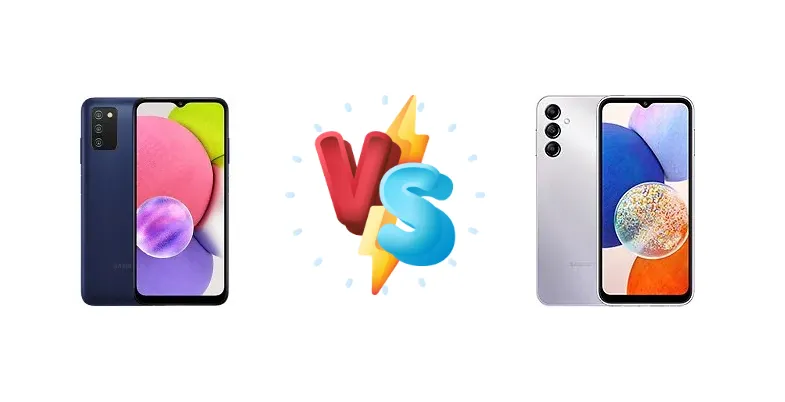
For most users, the Samsung Galaxy A14 5G is the clear winner. The Exynos 1330 (or Dimensity 700 depending on region) provides a substantial performance boost over the Helio P35, and the slightly improved display and battery life add to the value. The A03s remains viable for extremely basic use cases.
| PHONES | ||
|---|---|---|
| Phone Names | Samsung Galaxy A03s | Samsung Galaxy A14 5G |
| Network | ||
|---|---|---|
| 2G bands | GSM 850 / 900 / 1800 / 1900 | GSM 850 / 900 / 1800 / 1900 |
| 3G bands | HSDPA 850 / 900 / 2100 | HSDPA 850 / 900 / 1700(AWS) / 1900 / 2100 |
| 4G bands | 1, 3, 5, 7, 8, 20, 28, 38, 40, 41 | 1, 2, 3, 4, 5, 7, 8, 12, 17, 20, 26, 28, 38, 40, 41, 66 - International |
| 5G bands | - | 2, 5, 66, 77 Sub6/mmWave - USA |
| Speed | HSPA 42.2/5.76 Mbps, LTE Cat4 150/50 Mbps | HSPA, LTE, 5G |
| Technology | GSM / HSPA / LTE | GSM / HSPA / LTE / 5G |
| 2, 4, 5, 7, 12, 13, 14, 25, 26, 41, 66, 71 - SM-A037U | 1, 3, 5, 7, 8, 20, 28, 40, 41, 78 SA/NSA/Sub6 - India | |
| Launch | ||
|---|---|---|
| Announced | 2021, August 18 | 2023, January 04 |
| Status | Available. Released 2021, August 18 | Available. Released 2023, January 12 |
| Body | ||
|---|---|---|
| Build | Glass front, plastic frame, plastic back | Glass front, plastic back, plastic frame |
| Dimensions | 164.2 x 75.9 x 9.1 mm (6.46 x 2.99 x 0.36 in) | 167.7 x 78 x 9.1 mm (6.60 x 3.07 x 0.36 in) |
| SIM | Nano-SIM + Nano-SIM | · Nano-SIM· Nano-SIM + Nano-SIM |
| Weight | 196 g (6.91 oz) | 202 g (7.13 oz) |
| Display | ||
|---|---|---|
| Resolution | 720 x 1600 pixels, 20:9 ratio (~270 ppi density) | 1080 x 2408 pixels, 20:9 ratio (~400 ppi density) |
| Size | 6.5 inches, 102.0 cm2 (~81.8% screen-to-body ratio) | 6.6 inches, 104.9 cm2 (~80.2% screen-to-body ratio) |
| Type | PLS LCD | PLS LCD, 90Hz |
| Platform | ||
|---|---|---|
| CPU | Octa-core (4x2.35 GHz Cortex-A53 & 4x1.8 GHz Cortex-A53) | Octa-core (2x2.4 GHz Cortex-A78 & 6x2.0 GHz Cortex-A55) - SM-A146BOcta-core (2x2.2 GHz Cortex-A76 & 6x2.0 GHz Cortex-A55) - SM-A146P |
| Chipset | Mediatek MT6765 Helio P35 (12 nm) | Exynos 1330 (5 nm) - SM-A146BMediatek Dimensity 700 (7 nm) - SM-A146P |
| GPU | PowerVR GE8320 | Mali-G68 MP2 - SM-A146BMali-G57 MC2 - SM-A146P |
| OS | Android 11, upgradable to Android 13, One UI 5.1 Core | Android 13, upgradable to Android 15, One UI Core 7 |
| Memory | ||
|---|---|---|
| Card slot | microSDXC (dedicated slot) | microSDXC (uses shared SIM slot) - USA onlymicroSDXC (dedicated slot) - International |
| Internal | 32GB 2GB RAM, 32GB 3GB RAM, 32GB 4GB RAM, 64GB 3GB RAM, 64GB 4GB RAM | 64GB 4GB RAM, 128GB 4GB RAM, 128GB 6GB RAM, 128GB 8GB RAM |
| eMMC 5.1 | - | |
| Main Camera | ||
|---|---|---|
| Features | LED flash | LED flash, panorama, HDR |
| Single | 5 MP, f/2.2 | 13 MP, f/2.0, (wide) |
| Triple | 13 MP, f/2.2, (wide), AF 2 MP (macro) Auxiliary lens | 50 MP, f/1.8, 26mm (wide), 1/2.76", 0.64µm, PDAF 2 MP (macro) Auxiliary lens |
| Video | 1080p@30fps | 1080p@30fps |
| Selfie camera | ||
|---|---|---|
| Single | 5 MP, f/2.2 | 13 MP, f/2.0, 26mm (wide), 1.12µm |
| Video | 1080p@30fps | 1080p@30fps |
| Sound | ||
|---|---|---|
| 3.5mm jack | Yes | Yes |
| 35mm jack | Yes | Yes |
| Loudspeaker | Yes | Yes |
| Comms | ||
|---|---|---|
| Bluetooth | 5.0, A2DP | 5.2, A2DP, LE |
| NFC | Yes (market/region dependent) | Yes |
| Positioning | GPS, GLONASS, GALILEO, BDS | GPS, GLONASS, GALILEO |
| Radio | No | FM radio (Exynos 1330 chipset only), recording |
| USB | USB Type-C 2.0 | USB Type-C 2.0 |
| WLAN | Wi-Fi 802.11 b/g/n, Wi-Fi Direct | Wi-Fi 802.11 a/b/g/n/ac, dual-band, Wi-Fi Direct |
| Features | ||
|---|---|---|
| Sensors | Fingerprint (side-mounted), accelerometer, proximity | Fingerprint (side-mounted), accelerometer, gyro, proximity, compass, barometer (USA only) |
| Battery | ||
|---|---|---|
| Charging | 15W wired | 15W wired |
| Type | Li-Po 5000 mAh | Li-Po 5000 mAh |
| Misc | ||
|---|---|---|
| Colors | Black, Blue, White | Black, Light Green, Dark Red, Silver |
| Models | SM-A037F, SM-A037F/DS, SM-A037M, SM-A037G, SM-A037U, SM-S134DL, SM-A037W, SM-A037U1, SM-S135DL | SM-A146B, SM-A146B/DS, SM-A146P, SM-A146P/DS, SM-A146U, SM-A146U1, SM-A146U1/DS, SM-A146W, SM-A146P/N, SM-A146P/DSN, SM-S146VL, SM-A146M |
| Price | $ 65.65 / £ 82.99 / ₹ 10,800 | $ 77.63 / C$ 151.00 / £ 97.00 / € 159.79 / ₹ 14,990 |
| SAR | - | 1.00 W/kg (head) 1.00 W/kg (body) |
| SAR EU | 0.36 W/kg (head) 1.09 W/kg (body) | 0.56 W/kg (head) 1.28 W/kg (body) |
| Tests | ||
|---|---|---|
| Battery life | Endurance rating 122h | Endurance rating 130h |
| Camera | Photo / Video | Photo / Video |
| Display | Contrast ratio: 1718:1 (nominal) | Contrast ratio: 1334:1 (nominal) |
| Loudspeaker | -27.4 LUFS (Good) | -26.8 LUFS (Good) |
| Performance | AnTuTu: 103465 (v8), 101299 (v9) GeekBench: 889 (v5.1) GFXBench: 5.5fps (ES 3.1 onscreen) | AnTuTu: 307886 (v9) GeekBench: 1727 (v5.1) GFXBench: 12fps (ES 3.1 onscreen) |
Samsung Galaxy A03s
- Lowest possible price point
- Decent battery endurance for basic use
- Lightweight and compact
- Poor performance with multitasking
- Outdated processor architecture
- Limited camera capabilities
Samsung Galaxy A14 5G
- Significantly faster processor
- 5G connectivity for faster data speeds
- Brighter and more vibrant display
- Still uses 15W charging
- May have regional chipset variations (Exynos vs Dimensity)
- Larger size and weight compared to A03s
Display Comparison
Both phones feature displays adequate for their price points, but the A14 5G offers a noticeable improvement. While the A03s achieves a respectable 488 nits of peak brightness, the A14 5G pushes this to 519 nits, making it more usable outdoors. Contrast ratios are similar at 1718:1 and 1334:1 respectively, but the A14 5G’s slightly higher brightness contributes to a more vibrant image. Neither display boasts high refresh rates or advanced panel technologies like LTPO, keeping costs down.
Camera Comparison
Both phones list 'Photo / Video' capabilities, but details are sparse. Without specific sensor information, it’s difficult to make a definitive judgment. However, given the A14 5G’s overall hardware improvements, it’s reasonable to assume a better camera experience. The A14 5G likely benefits from more advanced image processing algorithms powered by its superior chipset. It's important to note that the inclusion of a 2MP macro camera on either device offers minimal practical benefit due to its low resolution and lack of optical image stabilization.
Performance
The performance gap is the most significant difference. The A03s’ Mediatek Helio P35, built on a 12nm process, struggles with demanding tasks. Its octa-core CPU, while offering eight cores, relies on older Cortex-A53 architecture. In contrast, the A14 5G utilizes either the Exynos 1330 (5nm) or the Mediatek Dimensity 700 (7nm), both representing substantial architectural leaps. The Exynos 1330’s Cortex-A78 cores provide significantly faster single-core performance, while the Dimensity 700 offers a balanced improvement. The smaller fabrication process (5nm vs 12nm) also translates to better power efficiency and reduced thermal throttling on the A14 5G.
Battery Life
Both the A03s and A14 5G achieve an endurance rating of around 122-130 hours, indicating similar overall battery life. The A14 5G’s slightly larger battery capacity and more efficient chipset offset the increased power draw of 5G connectivity. Both phones are limited to 15W wired charging, meaning 0-100% charge times will be relatively slow – around 2-3 hours. The efficiency gains of the A14 5G’s processor mean it will likely maintain its battery capacity for longer under sustained load.
Buying Guide
Buy the Samsung Galaxy A03s if you absolutely need the lowest possible price point for basic communication – calls, texts, and light social media. It's suitable for first-time smartphone users or as a temporary device. Buy the Samsung Galaxy A14 5G if you want a phone that can handle multitasking, streaming video, and occasional gaming, and if 5G connectivity is a priority. It offers a much more future-proof experience.