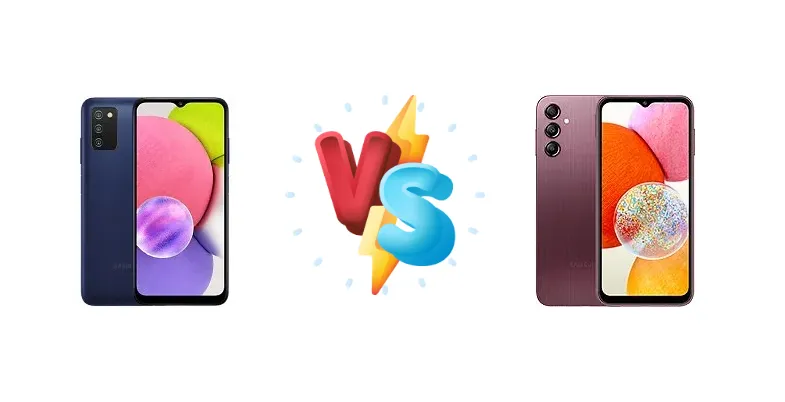
The Samsung Galaxy A03s has been a mainstay in the ultra-budget segment for some time, offering a basic smartphone experience at an incredibly low price. The newer Galaxy A14 aims to improve upon this foundation, but at a slightly higher cost. This comparison dissects the key differences between these two devices, helping you determine if the A14’s upgrades justify the price increase.
🏆 Quick Verdict
For most users, the Samsung Galaxy A14 is the better choice. Its Mediatek Helio G80 (or Exynos 850) chipset provides a significant performance boost over the A03s’ Helio P35, making everyday tasks and even light gaming noticeably smoother. While both offer similar battery endurance, the A14’s improved processing power delivers a more responsive user experience.
| Network |
|---|
| 2G bands | GSM 850 / 900 / 1800 / 1900 | GSM 850 / 900 / 1800 / 1900 |
| 3G bands | HSDPA 850 / 900 / 2100 | HSDPA 850 / 900 / 2100 |
| 4G bands | 1, 3, 5, 7, 8, 20, 28, 38, 40, 41 | 1, 3, 5, 7, 8, 20, 28, 38, 40, 41 |
| Speed | HSPA 42.2/5.76 Mbps, LTE Cat4 150/50 Mbps | HSPA, LTE |
| Technology | GSM / HSPA / LTE | GSM / HSPA / LTE |
| | 2, 4, 5, 7, 12, 13, 14, 25, 26, 41, 66, 71 - SM-A037U | - |
| Launch |
|---|
| Announced | 2021, August 18 | 2023, February 28 |
| Status | Available. Released 2021, August 18 | Available. Released 2023, March 27 |
| Body |
|---|
| Build | Glass front, plastic frame, plastic back | Glass front, plastic back, plastic frame |
| Dimensions | 164.2 x 75.9 x 9.1 mm (6.46 x 2.99 x 0.36 in) | 167.7 x 78 x 9.1 mm (6.60 x 3.07 x 0.36 in) |
| SIM | Nano-SIM + Nano-SIM | · Nano-SIM· Nano-SIM + Nano-SIM |
| Weight | 196 g (6.91 oz) | 201 g (7.09 oz) |
| Display |
|---|
| Resolution | 720 x 1600 pixels, 20:9 ratio (~270 ppi density) | 1080 x 2408 pixels, 20:9 ratio (~400 ppi density) |
| Size | 6.5 inches, 102.0 cm2 (~81.8% screen-to-body ratio) | 6.6 inches, 104.9 cm2 (~80.2% screen-to-body ratio) |
| Type | PLS LCD | PLS LCD |
| Platform |
|---|
| CPU | Octa-core (4x2.35 GHz Cortex-A53 & 4x1.8 GHz Cortex-A53) | Octa-core (2x2.0 GHz Cortex-A75 & 6x1.8 GHz Cortex-A55) - Version AOcta-core (4x2.0 GHz Cortex-A55 & 4x2.0 GHz Cortex-A55) - Version B |
| Chipset | Mediatek MT6765 Helio P35 (12 nm) | Mediatek MT6769 Helio G80 (12 nm) - Version AExynos 850 (8 nm) - Version B |
| GPU | PowerVR GE8320 | Mali-G52 MC2 |
| OS | Android 11, upgradable to Android 13, One UI 5.1 Core | Android 13, upgradable to Android 15, One UI 7 |
| Memory |
|---|
| Card slot | microSDXC (dedicated slot) | microSDXC (dedicated slot) |
| Internal | 32GB 2GB RAM, 32GB 3GB RAM, 32GB 4GB RAM, 64GB 3GB RAM, 64GB 4GB RAM | 64GB 4GB RAM, 128GB 4GB RAM, 128GB 6GB RAM |
| | eMMC 5.1 | - |
| Main Camera |
|---|
| Features | LED flash | LED flash, panorama, HDR |
| Single | 5 MP, f/2.2 | 13 MP, f/2.0, (wide) |
| Triple | 13 MP, f/2.2, (wide), AF
2 MP (macro)
Auxiliary lens | 50 MP, f/1.8, 26mm (wide), 1/2.75", 0.64µm, PDAF
5 MP, f/2.2, 17mm (ultrawide), 1/5.0", 1.12µm
2 MP (macro) |
| Video | 1080p@30fps | 1080p@30fps |
| Selfie camera |
|---|
| Single | 5 MP, f/2.2 | 13 MP, f/2.0, 26mm (wide), 1/3.1", 1.12µm |
| Video | 1080p@30fps | 1080p@30fps |
| Sound |
|---|
| 3.5mm jack | Yes | Yes |
| 35mm jack | Yes | Yes |
| Loudspeaker | Yes | Yes |
| Comms |
|---|
| Bluetooth | 5.0, A2DP | 5.1 or 5.3, A2DP, LE |
| NFC | Yes (market/region dependent) | Yes (market/region dependent) |
| Positioning | GPS, GLONASS, GALILEO, BDS | GPS, GALILEO, GLONASS, BDS, QZSS |
| Radio | No | Unspecified |
| USB | USB Type-C 2.0 | USB Type-C 2.0 |
| WLAN | Wi-Fi 802.11 b/g/n, Wi-Fi Direct | Wi-Fi 802.11 a/b/g/n/ac, dual-band, Wi-Fi Direct |
| Features |
|---|
| Sensors | Fingerprint (side-mounted), accelerometer, proximity | Fingerprint (side-mounted), accelerometer, proximity, compass |
| Battery |
|---|
| Charging | 15W wired | 15W wired |
| Type | Li-Po 5000 mAh | Li-Po 5000 mAh |
| Misc |
|---|
| Colors | Black, Blue, White | Black, Dark Red, Silver, Green |
| Models | SM-A037F, SM-A037F/DS, SM-A037M, SM-A037G, SM-A037U, SM-S134DL, SM-A037W, SM-A037U1, SM-S135DL | SM-A145F, SM-A145F/DSN, SM-A145M, SM-A145M/DS, SM-A145P, SM-A145R |
| Price | $ 65.65 / £ 82.99 / ₹ 10,800 | € 85.76 / $ 147.60 / £ 79.95 |
| SAR EU | 0.36 W/kg (head) 1.09 W/kg (body) | 0.46 W/kg (head) 1.37 W/kg (body) |
| Tests |
|---|
| Battery life |
Endurance rating 122h
| - |
| Camera |
Photo / Video | - |
| Display |
Contrast ratio: 1718:1 (nominal) | - |
| Loudspeaker |
-27.4 LUFS (Good)
| - |
| Performance |
AnTuTu: 103465 (v8), 101299 (v9)
GeekBench: 889 (v5.1)
GFXBench: 5.5fps (ES 3.1 onscreen) | - |
Samsung Galaxy A03s
- Lowest possible price point
- Decent battery endurance (122h)
- Functional for basic tasks
- Slow performance with Helio P35
- Basic camera capabilities
- Limited future-proofing
Samsung Galaxy A14
- Significantly improved performance (Helio G80/Exynos 850)
- More responsive user experience
- Potentially better camera image processing
- Higher price than the A03s
- Charging speed remains at 15W
- Display specifications are not significantly improved
Display Comparison
Both the A03s and A14 feature displays geared towards affordability. The A03s boasts a measured peak brightness of 488 nits and a 1718:1 contrast ratio, providing a reasonably visible experience indoors. While the A14’s display specifications aren’t provided, it’s reasonable to expect similar characteristics given their market positioning. Neither device is expected to offer high color accuracy or advanced features like high refresh rates, focusing instead on delivering a functional visual experience. The A03s’ contrast ratio, while nominal, suggests a basic IPS panel.
Camera Comparison
Both phones are listed as having 'Photo / Video' capabilities, but detailed camera specifications are lacking. Given their price points, it’s safe to assume both rely on basic camera sensors. The A14 likely benefits from improved image processing capabilities due to its more powerful chipset, potentially resulting in better image quality in various lighting conditions. The presence of a 2MP macro camera on the A14 is unlikely to be a significant selling point, as these sensors typically deliver limited detail. The A03s’ camera performance will likely be adequate for casual snapshots but will struggle in low-light scenarios.
Performance
The performance gap is the most significant differentiator. The A03s is powered by the Mediatek Helio P35, a 12nm chipset with an octa-core CPU configuration split between 2.35 GHz and 1.8 GHz Cortex-A53 cores. This is a relatively basic processor designed for light workloads. The A14, however, offers two distinct chipset options: the Mediatek Helio G80 (12nm) and the Exynos 850 (8nm). The Helio G80 features a more modern CPU architecture with 2x2.0 GHz Cortex-A75 and 6x1.8 GHz Cortex-A55 cores, offering a substantial performance improvement. The Exynos 850, built on a smaller 8nm process, further enhances efficiency and performance. This translates to faster app loading times, smoother multitasking, and a more responsive overall experience on the A14.
Battery Life
The Samsung Galaxy A03s achieves an endurance rating of 122 hours, indicating solid battery life for its capacity. The A14’s battery capacity isn’t specified, but given its more powerful processor, a similar endurance rating is plausible. Both devices support 15W wired charging, meaning charge times will be comparable. The A14’s more efficient chipset (particularly the Exynos 850 variant) could potentially offset the power draw, leading to slightly longer real-world battery life despite potentially having a similar capacity.
Buying Guide
Buy the Samsung Galaxy A03s if you absolutely need the lowest possible price and your smartphone usage is limited to basic tasks like calls, texts, and occasional social media browsing. Buy the Samsung Galaxy A14 if you prioritize smoother performance for multitasking, streaming, and gaming, and are willing to spend a little more for a more future-proof device. The A14 is also the better choice for users who anticipate using their phone for more than just essential functions.
Frequently Asked Questions
❓ Does the Exynos 850 version of the A14 noticeably outperform the Helio G80 version?
Yes, the Exynos 850, built on an 8nm process, is generally more efficient and offers slightly better performance than the Helio G80. While both are significant upgrades over the A03s’ Helio P35, the Exynos 850 will provide a smoother experience during demanding tasks and potentially better thermal management.
❓ Is the 2MP macro camera on the A14 worth considering?
Generally, 2MP macro cameras on budget phones offer limited practical benefit. The image quality is often subpar, lacking detail and sharpness. It's unlikely to be a key factor in your purchasing decision.
❓ Will the A14 be able to handle popular mobile games like PUBG or Call of Duty?
The A14, particularly the Exynos 850 version, can handle PUBG and Call of Duty at lower graphics settings. Expect frame rate drops during intense scenes, but it should provide a playable experience. The A03s would struggle significantly with these titles.
❓ Does the A14 support fast charging beyond the 15W standard?
No, both the A03s and A14 are limited to 15W wired charging. While not the fastest charging available, it's adequate for these budget devices.