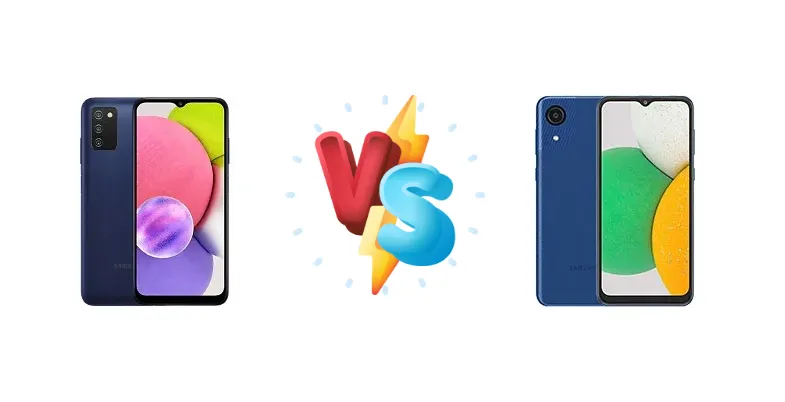
Samsung's A03 series represents the entry point into their smartphone ecosystem. The A03s and A03 Core are both ultra-budget devices, but cater to slightly different priorities. The A03s aims for a balance of features, while the A03 Core focuses on minimizing cost, resulting in significant internal differences that impact real-world performance and usability.
🏆 Quick Verdict
For most users, the Samsung Galaxy A03s is the better choice. Its Mediatek Helio P35 chipset, while not powerful, offers a noticeable performance advantage over the A03 Core’s Unisoc SC9863A, and the measured 488 nits brightness provides a more usable outdoor experience. The A03 Core is only recommended for those on the absolute tightest budget.
| Network |
|---|
| 2G bands | GSM 850 / 900 / 1800 / 1900 | GSM 850 / 900 / 1800 / 1900 |
| 3G bands | HSDPA 850 / 900 / 2100 | HSDPA 850 / 900 / 2100 |
| 4G bands | 1, 3, 5, 7, 8, 20, 28, 38, 40, 41 | 1, 3, 5, 7, 8, 20, 28, 38, 40, 41 |
| Speed | HSPA 42.2/5.76 Mbps, LTE Cat4 150/50 Mbps | HSPA 21.1/5.76 Mbps, LTE |
| Technology | GSM / HSPA / LTE | GSM / HSPA / LTE |
| | 2, 4, 5, 7, 12, 13, 14, 25, 26, 41, 66, 71 - SM-A037U | - |
| Launch |
|---|
| Announced | 2021, August 18 | 2021, November 15 |
| Status | Available. Released 2021, August 18 | Available. Released 2021, December 06 |
| Body |
|---|
| Build | Glass front, plastic frame, plastic back | Plastic back, plastic frame |
| Dimensions | 164.2 x 75.9 x 9.1 mm (6.46 x 2.99 x 0.36 in) | 164.2 x 75.9 x 9.1 mm (6.46 x 2.99 x 0.36 in) |
| SIM | Nano-SIM + Nano-SIM | · Nano-SIM· Nano-SIM + Nano-SIM |
| Weight | 196 g (6.91 oz) | 211 g (7.44 oz) |
| Display |
|---|
| Resolution | 720 x 1600 pixels, 20:9 ratio (~270 ppi density) | 720 x 1600 pixels, 20:9 ratio (~270 ppi density) |
| Size | 6.5 inches, 102.0 cm2 (~81.8% screen-to-body ratio) | 6.5 inches, 102.0 cm2 (~81.8% screen-to-body ratio) |
| Type | PLS LCD | PLS LCD |
| Platform |
|---|
| CPU | Octa-core (4x2.35 GHz Cortex-A53 & 4x1.8 GHz Cortex-A53) | Octa-core (4x1.6 GHz Cortex-A55 & 4x1.2 GHz Cortex-A55) |
| Chipset | Mediatek MT6765 Helio P35 (12 nm) | Unisoc SC9863A (28 nm) |
| GPU | PowerVR GE8320 | IMG8322 |
| OS | Android 11, upgradable to Android 13, One UI 5.1 Core | Android 11 (Go edition) |
| Memory |
|---|
| Card slot | microSDXC (dedicated slot) | microSDXC (dedicated slot) |
| Internal | 32GB 2GB RAM, 32GB 3GB RAM, 32GB 4GB RAM, 64GB 3GB RAM, 64GB 4GB RAM | 32GB 2GB RAM |
| | eMMC 5.1 | eMMC 5.1 |
| Main Camera |
|---|
| Features | LED flash | LED flash |
| Single | 5 MP, f/2.2 | 8 MP, f/2.0, AF |
| Triple | 13 MP, f/2.2, (wide), AF
2 MP (macro)
Auxiliary lens | - |
| Video | 1080p@30fps | 1080p@30fps |
| Selfie camera |
|---|
| Single | 5 MP, f/2.2 | 5 MP, f/2.2 |
| Video | 1080p@30fps | - |
| Sound |
|---|
| 3.5mm jack | Yes | Yes |
| 35mm jack | Yes | Yes |
| Loudspeaker | Yes | Yes |
| Comms |
|---|
| Bluetooth | 5.0, A2DP | 4.2, A2DP |
| NFC | Yes (market/region dependent) | No |
| Positioning | GPS, GLONASS, GALILEO, BDS | GPS, GLONASS |
| Radio | No | Unspecified |
| USB | USB Type-C 2.0 | microUSB 2.0, OTG |
| WLAN | Wi-Fi 802.11 b/g/n, Wi-Fi Direct | Wi-Fi 802.11 b/g/n, Wi-Fi Direct |
| Features |
|---|
| Sensors | Fingerprint (side-mounted), accelerometer, proximity | Accelerometer, proximity |
| Battery |
|---|
| Charging | 15W wired | - |
| Type | Li-Po 5000 mAh | Li-Ion 5000 mAh |
| Misc |
|---|
| Colors | Black, Blue, White | Black, Blue |
| Models | SM-A037F, SM-A037F/DS, SM-A037M, SM-A037G, SM-A037U, SM-S134DL, SM-A037W, SM-A037U1, SM-S135DL | SM-A032F, SM-A032F/DS, SM-A032M |
| Price | $ 65.65 / £ 82.99 / ₹ 10,800 | £ 74.99 |
| SAR | - | 0.30 W/kg (head) |
| SAR EU | 0.36 W/kg (head) 1.09 W/kg (body) | 0.24 W/kg (head) 1.39 W/kg (body) |
| Tests |
|---|
| Battery life |
Endurance rating 122h
| - |
| Camera |
Photo / Video | - |
| Display |
Contrast ratio: 1718:1 (nominal) | - |
| Loudspeaker |
-27.4 LUFS (Good)
| - |
| Performance |
AnTuTu: 103465 (v8), 101299 (v9)
GeekBench: 889 (v5.1)
GFXBench: 5.5fps (ES 3.1 onscreen) | - |
Samsung Galaxy A03s
- Better performance with the Helio P35 chipset
- Brighter display for improved visibility
- Faster 15W charging
- Longer battery endurance (122h)
- Still a budget device with limited features
- Camera performance likely basic
Samsung Galaxy A03 Core
- Lower price point
- Potentially more power efficient CPU cores (A55)
- Lightweight and compact
- Acceptable for basic tasks
- Significantly slower performance
- Likely dimmer display
- Slower charging
- Potentially shorter battery life
Display Comparison
The Samsung Galaxy A03s boasts a measured peak brightness of 488 nits and a 1718:1 contrast ratio, offering a significantly more vibrant and visible display than the A03 Core, for which display specifications are not provided. This difference is crucial for outdoor visibility and overall viewing comfort. While both likely utilize LCD panels, the A03s’ higher brightness makes it the clear winner for users who spend time outdoors. The lack of detailed display information for the A03 Core suggests a cost-cutting measure in this area.
Camera Comparison
Both devices are listed as having 'Photo / Video' capabilities, but detailed camera specifications are absent. Given their price points, it’s safe to assume both feature basic camera setups. The A03s likely has a slightly more capable sensor due to the overall higher specification of the device. However, without knowing sensor sizes, apertures, or image processing algorithms, a definitive comparison is impossible. It’s reasonable to expect similar image quality, with neither phone excelling in low-light conditions.
Performance
The core difference between these two devices lies in their chipsets. The A03s is powered by the Mediatek MT6765 Helio P35, a 12nm octa-core processor with a CPU configuration of 4x2.35 GHz Cortex-A53 and 4x1.8 GHz Cortex-A53 cores. In contrast, the A03 Core utilizes the Unisoc SC9863A, a 28nm octa-core processor with a CPU configuration of 4x1.6 GHz Cortex-A55 and 4x1.2 GHz Cortex-A55 cores. The Helio P35’s newer architecture and higher clock speeds, combined with the smaller 12nm manufacturing process, translate to demonstrably better performance. The A03 Core’s 28nm process is older and less efficient, resulting in lower performance and potentially higher power consumption. The Cortex-A55 cores in the A03 Core are more efficient than the A53 cores in the A03s, but the lower clock speeds and older process node negate this advantage.
Battery Life
The Samsung Galaxy A03s has an endurance rating of 122 hours, indicating solid battery life. While the A03 Core’s battery capacity and endurance rating are not provided, the less efficient Unisoc SC9863A chipset suggests it will likely have shorter battery life. The A03s also supports 15W wired charging, offering a faster charging experience than the A03 Core, which likely has a slower charging rate. The A03s’ combination of decent battery life and faster charging provides a more convenient user experience.
Buying Guide
Buy the Samsung Galaxy A03s if you need a phone capable of handling basic multitasking, social media, and occasional gaming without significant lag. It’s a better option for users who value a brighter display and a slightly smoother user experience. Buy the Samsung Galaxy A03 Core if your primary needs are making calls, sending texts, and very light app usage, and you prioritize the lowest possible price point above all else.
Frequently Asked Questions
❓ Will the Unisoc SC9863A in the A03 Core struggle with popular apps like Facebook or WhatsApp?
Yes, the Unisoc SC9863A is a very low-end chipset. While it can handle basic apps like Facebook and WhatsApp, you may experience noticeable lag and slowdowns, especially when multitasking or using more demanding features within those apps. The A03s with its Helio P35 will provide a smoother experience.
❓ Is the lack of detailed camera specs on both phones a concern?
Yes, it is. It indicates that neither phone is designed for serious photography. Expect basic image quality suitable for casual snapshots in good lighting conditions. Don't expect impressive low-light performance or detailed images.
❓ Does the Samsung Galaxy A03s support fast charging beyond 15W?
No, the Samsung Galaxy A03s officially supports up to 15W wired charging. While it might technically accept a higher wattage charger, it will only draw power at the 15W rate. Using a higher wattage charger won't result in faster charging times.
❓ How does the older 28nm process of the Unisoc SC9863A affect the A03 Core's battery life?
The 28nm process is less efficient than the 12nm process used in the Helio P35. This means the Unisoc SC9863A consumes more power to perform the same tasks, leading to potentially shorter battery life in the A03 Core, even if the battery capacity is similar.