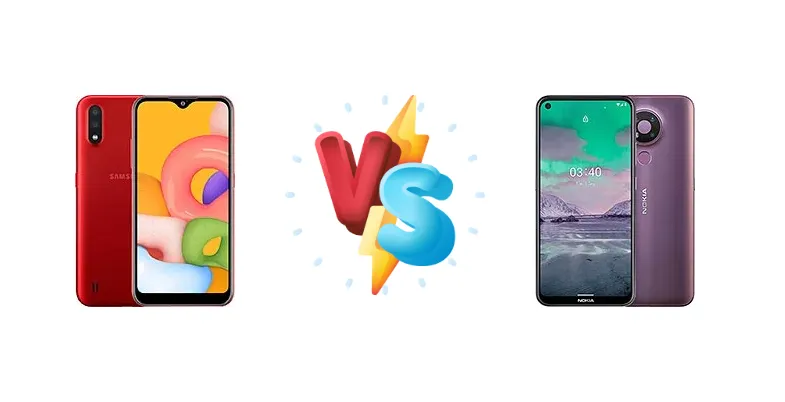
The Samsung Galaxy A01 and Nokia 3.4 represent the extreme end of the smartphone price spectrum. Both aim to deliver a connected experience at a minimal cost, but they achieve this with different approaches to hardware. This comparison dissects their core components to determine which offers the best value for users prioritizing affordability.
🏆 Quick Verdict
For most users, the Nokia 3.4 emerges as the better choice. While both phones are undeniably budget-focused, the Nokia 3.4’s newer Snapdragon 460 chipset, built on an 11nm process, provides a noticeable performance uplift over the A01’s older Snapdragon 439, making it more responsive for everyday tasks.
| Network |
|---|
| 2G bands | GSM 850 / 900 / 1800 / 1900 | GSM 850 / 900 / 1800 / 1900 |
| 3G bands | HSDPA 850 / 900 / 2100 | HSDPA 850 / 900 / 1700(AWS) / 1900 / 2100 |
| 4G bands | 1, 3, 5, 7, 8, 20, 28, 38, 40, 41 | 1, 2, 3, 4, 5, 7, 8, 12, 17, 13, 28, 66 |
| Speed | HSPA 42.2/5.76 Mbps, LTE Cat4 150/50 Mbps | HSPA, LTE |
| Technology | GSM / HSPA / LTE | GSM / HSPA / LTE |
| | 1, 2, 3, 4, 5, 7, 8, 12, 17, 28 - SM-A015M | - |
| Launch |
|---|
| Announced | 2019, December 17. Released 2020, January | 2020, September 22. Released 2020, October 26 |
| Status | Discontinued | Discontinued |
| Body |
|---|
| Build | Glass front, plastic back, plastic frame | - |
| Dimensions | 146.2 x 70.9 x 8.3 mm (5.76 x 2.79 x 0.33 in) | 161 x 76 x 8.7 mm (6.34 x 2.99 x 0.34 in) |
| SIM | · Nano-SIM· Nano-SIM + Nano-SIM | · Nano-SIM· Nano-SIM + Nano-SIM |
| Weight | 149 g (5.26 oz) | 180 g (6.35 oz) |
| Display |
|---|
| Resolution | 720 x 1520 pixels, 19:9 ratio (~294 ppi density) | 720 x 1560 pixels, 19.5:9 ratio (~269 ppi density) |
| Size | 5.7 inches, 81.6 cm2 (~78.8% screen-to-body ratio) | 6.39 inches, 100.2 cm2 (~81.9% screen-to-body ratio) |
| Type | PLS LCD | IPS LCD, 400 nits (typ) |
| Platform |
|---|
| CPU | Octa-core (4x1.95 GHz Cortex-A53 & 4x1.45 GHz Cortex A53) | Octa-core (4x1.8 GHz Cortex-A73 & 4x1.8 GHz Cortex-A53) |
| Chipset | Qualcomm SDM439 Snapdragon 439 (12 nm) | Qualcomm SM4250 Snapdragon 460 (11 nm) |
| GPU | Adreno 505 | Adreno 610 |
| OS | Android 10, upgradable to Android 12, One UI Core 4.1 | Android 10, upgradable to Android 11 |
| Memory |
|---|
| Card slot | microSDXC (dedicated slot) | microSDXC (dedicated slot) |
| Internal | 16GB 2GB RAM, 32GB 2GB RAM | 32GB 3GB RAM, 64GB 3GB RAM, 64GB 4GB RAM |
| | eMMC 5.1 | eMMC 5.1 |
| Main Camera |
|---|
| Dual | 13 MP, f/2.2, 28mm (wide), 1/3.1", 1.12µm, AF
Auxiliary lens | - |
| Features | LED flash | LED flash, HDR, panorama |
| Triple | - | 13 MP, (wide), PDAF
5 MP, (ultrawide)
Auxiliary lens |
| Video | 1080p@30fps | 1080p@30fps |
| Selfie camera |
|---|
| Single | 5 MP, f/2.2, 1/5.0", 1.12µm | 8 MP, (wide) |
| Video | Yes | 1080p@30fps |
| Sound |
|---|
| 3.5mm jack | Yes | Yes |
| 35mm jack | Yes | Yes |
| Loudspeaker | Yes | Yes |
| Comms |
|---|
| Bluetooth | 4.2, A2DP, LE | 4.2, A2DP, aptX |
| NFC | No | Yes (market/region dependent) |
| Positioning | GPS, GLONASS, GALILEO, BDS | GPS, GLONASS, GALILEO, BDS |
| Radio | FM radio, RDS, recording | FM radio |
| USB | microUSB 2.0 | USB Type-C 2.0 |
| WLAN | Wi-Fi 802.11 b/g/n, Wi-Fi Direct | Wi-Fi 802.11 b/g/n |
| Features |
|---|
| Sensors | Accelerometer, proximity | Fingerprint (rear-mounted), accelerometer, gyro, proximity |
| Battery |
|---|
| Charging | - | 10W wired |
| Type | Li-Ion 3000 mAh, non-removable | Li-Po 4000 mAh |
| Misc |
|---|
| Colors | Black, Blue, Red | Fjord, Dusk, Charcoal |
| Models | SM-A015F, SM-A015F/DS, SM-A015G, SM-A015G/DS, SM-A015M, SM-A015M/DS, SM-A015T1, SM-S111DL, SM-A015V, SM-A015A, SM-A015AZ, SM-A015U, SM-A015U1 | TA-1288, TA-1285, TA-1283 |
| Price | About 200 EUR | About 100 EUR |
| SAR | - | 0.83 W/kg (head) 1.05 W/kg (body) |
| SAR EU | 0.35 W/kg (head) 1.56 W/kg (body) | 0.36 W/kg (head) 1.56 W/kg (body) |
| Pricing |
|---|
| 16GB 2GB RAM | $ 72.90 | - |
| RENEWED | $ 88.00 | - |
Samsung Galaxy A01
- Lowest possible price point
- Functional for basic communication
- Compact size
- Outdated Snapdragon 439 chipset
- Limited performance
- Likely poor camera quality
Nokia 3.4
- More powerful Snapdragon 460 chipset
- Improved performance and efficiency
- More modern Android experience
- Still limited by 2GB of RAM
- Slow 10W charging
- Budget build quality
Display Comparison
Neither Samsung nor Nokia provide display specifications beyond resolution in their marketing materials for these models. Given their price points, both likely utilize LCD panels. However, the A01’s reliance on the older Snapdragon 439 suggests a less capable display driver, potentially resulting in lower brightness and less accurate color reproduction compared to the Nokia 3.4. Bezels are expected to be substantial on both devices, reflecting their budget nature.
Camera Comparison
Both devices are likely to feature basic camera systems. Without detailed sensor information, it’s difficult to make precise comparisons. However, given the A01’s age and price, its camera performance is likely to be inferior to the Nokia 3.4. The Nokia 3.4 benefits from the newer image signal processor (ISP) within the Snapdragon 460, which should result in better image processing, particularly in low-light conditions. Expect both to struggle with dynamic range and detail, but the Nokia 3.4 should offer a more consistently usable camera experience.
Performance
The core difference lies in the chipsets. The Nokia 3.4’s Snapdragon 460 (11nm) is a clear upgrade over the Galaxy A01’s Snapdragon 439 (12nm). The 11nm process allows for greater transistor density and improved power efficiency. Crucially, the 460 features Cortex-A73 cores in its CPU configuration (4x1.8 GHz), offering significantly better single-core performance than the A01’s all-Cortex-A53 setup (4x1.95 GHz & 4x1.45 GHz). This translates to snappier app launches and smoother scrolling. While both phones have 2GB of RAM, the superior CPU architecture of the Nokia 3.4 will mitigate the limitations of this small amount of memory more effectively.
Battery Life
Battery capacity isn’t specified for either device in the provided data. However, the Snapdragon 460’s 11nm process offers better power efficiency than the Snapdragon 439’s 12nm process. This, combined with the Nokia 3.4’s 10W wired charging, suggests it will likely offer comparable or slightly better battery life despite potentially having a similar capacity battery. The A01’s less efficient chipset will drain the battery faster under similar usage scenarios.
Buying Guide
Buy the Samsung Galaxy A01 if you absolutely need the lowest possible price and are comfortable with a very basic user experience. It’s a functional device for essential communication. Buy the Nokia 3.4 if you prioritize smoother multitasking, a slightly more modern chipset, and a more future-proofed Android experience, even if it means spending a little more.
Frequently Asked Questions
❓ Will the Nokia 3.4 handle popular social media apps like Facebook and Instagram smoothly?
The Snapdragon 460 in the Nokia 3.4 is significantly better equipped to handle social media apps than the Snapdragon 439 in the A01. While 2GB of RAM is still limiting, the A73 cores in the 460 will provide a more responsive experience when scrolling through feeds and loading content.
❓ Is the Nokia 3.4 a good choice for mobile gaming?
Neither phone is ideal for gaming. However, the Nokia 3.4’s Snapdragon 460 will offer a slightly better experience with less demanding titles. Expect to play at low settings and frame rates, and don't expect to run graphically intensive games smoothly. The A01 will struggle even with basic games.
❓ Does the Samsung Galaxy A01 support software updates?
Given its age and position in Samsung’s lineup, the Galaxy A01 is unlikely to receive significant software updates. It may have received one major Android update, but ongoing security patches are doubtful. The Nokia 3.4, benefiting from Nokia’s Android One program, is guaranteed at least two years of Android version upgrades and three years of security updates.