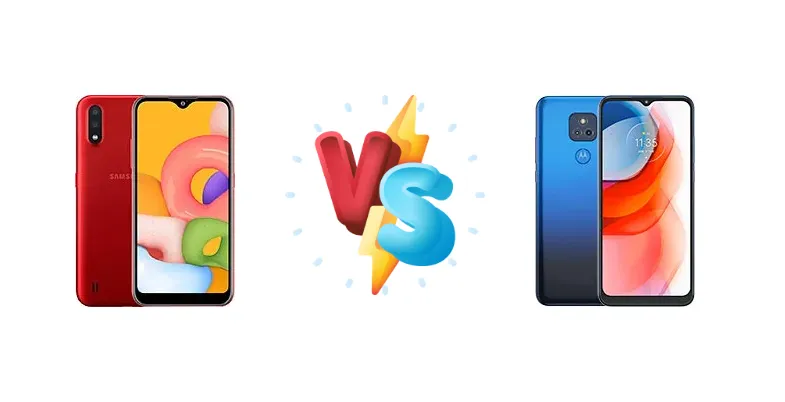
The sub-$100 smartphone market is fiercely competitive. Both the Samsung Galaxy A01 and the Motorola Moto G Play (2021) aim to deliver essential smartphone functionality at an incredibly low price point. However, they achieve this with different approaches to chipset selection and feature prioritization, making a direct comparison crucial for budget-conscious buyers.
🏆 Quick Verdict
For most users, the Motorola Moto G Play (2021) is the better choice. Its newer Snapdragon 460 chipset, built on an 11nm process, offers a noticeable performance advantage over the Galaxy A01’s Snapdragon 439, despite both utilizing Cortex-A53 cores. While neither phone excels in any single area, the Moto G Play provides a more modern and responsive experience.
| Network |
|---|
| 2G bands | GSM 850 / 900 / 1800 / 1900 | GSM 850 / 900 / 1800 / 1900 |
| 3G bands | HSDPA 850 / 900 / 2100 | HSDPA 850 / 900 / 1700(AWS) / 1900 / 2100 |
| 4G bands | 1, 3, 5, 7, 8, 20, 28, 38, 40, 41 | 1, 2, 3, 4, 5, 7, 8, 12, 13, 17, 25, 26, 38, 41, 66, 71 |
| Speed | HSPA 42.2/5.76 Mbps, LTE Cat4 150/50 Mbps | HSPA, LTE |
| Technology | GSM / HSPA / LTE | GSM / CDMA / HSPA / LTE |
| | 1, 2, 3, 4, 5, 7, 8, 12, 17, 28 - SM-A015M | 2, 4, 5, 12, 14, 30, 66 |
| Launch |
|---|
| Announced | 2019, December 17. Released 2020, January | 2021, January 08 |
| Status | Discontinued | Available. Released 2021, January 14 |
| Body |
|---|
| Build | Glass front, plastic back, plastic frame | Plastic frame, plastic back |
| Dimensions | 146.2 x 70.9 x 8.3 mm (5.76 x 2.79 x 0.33 in) | 166.6 x 76 x 9.4 mm (6.56 x 2.99 x 0.37 in) |
| SIM | · Nano-SIM· Nano-SIM + Nano-SIM | Nano-SIM |
| Weight | 149 g (5.26 oz) | 204 g (7.20 oz) |
| | - | Water-repellent coating |
| Display |
|---|
| Resolution | 720 x 1520 pixels, 19:9 ratio (~294 ppi density) | 720 x 1600 pixels, 20:9 ratio (~270 ppi density) |
| Size | 5.7 inches, 81.6 cm2 (~78.8% screen-to-body ratio) | 6.5 inches, 102.0 cm2 (~80.6% screen-to-body ratio) |
| Type | PLS LCD | IPS LCD |
| Platform |
|---|
| CPU | Octa-core (4x1.95 GHz Cortex-A53 & 4x1.45 GHz Cortex A53) | Octa-core (4x1.8 GHz Kryo 240 & 4x1.6 GHz Kryo 240) |
| Chipset | Qualcomm SDM439 Snapdragon 439 (12 nm) | Qualcomm SM4250 Snapdragon 460 (11 nm) |
| GPU | Adreno 505 | Adreno 610 |
| OS | Android 10, upgradable to Android 12, One UI Core 4.1 | Android 10 |
| Memory |
|---|
| Card slot | microSDXC (dedicated slot) | microSDXC (dedicated slot) |
| Internal | 16GB 2GB RAM, 32GB 2GB RAM | 32GB 3GB RAM |
| | eMMC 5.1 | eMMC 5.1 |
| Main Camera |
|---|
| Dual | 13 MP, f/2.2, 28mm (wide), 1/3.1", 1.12µm, AF
Auxiliary lens | 13 MP, f/2.0, (wide), 1/3.1", 1.12µm, PDAF
Auxiliary lens |
| Features | LED flash | LED flash, HDR, panorama |
| Video | 1080p@30fps | 1080p@30/60fps |
| Selfie camera |
|---|
| Features | - | HDR |
| Single | 5 MP, f/2.2, 1/5.0", 1.12µm | 5 MP, f/2.2, (wide), 1.12µm |
| Video | Yes | 1080p@30fps |
| Sound |
|---|
| 3.5mm jack | Yes | Yes |
| 35mm jack | Yes | Yes |
| Loudspeaker | Yes | Yes |
| Comms |
|---|
| Bluetooth | 4.2, A2DP, LE | 5.0, A2DP, LE |
| NFC | No | No |
| Positioning | GPS, GLONASS, GALILEO, BDS | GPS, GLONASS, GALILEO |
| Radio | FM radio, RDS, recording | Unspecified |
| USB | microUSB 2.0 | USB Type-C 2.0 |
| WLAN | Wi-Fi 802.11 b/g/n, Wi-Fi Direct | Wi-Fi 802.11 a/b/g/n/ac, dual-band, Wi-Fi Direct |
| Features |
|---|
| Sensors | Accelerometer, proximity | Fingerprint (rear-mounted), accelerometer, proximity |
| Battery |
|---|
| Charging | - | 10W wired |
| Type | Li-Ion 3000 mAh, non-removable | Li-Po 5000 mAh |
| Misc |
|---|
| Colors | Black, Blue, Red | Misty Blue |
| Models | SM-A015F, SM-A015F/DS, SM-A015G, SM-A015G/DS, SM-A015M, SM-A015M/DS, SM-A015T1, SM-S111DL, SM-A015V, SM-A015A, SM-A015AZ, SM-A015U, SM-A015U1 | XT2093-3, XT2093-7, XT2093-DL, XT2093DL |
| Price | About 200 EUR | About 60 EUR |
| SAR EU | 0.35 W/kg (head) 1.56 W/kg (body) | - |
| Pricing |
|---|
| 16GB 2GB RAM | $ 72.90 | - |
| RENEWED | $ 88.00 | - |
Samsung Galaxy A01
- Lowest possible price point
- Compact size for easy handling
- Samsung brand recognition
- Outdated Snapdragon 439 chipset
- Limited RAM (2GB)
- Smaller battery capacity
Motorola Moto G Play (2021)
- More powerful Snapdragon 460 chipset
- Larger 5000mAh battery
- 3GB of RAM for smoother multitasking
- Still a budget device with limitations
- 10W charging is relatively slow
- Basic camera performance
Display Comparison
Neither Samsung nor Motorola provide detailed display specifications for these models. Given their price points, both likely utilize LCD panels with 720p+ resolutions. The A01’s display size is 6.5 inches, while the Moto G Play (2021) features a slightly smaller 6.5-inch display. Without specific brightness data, it’s difficult to determine a clear winner, but the newer Moto G Play likely benefits from minor panel improvements. Bezels are expected to be substantial on both devices.
Camera Comparison
Camera performance on both devices is expected to be basic. Both phones feature a primary camera, but details are sparse. The Moto G Play (2021) has a 13MP main camera, while the A01 has a 13MP main camera. Both also include depth sensors and macro lenses, which are of limited utility. Image processing will likely be heavily reliant on software algorithms, and image quality will be heavily dependent on lighting conditions. Neither phone offers Optical Image Stabilization (OIS).
Performance
The core difference lies in the chipsets. The Motorola Moto G Play (2021) utilizes the Qualcomm Snapdragon 460 (11nm), while the Samsung Galaxy A01 is equipped with the older Snapdragon 439 (12nm). While both are octa-core CPUs with a similar core configuration (4x high-performance, 4x efficiency), the 460’s newer architecture and smaller manufacturing process provide a performance edge. The Snapdragon 460’s Kryo 240 cores, while still based on Cortex-A53, are optimized for efficiency and responsiveness. The 12nm process of the SD439 consumes more power for similar tasks. The Moto G Play’s 3GB of RAM (versus the A01’s 2GB) further contributes to a smoother multitasking experience.
Battery Life
The Motorola Moto G Play (2021) packs a 5000mAh battery, while the Samsung Galaxy A01 has a 3000mAh battery. The larger capacity of the Moto G Play provides significantly longer battery life. However, the Snapdragon 460 is more power-efficient, further extending its runtime. The Moto G Play supports 10W wired charging, while the A01’s charging speed is unspecified but likely similar. The larger battery and more efficient chipset give the Moto G Play a clear advantage in real-world usage.
Buying Guide
Buy the Samsung Galaxy A01 if you absolutely need the lowest possible upfront cost and are primarily using the phone for very basic tasks like calls, texts, and light social media. Buy the Motorola Moto G Play (2021) if you prioritize a smoother user experience, slightly better performance for app loading and multitasking, and the benefit of a more recent chipset architecture, even if it means spending a little more.
Frequently Asked Questions
❓ Will the Motorola Moto G Play (2021) handle popular apps like Facebook and WhatsApp smoothly?
Yes, the Snapdragon 460 and 3GB of RAM in the Moto G Play (2021) are sufficient for running social media apps like Facebook and WhatsApp without significant lag. While it won't offer a flagship-level experience, it provides a usable and responsive experience for these common tasks.
❓ Is the 2MP macro camera on either phone worth using?
Generally, no. 2MP macro cameras on budget phones typically produce low-resolution, soft images with limited detail. They are often included as a marketing feature but offer minimal practical benefit in most shooting scenarios. The primary 13MP camera will deliver far superior results in most cases.
❓ How long does the Motorola Moto G Play (2021) typically last on a single charge?
The Moto G Play (2021)'s 5000mAh battery, combined with the efficient Snapdragon 460, can easily last a full day of moderate use, including browsing, social media, and calls. Users can expect 8-10 hours of screen-on time, depending on usage patterns.
❓ Can the Samsung Galaxy A01 run modern mobile games?
The Galaxy A01 can run some less demanding mobile games, but performance will be limited by the Snapdragon 439. Expect low frame rates and potential stuttering in more graphically intensive titles. It's best suited for casual gaming rather than demanding 3D games.