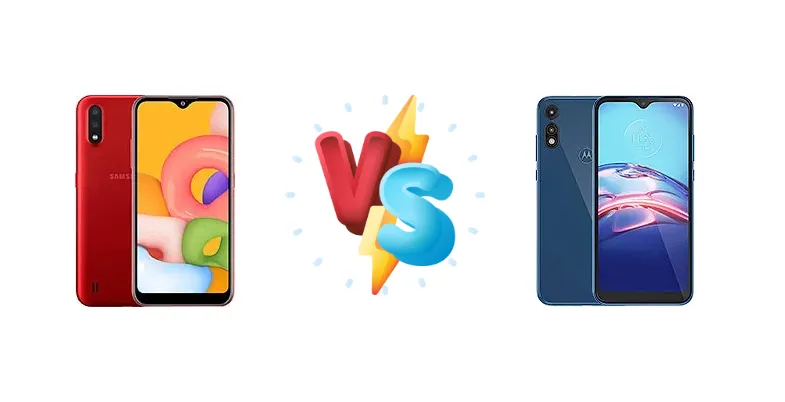
The Samsung Galaxy A01 and Motorola Moto E (2020) represent the absolute entry point into smartphone ownership. Both devices aim to deliver essential functionality at an incredibly low price, but they achieve this with different approaches to hardware. This comparison dissects their core components to determine which offers the best experience for the budget-conscious consumer.
🏆 Quick Verdict
For the average user, the Motorola Moto E (2020) is the better choice. While both phones are limited by their price point, the Moto E’s Snapdragon 632 chipset, built on a more efficient 14nm process, provides a noticeable performance advantage and better thermal management compared to the A01’s Snapdragon 439.
| Network |
|---|
| 2G bands | GSM 850 / 900 / 1800 / 1900 | GSM 850 / 900 / 1800 / 1900 |
| 3G bands | HSDPA 850 / 900 / 2100 | HSDPA 850 / 900 / 1700(AWS) / 1900 / 2100 |
| 4G bands | 1, 3, 5, 7, 8, 20, 28, 38, 40, 41 | 1, 2, 3, 4, 5, 7, 8, 12, 13, 14, 17, 25, 26, 30, 66, 71 |
| Speed | HSPA 42.2/5.76 Mbps, LTE Cat4 150/50 Mbps | HSPA, LTE |
| Technology | GSM / HSPA / LTE | GSM / CDMA / HSPA / EVDO / LTE |
| | 1, 2, 3, 4, 5, 7, 8, 12, 17, 28 - SM-A015M | CDMA2000 1xEV-DO |
| Launch |
|---|
| Announced | 2019, December 17. Released 2020, January | 2020, June 05. Released 2020, June 10 |
| Status | Discontinued | Discontinued |
| Body |
|---|
| Build | Glass front, plastic back, plastic frame | Glass front, plastic back, plastic frame |
| Dimensions | 146.2 x 70.9 x 8.3 mm (5.76 x 2.79 x 0.33 in) | 159.8 x 76.6 x 8.7 mm (6.29 x 3.02 x 0.34 in) |
| SIM | · Nano-SIM· Nano-SIM + Nano-SIM | Nano-SIM |
| Weight | 149 g (5.26 oz) | 185 g (6.53 oz) |
| | - | Water-repellent coating |
| Display |
|---|
| Resolution | 720 x 1520 pixels, 19:9 ratio (~294 ppi density) | 720 x 1520 pixels, 19:9 ratio (~271 ppi density) |
| Size | 5.7 inches, 81.6 cm2 (~78.8% screen-to-body ratio) | 6.2 inches, 95.9 cm2 (~78.4% screen-to-body ratio) |
| Type | PLS LCD | IPS LCD |
| Platform |
|---|
| CPU | Octa-core (4x1.95 GHz Cortex-A53 & 4x1.45 GHz Cortex A53) | Octa-core (4x1.8 GHz Kryo 250 Gold & 4x1.8 GHz Kryo 250 Silver) |
| Chipset | Qualcomm SDM439 Snapdragon 439 (12 nm) | Qualcomm SDM632 Snapdragon 632 (14 nm) |
| GPU | Adreno 505 | Adreno 506 |
| OS | Android 10, upgradable to Android 12, One UI Core 4.1 | Android 10 |
| Memory |
|---|
| Card slot | microSDXC (dedicated slot) | microSDXC (dedicated slot) |
| Internal | 16GB 2GB RAM, 32GB 2GB RAM | 32GB 2GB RAM, 32GB 3GB RAM |
| | eMMC 5.1 | eMMC 5.1 |
| Main Camera |
|---|
| Dual | 13 MP, f/2.2, 28mm (wide), 1/3.1", 1.12µm, AF
Auxiliary lens | 13 MP, f/2.0, 1/3.1", 1.12µm, PDAF
Auxiliary lens |
| Features | LED flash | LED flash, HDR, panorama |
| Video | 1080p@30fps | 1080p@30/60fps |
| Selfie camera |
|---|
| Features | - | HDR |
| Single | 5 MP, f/2.2, 1/5.0", 1.12µm | 5 MP, f/2.0, 1.12µm |
| Video | Yes | 1080p@30fps |
| Sound |
|---|
| 3.5mm jack | Yes | Yes |
| 35mm jack | Yes | Yes |
| Loudspeaker | Yes | Yes |
| Comms |
|---|
| Bluetooth | 4.2, A2DP, LE | 4.2, A2DP, LE |
| NFC | No | No |
| Positioning | GPS, GLONASS, GALILEO, BDS | GPS, GLONASS, GALILEO |
| Radio | FM radio, RDS, recording | FM radio |
| USB | microUSB 2.0 | microUSB 2.0 |
| WLAN | Wi-Fi 802.11 b/g/n, Wi-Fi Direct | Wi-Fi 802.11 a/b/g/n, dual-band |
| Features |
|---|
| Sensors | Accelerometer, proximity | Fingerprint (rear-mounted), accelerometer, proximity, compass |
| Battery |
|---|
| Type | Li-Ion 3000 mAh, non-removable | Li-Po 3550 mAh |
| Misc |
|---|
| Colors | Black, Blue, Red | Midnight Blue |
| Models | SM-A015F, SM-A015F/DS, SM-A015G, SM-A015G/DS, SM-A015M, SM-A015M/DS, SM-A015T1, SM-S111DL, SM-A015V, SM-A015A, SM-A015AZ, SM-A015U, SM-A015U1 | XT2052DL |
| Price | About 200 EUR | About 90 EUR |
| SAR EU | 0.35 W/kg (head) 1.56 W/kg (body) | - |
| Pricing |
|---|
| 16GB 2GB RAM | $ 72.90 | - |
| RENEWED | $ 88.00 | - |
Samsung Galaxy A01
- Recognizable Samsung brand
- Potentially slightly more compact form factor
- Lower initial price (depending on retailer)
- Less powerful Snapdragon 439 chipset
- Less efficient processor leading to potential throttling
- Smaller battery capacity
Motorola Moto E (2020)
- More efficient Snapdragon 632 chipset
- Larger battery capacity for potentially longer runtime
- Smoother overall performance
- Less brand recognition compared to Samsung
- Slightly larger form factor
- May be slightly more expensive
Display Comparison
Neither Samsung nor Motorola provide detailed display specifications for these models. However, given their price points, both likely utilize LCD panels with 720p+ resolutions. The A01’s smaller screen size (typically 5.7 inches) may result in a slightly higher pixel density than the Moto E’s 6.1-inch display, but the difference will be minimal. Expect both to suffer from limited brightness and narrow viewing angles. Color accuracy is unlikely to be a strong point on either device.
Camera Comparison
Camera performance on both devices is expected to be basic. Details on sensor sizes are scarce, but both likely feature a primary camera around 13MP. The Moto E may have a slight edge due to Qualcomm’s image signal processing capabilities within the Snapdragon 632. Both phones likely include secondary cameras (depth or macro) of very low resolution (2MP), which offer limited practical value. Image quality will be acceptable in good lighting conditions, but expect significant noise and a lack of detail in low light.
Performance
The core difference lies in the chipsets. The Motorola Moto E (2020) features the Qualcomm Snapdragon 632 (14nm), an octa-core processor with a Kryo 250 architecture. This chip utilizes a big.LITTLE configuration with 4x1.8 GHz Kryo 250 Gold cores for performance and 4x1.8 GHz Kryo 250 Silver cores for efficiency. The Samsung Galaxy A01, conversely, is equipped with the Snapdragon 439 (12nm), also an octa-core processor, but using older Cortex-A53 cores clocked at 1.95 GHz and 1.45 GHz. The 14nm process of the SD632 is more efficient, leading to better sustained performance and less heat generation. While the A01’s clock speeds appear higher, the architectural advantages of the Kryo cores in the Moto E translate to a smoother user experience, especially when multitasking. Both phones are paired with 2GB of RAM, which will limit multitasking capabilities on both devices.
Battery Life
The Motorola Moto E (2020) typically includes a 4000mAh battery, while the Samsung Galaxy A01 usually has a 3000mAh battery. However, battery life isn’t solely determined by capacity. The Snapdragon 632’s superior power efficiency means the Moto E will likely offer comparable or even better battery life despite the smaller capacity. Charging speeds are slow on both devices, likely limited to 10W, meaning a full charge will take several hours.
Buying Guide
Buy the Samsung Galaxy A01 if your primary need is a recognizable brand name and you prioritize minimal app usage – think basic calling, texting, and light social media. Buy the Motorola Moto E (2020) if you want a phone that feels more responsive for everyday tasks, can handle slightly more demanding apps, and offers a more future-proofed experience within this ultra-budget segment.
Frequently Asked Questions
❓ Will the Snapdragon 439 in the Galaxy A01 struggle with popular apps like Facebook or WhatsApp?
Yes, the Snapdragon 439 is a very basic processor. While it can handle these apps, you may experience noticeable lag and slowdowns, especially when multitasking or using the apps for extended periods. The Moto E’s Snapdragon 632 will provide a significantly smoother experience.
❓ Is the Motorola Moto E (2020) a good choice for mobile gaming?
The Moto E (2020) is not ideal for demanding mobile games. While it can run simpler games, you’ll need to lower graphics settings significantly and still expect occasional frame drops. The Snapdragon 632 offers a slight advantage over the A01, but neither phone is designed for serious gaming.
❓ How long will software updates be supported on these devices?
Software update support is limited on both devices. Both Samsung and Motorola typically provide only one major Android update for phones in this price range. Expect security updates to be infrequent or non-existent after a year or two.
❓ Does either phone support fast charging?
Neither the Samsung Galaxy A01 nor the Motorola Moto E (2020) support fast charging. Both are limited to standard 10W charging, meaning a full charge will take several hours.