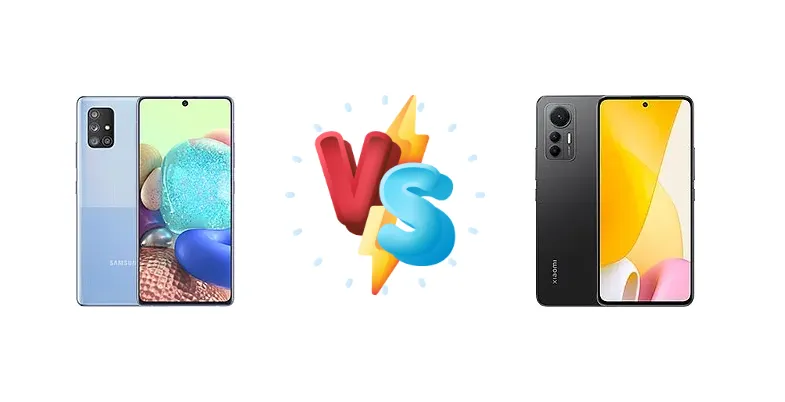
The Samsung Galaxy A Quantum and Xiaomi 12 Lite represent distinct approaches to the mid-range smartphone market. The Quantum prioritizes security with its integrated QRNG chipset, while the 12 Lite focuses on a sleek design and rapid charging. This comparison dissects their core components to determine which device delivers the best overall experience.
🏆 Quick Verdict
For the average user prioritizing speed and convenience, the Xiaomi 12 Lite is the better choice. Its Snapdragon 778G chipset offers a performance edge, and the 67W charging significantly reduces downtime. However, users deeply concerned about hardware-level security will find the Quantum's QRNG a compelling feature.
| Network |
|---|
| 2G bands | GSM 850 / 900 / 1800 / 1900 | GSM 850 / 900 / 1800 / 1900 |
| 3G bands | HSDPA 850 / 900 / 1900 / 2100 | HSDPA 850 / 900 / 1700(AWS) / 1900 / 2100 |
| 4G bands | LTE | 1, 2, 3, 4, 5, 7, 8, 12, 13, 17, 18, 19, 20, 26, 28, 32, 38, 40, 41, 42, 48, 66 |
| 5G bands | SA/NSA | 1, 3, 5, 7, 8, 20, 28, 38, 40, 41, 66, 77, 78 SA/NSA |
| Speed | HSPA, LTE, 5G | HSPA, LTE, 5G |
| Technology | GSM / HSPA / LTE / 5G | GSM / HSPA / LTE / 5G |
| Launch |
|---|
| Announced | 2020, May 14. Released 2020, May 22 | 2022, July 09 |
| Status | Discontinued | Available. Released 2022, July 11 |
| Body |
|---|
| Build | Glass front (Gorilla Glass 3), plastic back, plastic frame | Glass front (Gorilla Glass 5), glass back, plastic frame |
| Dimensions | 162.5 x 75.5 x 8.1 mm (6.40 x 2.97 x 0.32 in) | 159.3 x 73.7 x 7.3 mm (6.27 x 2.90 x 0.29 in) |
| SIM | Nano-SIM | Nano-SIM + Nano-SIM |
| Weight | 185 g (6.53 oz) | 173 g (6.10 oz) |
| Display |
|---|
| Protection | Corning Gorilla Glass 3 | Corning Gorilla Glass 5 |
| Resolution | 1080 x 2400 pixels, 20:9 ratio (~393 ppi density) | 1080 x 2400 pixels, 20:9 ratio (~402 ppi density) |
| Size | 6.7 inches, 108.4 cm2 (~88.3% screen-to-body ratio) | 6.55 inches, 103.6 cm2 (~88.2% screen-to-body ratio) |
| Type | Super AMOLED Plus | AMOLED, 68B colors, 120Hz, Dolby Vision, HDR10+, 950 nits (peak) |
| Platform |
|---|
| CPU | Octa-core (2x2.2 GHz Cortex-A77 & 6x1.8 GHz Cortex A55) | Octa-core (1x2.4 GHz Cortex-A78 & 3x2.2 GHz Cortex-A78 & 4x1.9 GHz Cortex-A55) |
| Chipset | Exynos 980 (8 nm), QRNG security chipset | Qualcomm SM7325 Snapdragon 778G 5G (6 nm) |
| GPU | Mali-G76 MP5 | Adreno 642L |
| OS | Android 10, One UI 2 | Android 12, upgradable to Android 14, HyperOS |
| Memory |
|---|
| Card slot | microSDXC (dedicated slot) | No |
| Internal | 128GB 8GB RAM | 128GB 6GB RAM, 128GB 8GB RAM, 256GB 8GB RAM |
| | UFS 2.1 | UFS 2.2 |
| Main Camera |
|---|
| Features | LED flash, panorama, HDR | Dual-LED dual-tone flash, HDR, panorama |
| Quad | 64 MP, f/1.8, 26mm (wide), 1/1.72", 0.8µm, PDAF
12 MP, f/2.2, 12mm (ultrawide)
5 MP (macro)
Auxiliary lens | - |
| Single | - | 32 MP, f/2.5, (wide), 1/2.8", 0.8µm, AF |
| Triple | - | 108 MP, f/1.9, 26mm (wide), 1/1.52", 0.7µm, PDAF
8 MP, f/2.2, 120˚ (ultrawide), 1/4.0", 1.12µm
2 MP (macro) |
| Video | 4K@30fps, 1080p@30/240fps, 1080p@960fps; gyro-EIS | 4K@30fps, 1080p@30/60/120fps; gyro-EIS |
| Selfie camera |
|---|
| Features | HDR | HDR, panorama |
| Single | 32 MP, f/2.2, 26mm (wide), 1/2.8", 0.8µm | 32 MP, f/2.5, (wide), 1/2.8", 0.8µm, AF |
| Video | 1080p@30fps | 1080p@30/60fps, 720p@120fps |
| Sound |
|---|
| 3.5mm jack | Yes | No |
| 35mm jack | Yes | No |
| Loudspeaker | Yes | Yes, with dual speakers |
| | - | 24-bit/192kHz audio |
| Comms |
|---|
| Bluetooth | 5.0, A2DP, LE | 5.2, A2DP, LE, aptX HD, aptX Adaptive |
| Infrared port | - | Yes |
| NFC | Yes | Yes (market/region dependent) |
| Positioning | GPS, GLONASS, GALILEO, BDS | GPS (L1), GLONASS (G1), BDS (B1I+B1c), GALILEO (E1), QZSS (L1) |
| Radio | No | No |
| USB | USB Type-C 2.0, OTG | USB Type-C 2.0, OTG |
| WLAN | Wi-Fi 802.11 a/b/g/n/ac, dual-band, Wi-Fi Direct | Wi-Fi 802.11 a/b/g/n/ac/6, dual-band, Wi-Fi Direct |
| Features |
|---|
| Sensors | Fingerprint (under display, optical), accelerometer, gyro, proximity, compass | Fingerprint (under display, optical), accelerometer, gyro, compass |
| | ANT+ | Virtual proximity sensing |
| Battery |
|---|
| Charging | 25W wired | 67W wired, PD3.0, QC4, 50% in 13 min |
| Type | Li-Po 4500 mAh | Li-Po 4300 mAh |
| Misc |
|---|
| Colors | Prism Cube Black, Prism Cube Sliver, Prism Cube Blue | Black, Lite Green, Lite Pink |
| Models | SM-A716N, SM-A716SS, SM-A716S | 2203129G |
| Price | About 500 EUR | € 119.80 / $ 269.00 / £ 121.15 |
| SAR | - | 1.09 W/kg (head) 0.73 W/kg (body) |
| SAR EU | - | 0.60 W/kg (head) 1.00 W/kg (body) |
| Tests |
|---|
| Battery life | - |
Endurance rating 100h
|
| Camera | - |
Photo / Video |
| Display | - |
Contrast ratio: Infinite (nominal) |
| Loudspeaker | - |
-25.2 LUFS (Very good)
|
| Performance | - |
AnTuTu: 528905 (v9)
GeekBench: 2943 (v5.1)
GFXBench: 29fps (ES 3.1 onscreen) |
Samsung Galaxy A Quantum
- Hardware-backed QRNG for enhanced security
- Potentially lower price point (depending on market)
- Samsung’s established software ecosystem
- Older Exynos 980 chipset with less performance
- Slower 25W charging
- Limited display information
Xiaomi 12 Lite
- Faster Snapdragon 778G 5G chipset
- 67W fast charging with PD3.0/QC4 support
- Brighter 824 nit display
- Lacks hardware-level security features like QRNG
- May have a more generic software experience
- Potentially higher price point
Display Comparison
The Xiaomi 12 Lite boasts a significantly brighter display, reaching 824 nits measured, compared to an unspecified brightness for the Galaxy A Quantum. This makes the 12 Lite far more usable in direct sunlight. While the Quantum’s display details are missing, the 12 Lite’s ‘Infinite’ contrast ratio (nominal) suggests a strong AMOLED panel. The lack of refresh rate information for the Quantum is a disadvantage, as the 12 Lite likely offers a smoother experience.
Camera Comparison
Both devices offer photo and video capabilities, but detailed camera specifications are limited. Without sensor size or aperture information, a direct comparison is difficult. However, the Xiaomi 12 Lite’s focus on overall user experience suggests more refined image processing. The Quantum’s inclusion of a QRNG might play a role in secure image metadata, but its impact on image quality itself is minimal. We can assume both phones will have a standard set of camera modes, but the 12 Lite likely offers a more polished experience.
Performance
The Xiaomi 12 Lite’s Qualcomm SM7325 Snapdragon 778G 5G, fabricated on a 6nm process, holds a clear architectural advantage over the Samsung Galaxy A Quantum’s 8nm Exynos 980. The Snapdragon 778G features a Cortex-A78 prime core clocked at 2.4 GHz, while the Quantum uses older Cortex-A77 cores at 2.2 GHz. This translates to faster single-core performance on the Xiaomi. The 12 Lite’s CPU configuration (1x2.4GHz + 3x2.2GHz + 4x1.9GHz) also appears more balanced than the Quantum’s (2x2.2GHz + 6x1.8GHz).
Battery Life
Both phones share an endurance rating of 100 hours, suggesting similar real-world battery life despite potentially different battery capacities. However, the charging experience is drastically different. The Xiaomi 12 Lite’s 67W wired charging, supporting PD3.0 and QC4, can reach 50% charge in just 13 minutes. The Samsung Galaxy A Quantum’s 25W charging is significantly slower, requiring considerably more time to fully replenish the battery. This charging speed difference is a major advantage for the 12 Lite.
Buying Guide
Buy the Samsung Galaxy A Quantum if you require a hardware-backed random number generator for enhanced security applications, such as secure banking or VPN usage. Buy the Xiaomi 12 Lite if you prioritize a faster, more responsive user experience, a brighter display for outdoor visibility, and incredibly quick charging capabilities – ideal for users constantly on the go.
Frequently Asked Questions
❓ Does the Exynos 980 in the Galaxy A Quantum overheat during extended gaming sessions?
The Exynos 980, being an 8nm chip, is more prone to thermal throttling compared to the 6nm Snapdragon 778G in the Xiaomi 12 Lite. While it can handle casual gaming, demanding titles may experience performance drops after prolonged use. The 12 Lite’s more efficient chipset and potentially better thermal design offer a more consistent gaming experience.
❓ Is the QRNG security feature on the Galaxy A Quantum useful for everyday users?
The QRNG (Quantum Random Number Generator) provides a higher level of randomness for security-sensitive applications. For most users, standard software-based random number generators are sufficient. However, if you frequently use VPNs, secure banking apps, or require strong encryption, the Quantum’s QRNG offers an added layer of protection.
❓ How long does it *actually* take to fully charge the Xiaomi 12 Lite from 0%?
While the Xiaomi 12 Lite charges to 50% in 13 minutes, a full charge from 0% takes approximately 38-40 minutes thanks to the 67W fast charging. This is significantly faster than the Samsung Galaxy A Quantum, which will likely take well over an hour with its 25W charging.