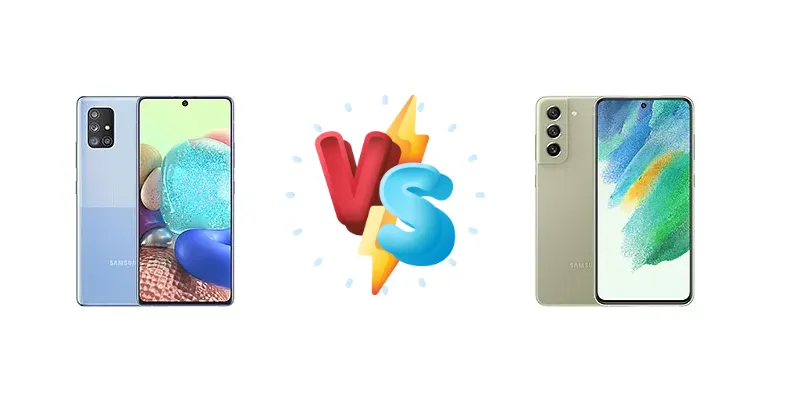
The Samsung Galaxy A Quantum and S21 FE 5G represent different approaches within Samsung’s lineup. The A Quantum prioritizes security with its unique QRNG chipset, while the S21 FE aims to deliver a flagship experience at a more accessible price point. This comparison dissects their core differences to determine which device best suits your needs.
🏆 Quick Verdict
For the average user prioritizing performance and a vibrant display, the Samsung Galaxy S21 FE 5G is the clear winner. Its Snapdragon 888 or Exynos 2100 chipset (depending on region) offers significantly more processing power, and its brighter display enhances media consumption. However, the A Quantum’s QRNG provides a unique security advantage for privacy-conscious users.
| Network |
|---|
| 2G bands | GSM 850 / 900 / 1800 / 1900 | GSM 850 / 900 / 1800 / 1900 |
| 3G bands | HSDPA 850 / 900 / 1900 / 2100 | HSDPA 850 / 900 / 1700(AWS) / 1900 / 2100 |
| 4G bands | LTE | 1, 2, 3, 4, 5, 7, 8, 12, 17, 20, 26, 28, 32, 38, 40, 41, 66 - International |
| 5G bands | SA/NSA | 1, 3, 5, 8, 20, 28, 38, 40, 41, 66, 78 SA/NSA/Sub6 - International |
| Speed | HSPA, LTE, 5G | HSPA 42.2/5.76 Mbps, LTE (5CA) Cat19 1600/200 Mbps, 5G |
| Technology | GSM / HSPA / LTE / 5G | GSM / CDMA / HSPA / EVDO / LTE / 5G |
| | - | 41, 66, 71, 260, 261 SA/NSA/Sub6/mmWave - USA |
| Launch |
|---|
| Announced | 2020, May 14. Released 2020, May 22 | 2022, January 04 |
| Status | Discontinued | Available. Released 2022, January 07 |
| Body |
|---|
| Build | Glass front (Gorilla Glass 3), plastic back, plastic frame | Glass front (Gorilla Glass Victus), plastic back, aluminum frame |
| Dimensions | 162.5 x 75.5 x 8.1 mm (6.40 x 2.97 x 0.32 in) | 155.7 x 74.5 x 7.9 mm (6.13 x 2.93 x 0.31 in) |
| SIM | Nano-SIM | · Nano-SIM· Nano-SIM + Nano-SIM |
| Weight | 185 g (6.53 oz) | 177 g (6.24 oz) |
| | - | IP68 dust/water resistant (up to 1.5m for 30 min) |
| Display |
|---|
| Protection | Corning Gorilla Glass 3 | Corning Gorilla Glass Victus |
| Resolution | 1080 x 2400 pixels, 20:9 ratio (~393 ppi density) | 1080 x 2340 pixels, 19.5:9 ratio (~403 ppi density) |
| Size | 6.7 inches, 108.4 cm2 (~88.3% screen-to-body ratio) | 6.4 inches, 100.5 cm2 (~86.7% screen-to-body ratio) |
| Type | Super AMOLED Plus | Dynamic AMOLED 2X, 120Hz, HDR10+ |
| | - | Always-on display |
| Platform |
|---|
| CPU | Octa-core (2x2.2 GHz Cortex-A77 & 6x1.8 GHz Cortex A55) | Octa-core (1x2.84 GHz Cortex-X1 & 3x2.42 GHz Cortex-A78 & 4x1.80 GHz Cortex-A55) - Version 1Octa-core (1x2.9 GHz Cortex-X1 & 3x2.80 GHz Cortex-A78 & 4x2.2 GHz Cortex-A55) - Version 2 |
| Chipset | Exynos 980 (8 nm), QRNG security chipset | Qualcomm SM8350 Snapdragon 888 5G (5 nm) - Version 1Exynos 2100 (5 nm) - Version 2 |
| GPU | Mali-G76 MP5 | Adreno 660 - Version 1Mali-G78 MP14 - Version 2 |
| OS | Android 10, One UI 2 | Android 12, up to 4 major Android upgrades, One UI 8 |
| Memory |
|---|
| Card slot | microSDXC (dedicated slot) | No |
| Internal | 128GB 8GB RAM | 128GB 6GB RAM, 128GB 8GB RAM, 256GB 6GB RAM, 256GB 8GB RAM |
| | UFS 2.1 | - |
| Main Camera |
|---|
| Features | LED flash, panorama, HDR | LED flash, auto-HDR, panorama |
| Quad | 64 MP, f/1.8, 26mm (wide), 1/1.72", 0.8µm, PDAF
12 MP, f/2.2, 12mm (ultrawide)
5 MP (macro)
Auxiliary lens | - |
| Single | - | 32 MP, f/2.2, 26mm (wide), 1/2.74", 0.8µm |
| Triple | - | 12 MP, f/1.8, 26mm (wide), 1/1.76", 1.8µm, dual pixel PDAF, OIS
8 MP, f/2.4, 76mm (telephoto), 1/4.5", 1.0µm, PDAF, OIS, 3x optical zoom
12 MP, f/2.2, 13mm, 123˚ (ultrawide), 1/3.0", 1.12µm |
| Video | 4K@30fps, 1080p@30/240fps, 1080p@960fps; gyro-EIS | 4K@30/60fps, 1080p@30/60/120/240fps, HDR10+, gyro-EIS |
| Selfie camera |
|---|
| Features | HDR | HDR |
| Single | 32 MP, f/2.2, 26mm (wide), 1/2.8", 0.8µm | 32 MP, f/2.2, 26mm (wide), 1/2.74", 0.8µm |
| Video | 1080p@30fps | 4K@30/60fps, 1080p@30/60fps, gyro-EIS |
| Sound |
|---|
| 3.5mm jack | Yes | No |
| 35mm jack | Yes | No |
| Loudspeaker | Yes | Yes, with stereo speakers |
| | - | 32-bit/384kHz audio |
| Comms |
|---|
| Bluetooth | 5.0, A2DP, LE | 5.0, A2DP, LE |
| NFC | Yes | Yes |
| Positioning | GPS, GLONASS, GALILEO, BDS | GPS, GLONASS, BDS, GALILEO |
| Radio | No | Unspecified |
| USB | USB Type-C 2.0, OTG | USB Type-C, OTG |
| WLAN | Wi-Fi 802.11 a/b/g/n/ac, dual-band, Wi-Fi Direct | Wi-Fi 802.11 a/b/g/n/ac/6, dual-band, Wi-Fi Direct |
| Features |
|---|
| Sensors | Fingerprint (under display, optical), accelerometer, gyro, proximity, compass | Fingerprint (under display, optical), accelerometer, gyro, proximity, compass |
| | ANT+ | Bixby natural language commands and dictation
Samsung Pay (Visa, MasterCard certified)
Samsung DeX (desktop experience support) |
| Battery |
|---|
| Charging | 25W wired | 25W wired, PD3.0, 50% in 30 min
15W wireless
Reverse wireless |
| Type | Li-Po 4500 mAh | Li-Ion 4500 mAh |
| Misc |
|---|
| Colors | Prism Cube Black, Prism Cube Sliver, Prism Cube Blue | White, Graphite, Lavender, Olive |
| Models | SM-A716N, SM-A716SS, SM-A716S | SM-G990B, SM-G990B/DS, SM-G990U, SM-G990U1, SM-G990W, SM-G990E, SM-G9900, SM-G990B2, SM-G990U2, SM-G990W2, SM-G990U3 |
| Price | About 500 EUR | € 199.00 / $ 143.95 / £ 154.99 / ₹ 29,990 |
| SAR | - | 0.77 W/kg (head) 0.90 W/kg (body) |
| SAR EU | - | 0.95 W/kg (head) 1.48 W/kg (body) |
| Tests |
|---|
| Battery life | - |
Endurance rating 92h
|
| Camera | - |
Photo / Video |
| Display | - |
Contrast ratio: Infinite (nominal) |
| Loudspeaker | - |
-26.9 LUFS (Good)
|
| Performance | - |
AnTuTu: 566529 (v8), 719696 (v9)
GeekBench: 3049 (v5.1)
GFXBench: 56fps (ES 3.1 onscreen) |
Samsung Galaxy A Quantum
- Unique QRNG security chipset for enhanced privacy
- More affordable price point
- Competent everyday performance for basic tasks
- Outdated Exynos 980 chipset
- Less powerful camera system
- Display specifications are less impressive
Samsung Galaxy S21 FE 5G
- Powerful Snapdragon 888 or Exynos 2100 chipset
- Brighter and more vibrant display
- Faster charging and wireless charging capabilities
- Higher price tag
- Lacks the A Quantum’s QRNG security feature
- Potential for throttling under sustained heavy load (depending on region/chipset)
Display Comparison
The S21 FE 5G boasts a significantly brighter display, reaching a measured 792 nits, compared to the A Quantum’s unspecified brightness. While both utilize AMOLED technology, the S21 FE’s higher peak brightness translates to better visibility in direct sunlight. The S21 FE also benefits from an 'Infinite' contrast ratio, typical of Samsung’s flagship displays, offering deeper blacks and more vibrant colors. The A Quantum’s display specs are less detailed, suggesting a more standard AMOLED experience.
Camera Comparison
Both devices feature capable camera systems, but details are limited. The S21 FE’s camera is expected to deliver superior image quality due to its more advanced image signal processor (ISP) within the Snapdragon 888 or Exynos 2100. While both are listed as having Photo/Video capabilities, the S21 FE likely benefits from features like improved low-light performance and more sophisticated video stabilization. The A Quantum’s camera system is less detailed in available specifications, suggesting a more basic photography experience. The presence of a 2MP macro camera on the A Quantum is unlikely to significantly impact overall image quality.
Performance
The performance gap is substantial. The S21 FE 5G, equipped with either the Qualcomm Snapdragon 888 (5nm) or Exynos 2100 (5nm), utilizes a more advanced fabrication process and a more powerful CPU architecture. The Snapdragon 888’s Cortex-X1 prime core clocked at 2.84 GHz (or 2.9 GHz in Version 2) significantly outperforms the A Quantum’s Exynos 980’s Cortex-A77 cores at 2.2 GHz. This translates to faster app loading, smoother multitasking, and superior gaming performance. The 5nm process also contributes to better thermal efficiency, potentially mitigating throttling during sustained workloads. The A Quantum’s Exynos 980, while capable, is a generation behind and built on an 8nm process.
Battery Life
Both phones share a 25W wired charging capability, with the S21 FE adding the convenience of 15W wireless charging and reverse wireless charging. Both achieve an endurance rating of 92 hours, suggesting comparable battery life despite potential differences in battery capacity (not specified for the A Quantum). The S21 FE’s PD3.0 support and advertised 50% charge in 30 minutes offer a slight advantage in charging speed and compatibility.
Buying Guide
Buy the Samsung Galaxy A Quantum if you require a heightened level of security for sensitive data, valuing the peace of mind offered by its QRNG chipset. Buy the Samsung Galaxy S21 FE 5G if you prioritize gaming, photography, and a premium display experience, and are willing to trade the specialized security feature for broader performance capabilities.
Frequently Asked Questions
❓ Does the Exynos 980 in the A Quantum overheat during prolonged gaming sessions?
The Exynos 980 is less prone to overheating than the Snapdragon 888 or Exynos 2100, due to its lower peak performance. However, it will still experience thermal throttling during extended gaming, resulting in reduced frame rates. It's suitable for casual gaming but not ideal for demanding titles at maximum settings.
❓ How does the QRNG security chipset in the A Quantum actually improve my privacy?
The Quantum Random Number Generator (QRNG) creates truly random numbers, unlike the pseudo-random number generators used in most devices. This is crucial for cryptographic keys and secure transactions, making it significantly harder for attackers to predict and compromise your data. It enhances security for applications like mobile banking and password generation.
❓ Which version of the S21 FE (Snapdragon or Exynos) is better?
Generally, the Snapdragon 888 version of the S21 FE exhibits slightly better thermal management and sustained performance compared to the Exynos 2100 version. However, the difference is often minimal in everyday use, and both offer a significant performance upgrade over the A Quantum’s Exynos 980.
❓ Is the 2MP macro camera on the A Quantum worth using?
The 2MP macro camera on the A Quantum is unlikely to deliver exceptional results. Macro photography requires a high-resolution sensor and good optics, which are typically absent in budget-oriented macro lenses. It can be used for close-up shots, but don't expect professional-level detail.