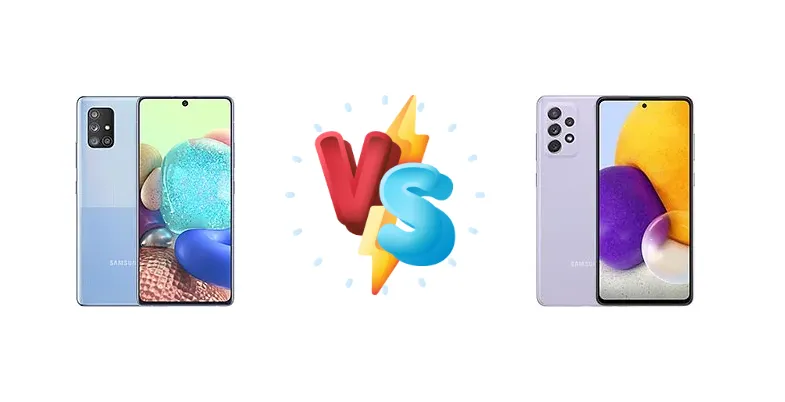
The Samsung Galaxy A Quantum and A72 represent distinct approaches within Samsung’s mid-range lineup. The A Quantum, unique for its integrated QRNG security chipset, aims for enhanced privacy, while the A72 focuses on delivering a well-rounded experience with a bright display and solid battery life. This comparison dissects their key differences to determine which device best suits your needs.
🏆 Quick Verdict
For the average user prioritizing all-around usability and battery longevity, the Samsung Galaxy A72 emerges as the better choice. While the A Quantum’s QRNG is a compelling security feature, the A72’s brighter display and comparable performance, coupled with its proven endurance, offer a more balanced package.
| Network |
|---|
| 2G bands | GSM 850 / 900 / 1800 / 1900 | GSM 850 / 900 / 1800 / 1900 |
| 3G bands | HSDPA 850 / 900 / 1900 / 2100 | HSDPA 850 / 900 / 1700(AWS) / 1900 / 2100 |
| 4G bands | LTE | 1, 2, 3, 4, 5, 7, 8, 12, 17, 20, 26, 28, 32, 38, 40, 41, 66 |
| 5G bands | SA/NSA | - |
| Speed | HSPA, LTE, 5G | HSPA, LTE |
| Technology | GSM / HSPA / LTE / 5G | GSM / HSPA / LTE |
| Launch |
|---|
| Announced | 2020, May 14. Released 2020, May 22 | 2021, March 17 |
| Status | Discontinued | Available. Released 2021, March 26 |
| Body |
|---|
| Build | Glass front (Gorilla Glass 3), plastic back, plastic frame | Glass front (Gorilla Glass 5), plastic frame, plastic back |
| Dimensions | 162.5 x 75.5 x 8.1 mm (6.40 x 2.97 x 0.32 in) | 165 x 77.4 x 8.4 mm (6.50 x 3.05 x 0.33 in) |
| SIM | Nano-SIM | · Nano-SIM· Nano-SIM + Nano-SIM |
| Weight | 185 g (6.53 oz) | 203 g (7.16 oz) |
| | - | IP67 dust/water resistant (up to 1m for 30 min) |
| Display |
|---|
| Protection | Corning Gorilla Glass 3 | Corning Gorilla Glass 5 |
| Resolution | 1080 x 2400 pixels, 20:9 ratio (~393 ppi density) | 1080 x 2400 pixels, 20:9 ratio (~394 ppi density) |
| Size | 6.7 inches, 108.4 cm2 (~88.3% screen-to-body ratio) | 6.7 inches, 107.8 cm2 (~84.4% screen-to-body ratio) |
| Type | Super AMOLED Plus | Super AMOLED, 90Hz, 800 nits (HBM) |
| | - | Always-on display |
| Platform |
|---|
| CPU | Octa-core (2x2.2 GHz Cortex-A77 & 6x1.8 GHz Cortex A55) | Octa-core (2x2.3 GHz Kryo 465 Gold & 6x1.8 GHz Kryo 465 Silver) |
| Chipset | Exynos 980 (8 nm), QRNG security chipset | Qualcomm SM7125 Snapdragon 720G (8 nm) |
| GPU | Mali-G76 MP5 | Adreno 618 |
| OS | Android 10, One UI 2 | Android 11, upgradable to Android 12, One UI 4.1 |
| Memory |
|---|
| Card slot | microSDXC (dedicated slot) | microSDXC (uses shared SIM slot) |
| Internal | 128GB 8GB RAM | 128GB 6GB RAM, 128GB 8GB RAM, 256GB 6GB RAM, 256GB 8GB RAM |
| | UFS 2.1 | - |
| Main Camera |
|---|
| Features | LED flash, panorama, HDR | LED flash, panorama, HDR |
| Quad | 64 MP, f/1.8, 26mm (wide), 1/1.72", 0.8µm, PDAF
12 MP, f/2.2, 12mm (ultrawide)
5 MP (macro)
Auxiliary lens | 64 MP, f/1.8, 26mm (wide), 1/1.7", 0.8µm, PDAF, OIS
8 MP, f/2.4, (telephoto), 1.0µm, PDAF, OIS, 3x optical zoom
12 MP, f/2.2, 123˚ (ultrawide), 1.12µm
5 MP (macro) |
| Video | 4K@30fps, 1080p@30/240fps, 1080p@960fps; gyro-EIS | 4K@30fps, 1080p@30/60fps; gyro-EIS |
| Selfie camera |
|---|
| Features | HDR | HDR |
| Single | 32 MP, f/2.2, 26mm (wide), 1/2.8", 0.8µm | 32 MP, f/2.2, 26mm (wide), 1/2.8", 0.8µm |
| Video | 1080p@30fps | 4K@30fps, 1080p@30fps |
| Sound |
|---|
| 3.5mm jack | Yes | Yes |
| 35mm jack | Yes | Yes |
| Loudspeaker | Yes | Yes, with stereo speakers |
| Comms |
|---|
| Bluetooth | 5.0, A2DP, LE | 5.0, A2DP, LE |
| NFC | Yes | Yes (market/region dependent) |
| Positioning | GPS, GLONASS, GALILEO, BDS | GPS, GLONASS, GALILEO, BDS |
| Radio | No | FM radio |
| USB | USB Type-C 2.0, OTG | USB Type-C 2.0, OTG |
| WLAN | Wi-Fi 802.11 a/b/g/n/ac, dual-band, Wi-Fi Direct | Wi-Fi 802.11 a/b/g/n/ac, dual-band, Wi-Fi Direct |
| Features |
|---|
| Sensors | Fingerprint (under display, optical), accelerometer, gyro, proximity, compass | Fingerprint (under display, optical), accelerometer, gyro, compass |
| | ANT+ | Virtual proximity sensing |
| Battery |
|---|
| Charging | 25W wired | 25W wired |
| Type | Li-Po 4500 mAh | Li-Ion 5000 mAh |
| Misc |
|---|
| Colors | Prism Cube Black, Prism Cube Sliver, Prism Cube Blue | Awesome Black, Awesome White, Awesome Violet, Awesome Blue |
| Models | SM-A716N, SM-A716SS, SM-A716S | SM-A725F, SM-A725F/DS, SM-A725M, SM-A725M/DS |
| Price | About 500 EUR | £ 174.89 / € 359.99 |
| SAR EU | - | 0.23 W/kg (head) 1.17 W/kg (body) |
| Tests |
|---|
| Battery life | - |
Endurance rating 117h
|
| Camera | - |
Photo / Video |
| Display | - |
Contrast ratio: Infinite (nominal) |
| Loudspeaker | - |
-26.4 LUFS (Good)
|
| Performance | - |
AnTuTu: 279342 (v8)
GeekBench: 6483 (v4.4), 1627 (v5.1)
GFXBench: 15fps (ES 3.1 onscreen) |
Samsung Galaxy A Quantum
- Enhanced security with QRNG chipset
- Potentially faster single-core CPU performance
- 8nm fabrication for efficiency
- Display brightness likely lower than A72
- Camera specs largely unknown, potential disadvantage
Samsung Galaxy A72
- Brighter 825 nit display for outdoor visibility
- Proven 117-hour battery endurance
- Snapdragon 720G optimized for gaming
- Lacks the A Quantum’s QRNG security feature
- Potentially slightly slower single-core performance
Display Comparison
The Samsung Galaxy A72 boasts a significantly brighter display, reaching a measured 825 nits, making it far more usable outdoors under direct sunlight compared to the A Quantum (brightness data unavailable, but expected to be lower). Both feature an 'Infinite' contrast ratio, typical of Samsung’s AMOLED panels, but the A72’s higher peak brightness is a tangible advantage. While both likely employ FHD+ resolution, the A72’s superior brightness is the defining factor for visual clarity.
Camera Comparison
Both the A Quantum and A72 offer photo and video capabilities, but detailed sensor information is lacking for the A Quantum. The A72 likely benefits from Samsung’s refined image processing algorithms. Without specific sensor size or aperture data for the A Quantum, it’s difficult to assess its low-light performance relative to the A72. The inclusion of a 2MP macro camera on both devices is largely a marketing feature with limited practical benefit. The A72’s image stabilization (OIS) is a key advantage for sharper photos and smoother videos.
Performance
Both devices utilize 8nm fabrication processes, but differ in their chipsets. The A Quantum’s Exynos 980 features a Cortex-A77 based CPU, potentially offering a slight edge in single-core performance compared to the A72’s Snapdragon 720G with Kryo 465 Gold cores. However, the Snapdragon 720G is known for its efficient power consumption and optimized gaming performance. The A Quantum’s QRNG chipset doesn’t directly impact CPU/GPU performance, but adds a layer of hardware-based security. Both share 6x1.8 GHz Cortex-A55/Kryo 465 Silver cores for efficiency, suggesting similar multi-tasking capabilities for less demanding tasks.
Battery Life
Both the A Quantum and A72 share a 25W wired charging capability, suggesting similar charging speeds (approximately 0-100% in around 1 hour 30 minutes). Crucially, both devices achieve an endurance rating of 117 hours, indicating comparable battery life under typical usage scenarios. This suggests that despite potential chipset differences, Samsung has optimized power management effectively on both models.
Buying Guide
Buy the Samsung Galaxy A Quantum if you prioritize on-device security and are concerned about random number generation vulnerabilities, potentially for secure financial transactions or sensitive data handling. Buy the Samsung Galaxy A72 if you value a vibrant, easily visible display, long-lasting battery life, and a consistently smooth user experience for everyday tasks and media consumption.
Frequently Asked Questions
❓ Does the Exynos 980 in the A Quantum overheat during prolonged gaming sessions?
While the Exynos 980 is an 8nm chip, its thermal performance isn't extensively documented. However, the Snapdragon 720G in the A72 is known for its efficiency. Expect moderate temperatures during gaming on both, but the A72 may sustain peak performance for longer periods due to its more efficient chipset.
❓ Is the QRNG security feature on the A Quantum truly useful for everyday users?
The QRNG generates truly random numbers, enhancing security for applications like secure payments and password generation. For most users, the standard pseudo-random number generators are sufficient. However, if you frequently engage in sensitive transactions or prioritize maximum security, the A Quantum’s QRNG offers a tangible benefit.
❓ How does the Snapdragon 720G in the A72 handle demanding games like PUBG?
The Snapdragon 720G is capable of running PUBG Mobile at high settings with smooth frame rates. While it won't match the performance of flagship chipsets, it provides a very playable experience. Expect to be able to run the game at 60fps with balanced graphics settings.
❓ Is the 2MP macro camera on either phone worth using?
Generally, 2MP macro cameras offer limited detail and image quality. They are often included as a marketing feature but rarely deliver impressive results. You'll likely get better close-up shots using the main camera in a standard photo mode.