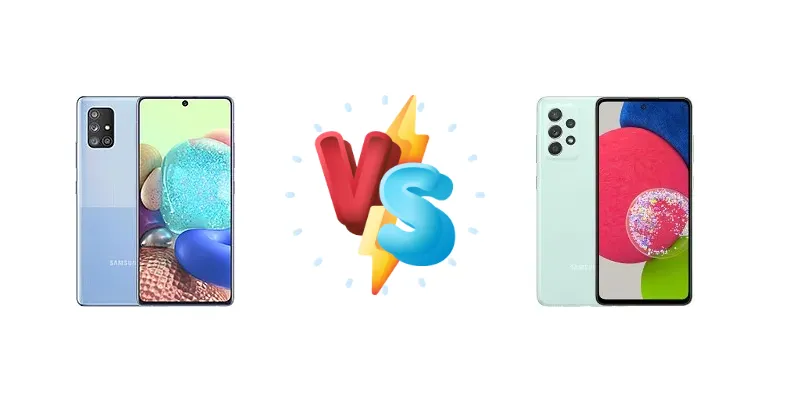
The Samsung Galaxy A52s 5G and Galaxy A Quantum represent different approaches to the mid-range market. The A Quantum, with its unique QRNG security chip, prioritizes privacy, while the A52s 5G focuses on delivering a strong all-around experience with a more modern chipset. This comparison dives deep into the specifications to determine which device offers the best value for your needs.
🏆 Quick Verdict
For most users, the Samsung Galaxy A52s 5G is the superior choice. Its Snapdragon 778G chipset provides a noticeable performance boost over the A Quantum’s Exynos 980, translating to smoother multitasking and gaming. While the A Quantum’s QRNG is a niche benefit, the A52s 5G’s overall package is more compelling.
| Network |
|---|
| 2G bands | GSM 850 / 900 / 1800 / 1900 | GSM 850 / 900 / 1800 / 1900 |
| 3G bands | HSDPA 850 / 900 / 1900 / 2100 | HSDPA 850 / 900 / 1700(AWS) / 1900 / 2100 |
| 4G bands | LTE | 1, 2, 3, 4, 5, 7, 8, 12, 17, 20, 26, 28, 32, 38, 40, 41, 66 |
| 5G bands | SA/NSA | 1, 3, 5, 7, 8, 20, 28, 38, 40, 41, 66, 78 SA/NSA/Sub6 |
| Speed | HSPA, LTE, 5G | HSPA 42.2/5.76 Mbps, LTE Cat18 1200/150 Mbps, 5G |
| Technology | GSM / HSPA / LTE / 5G | GSM / HSPA / LTE / 5G |
| Launch |
|---|
| Announced | 2020, May 14. Released 2020, May 22 | 2021, August 17 |
| Status | Discontinued | Available. Released 2021, September 01 |
| Body |
|---|
| Build | Glass front (Gorilla Glass 3), plastic back, plastic frame | Glass front (Gorilla Glass 5), plastic back |
| Dimensions | 162.5 x 75.5 x 8.1 mm (6.40 x 2.97 x 0.32 in) | 159.9 x 75.1 x 8.4 mm (6.30 x 2.96 x 0.33 in) |
| SIM | Nano-SIM | · Nano-SIM· Nano-SIM + Nano-SIM |
| Weight | 185 g (6.53 oz) | 189 g (6.67 oz) |
| | - | IP67 dust/water resistant (up to 1m for 30 min) |
| Display |
|---|
| Protection | Corning Gorilla Glass 3 | Corning Gorilla Glass 5 |
| Resolution | 1080 x 2400 pixels, 20:9 ratio (~393 ppi density) | 1080 x 2400 pixels, 20:9 ratio (~405 ppi density) |
| Size | 6.7 inches, 108.4 cm2 (~88.3% screen-to-body ratio) | 6.5 inches, 102.0 cm2 (~84.9% screen-to-body ratio) |
| Type | Super AMOLED Plus | Super AMOLED, 120Hz, 800 nits (HBM) |
| Platform |
|---|
| CPU | Octa-core (2x2.2 GHz Cortex-A77 & 6x1.8 GHz Cortex A55) | Octa-core (1x2.4 GHz Cortex-A78 & 3x2.2 GHz Cortex-A78 & 4x1.9 GHz Cortex-A55) |
| Chipset | Exynos 980 (8 nm), QRNG security chipset | Qualcomm SM7325 Snapdragon 778G 5G (6 nm) |
| GPU | Mali-G76 MP5 | Adreno 642L |
| OS | Android 10, One UI 2 | Android 11, upgradable to Android 14, One UI 6 |
| Memory |
|---|
| Card slot | microSDXC (dedicated slot) | microSDXC (uses shared SIM slot) |
| Internal | 128GB 8GB RAM | 128GB 4GB RAM, 128GB 6GB RAM, 128GB 8GB RAM, 256GB 6GB RAM, 256GB 8GB RAM |
| | UFS 2.1 | - |
| Main Camera |
|---|
| Features | LED flash, panorama, HDR | LED flash, panorama, HDR |
| Quad | 64 MP, f/1.8, 26mm (wide), 1/1.72", 0.8µm, PDAF
12 MP, f/2.2, 12mm (ultrawide)
5 MP (macro)
Auxiliary lens | 64 MP, f/1.8, 26mm (wide), 1/1.7", 0.8µm, PDAF, OIS
12 MP, f/2.2, 123˚ (ultrawide), 1.12µm
5 MP (macro)
Auxiliary lens |
| Single | - | 32 MP, f/2.2, 26mm (wide), 1/2.8", 0.8µm |
| Video | 4K@30fps, 1080p@30/240fps, 1080p@960fps; gyro-EIS | 4K@30fps, 1080p@30/60fps; gyro-EIS |
| Selfie camera |
|---|
| Features | HDR | HDR |
| Single | 32 MP, f/2.2, 26mm (wide), 1/2.8", 0.8µm | 32 MP, f/2.2, 26mm (wide), 1/2.8", 0.8µm |
| Video | 1080p@30fps | 4K@30fps, 1080p@30/60fps |
| Sound |
|---|
| 3.5mm jack | Yes | Yes |
| 35mm jack | Yes | Yes |
| Loudspeaker | Yes | Yes, with stereo speakers |
| Comms |
|---|
| Bluetooth | 5.0, A2DP, LE | 5.0, A2DP, LE |
| NFC | Yes | Yes (market/region dependent) |
| Positioning | GPS, GLONASS, GALILEO, BDS | GPS, GLONASS, GALILEO, BDS, QZSS |
| Radio | No | No |
| USB | USB Type-C 2.0, OTG | USB Type-C 2.0, OTG |
| WLAN | Wi-Fi 802.11 a/b/g/n/ac, dual-band, Wi-Fi Direct | Wi-Fi 802.11 a/b/g/n/ac/6, dual-band, Wi-Fi Direct |
| Features |
|---|
| Sensors | Fingerprint (under display, optical), accelerometer, gyro, proximity, compass | Fingerprint (under display, optical), accelerometer, gyro, compass |
| | ANT+ | Virtual Proximity Sensing |
| Battery |
|---|
| Charging | 25W wired | 25W wired |
| Type | Li-Po 4500 mAh | Li-Ion 4500 mAh |
| Misc |
|---|
| Colors | Prism Cube Black, Prism Cube Sliver, Prism Cube Blue | Awesome Black, Awesome White, Awesome Purple, Awesome Mint |
| Models | SM-A716N, SM-A716SS, SM-A716S | SM-A528B, SM-A528B/DS, SM-A528N |
| Price | About 500 EUR | £ 112.98 / € 249.47 |
| SAR | - | 0.72 W/kg (head) |
| SAR EU | - | 0.88 W/kg (head) 0.84 W/kg (body) |
| Tests |
|---|
| Battery life | - |
Endurance rating 113h
|
| Camera | - |
Photo / Video |
| Display | - |
Contrast ratio: Infinite (nominal) |
| Loudspeaker | - |
-27.5 LUFS (Good)
|
| Performance | - |
AnTuTu: 429675 (v8), 506432(v9)
GeekBench: 11060 (v4.4), 2801 (v5.1)
GFXBench: 28fps (ES 3.1 onscreen) |
Samsung Galaxy A Quantum
- Hardware-backed QRNG for enhanced security
- Potentially lower price point (depending on market)
- Samsung’s One UI software experience
- Older Exynos 980 chipset offers lower performance
- Less efficient 8nm fabrication process
- Display likely less bright than A52s 5G
Samsung Galaxy A52s 5G
- More powerful Snapdragon 778G chipset
- Brighter 800 nit display for better outdoor visibility
- More efficient 6nm fabrication process
- Lacks the dedicated QRNG security chip
- May be slightly more expensive than the A Quantum
- Software bloat (typical of Samsung)
Display Comparison
The Galaxy A52s 5G boasts a significantly brighter display, reaching a measured peak of 800 nits, compared to an unspecified brightness for the A Quantum. This higher brightness translates to better visibility outdoors. Both displays feature an 'Infinite' contrast ratio, suggesting they are AMOLED panels, but the A52s 5G’s superior peak brightness is a clear advantage for users who frequently use their phones in sunlight. While both likely employ similar color calibration profiles typical of Samsung, the A52s 5G’s brighter panel will deliver a more vibrant image.
Camera Comparison
Both phones offer photo and video capabilities, but detailed sensor information is lacking for the A Quantum. The A52s 5G likely benefits from Qualcomm’s image signal processor (ISP), known for its excellent image processing and low-light performance. Without specific sensor details for the A Quantum, it’s difficult to make a direct comparison, but the A52s 5G’s more modern ISP and potentially larger sensor size (typical for its price bracket) likely provide superior image quality and dynamic range. The presence of Optical Image Stabilization (OIS) on the A52s 5G, if present, would further enhance low-light photography and video stabilization.
Performance
The core difference lies in the chipsets. The A52s 5G’s Qualcomm Snapdragon 778G (6nm) is built on a smaller fabrication process than the A Quantum’s Exynos 980 (8nm). This 6nm process allows for greater transistor density and improved power efficiency, resulting in better sustained performance and reduced thermal throttling. The Snapdragon 778G’s CPU configuration – 1x2.4 GHz Cortex-A78, 3x2.2 GHz Cortex-A78, and 4x1.9 GHz Cortex-A55 – is also architecturally more advanced than the A Quantum’s 2x2.2 GHz Cortex-A77 & 6x1.8 GHz Cortex A55. The A78 cores in the Snapdragon offer a substantial performance uplift over the A77 cores in the Exynos, particularly in single-core tasks. This translates to snappier app launches and smoother overall responsiveness.
Battery Life
Both devices share a 25W wired charging capability, suggesting similar charging speeds from 0-100%. However, the Snapdragon 778G’s superior power efficiency in the A52s 5G could translate to slightly better real-world battery life despite both phones achieving an endurance rating of 113 hours. The 6nm process node contributes to lower power consumption during typical usage, potentially offsetting any capacity differences.
Buying Guide
Buy the Samsung Galaxy A Quantum if you prioritize on-device security and require a hardware-based random number generator for applications like blockchain or secure authentication. Buy the Samsung Galaxy A52s 5G if you value performance, a brighter display, and a more versatile overall smartphone experience, especially for gaming and media consumption.
Frequently Asked Questions
❓ Does the Exynos 980 in the Galaxy A Quantum overheat during extended gaming sessions?
The Exynos 980, being an 8nm chip, is more prone to thermal throttling than the 6nm Snapdragon 778G. While it can handle casual gaming, demanding titles played for extended periods may result in noticeable performance drops as the chip heats up. The A52s 5G will maintain higher sustained performance.
❓ Is the QRNG security chip on the Galaxy A Quantum useful for everyday users?
The Quantum Random Number Generator (QRNG) is a niche feature primarily beneficial for users who require a high level of cryptographic security, such as those involved in blockchain, secure authentication, or other applications where truly random number generation is critical. For typical smartphone usage like browsing, social media, and streaming, the benefits are minimal.
❓ What kind of gaming performance can I expect from the Galaxy A52s 5G?
The Snapdragon 778G in the A52s 5G is capable of running most popular mobile games at high settings with smooth frame rates. Expect excellent performance in titles like PUBG Mobile, Call of Duty Mobile, and Genshin Impact. While it won't match flagship-level performance, it provides a very enjoyable gaming experience.
❓ How does the camera on the A52s 5G perform in low-light conditions?
The A52s 5G’s camera, powered by Qualcomm’s ISP, excels in low-light photography. It captures detailed images with good dynamic range and minimal noise. The presence of OIS (if equipped) further enhances low-light performance by reducing blur from hand shake.