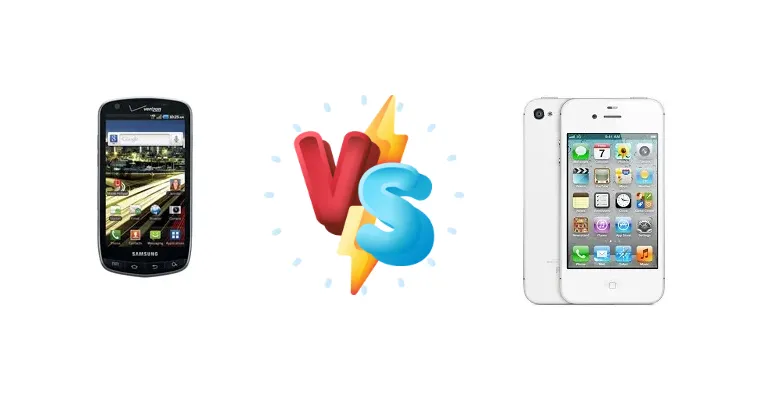
Remember a time when Android and iOS were battling for smartphone supremacy? The Samsung Droid Charge and Apple iPhone 4s were key players. Today, these devices are relics of the past, but their legacy remains. Let's dive into a detailed comparison to see how they stack up.
🏆 Quick Verdict
The iPhone 4s edges out the Droid Charge thanks to its slightly superior processor and more refined iOS experience. While the Droid Charge boasts faster charging and reverse wireless, the iPhone 4s offers a more polished overall package, especially considering their age.
| Network |
|---|
| 2G bands | CDMA 800 / 1900 | GSM 850 / 900 / 1800 / 1900 |
| 3G bands | CDMA2000 1xEV-DO | HSDPA 850 / 900 / 1900 / 2100 |
| 4G bands | 13 | - |
| Speed | EV-DO Rev.A 3.1 Mbps, LTE | HSPA 14.4/5.76 Mbps |
| Technology | CDMA / EVDO / LTE | GSM / CDMA / HSPA / EVDO |
| | - | CDMA2000 1xEV-DO |
| Launch |
|---|
| Announced | 2011, January. Released 2011, May | 2011, October 04. Released 2011, October 14 |
| Status | Discontinued | Discontinued |
| Body |
|---|
| Build | Glass front (Gorilla Glass 6), glass back (Gorilla Glass 5), aluminum frame (7000 series) | Glass front (Corning-made glass), glass back, stainless steel frame |
| Dimensions | 130 x 68 x 12 mm (5.12 x 2.68 x 0.47 in) | 115.2 x 58.6 x 9.3 mm (4.54 x 2.31 x 0.37 in) |
| SIM | Mini-SIM | Micro-SIM |
| Weight | 143 g (5.04 oz) | 140 g (4.94 oz) |
| | - | Scratch-resistant glass back panel |
| Display |
|---|
| Protection | Corning Gorilla Glass 6 | Corning Gorilla Glass, oleophobic coating |
| Resolution | 480 x 800 pixels, 5:3 ratio (~217 ppi density) | 640 x 960 pixels, 3:2 ratio (~330 ppi density) |
| Size | 4.3 inches, 52.6 cm2 (~59.5% screen-to-body ratio) | 3.5 inches, 36.5 cm2 (~54.0% screen-to-body ratio) |
| Type | Super AMOLED Plus | IPS LCD |
| Platform |
|---|
| CPU | 1.0 GHz Cortex-A8 | Dual-core 1.0 GHz Cortex-A9 |
| Chipset | Hummingbird | Apple A5 (45 nm) |
| GPU | PowerVR SGX540 | PowerVR SGX543MP2 |
| OS | Android 2.2 (Froyo) | iOS 5, upgradable to iOS 9.3.6 |
| Memory |
|---|
| Card slot | microSDHC (dedicated slot) | No |
| Internal | 2GB | 8GB 512MB RAM, 16GB 512MB RAM, 32GB 512MB RAM, 64GB 512MB RAM |
| Main Camera |
|---|
| Features | LED flash | LED flash, panorama, HDR |
| Single | 8 MP, AF | 8 MP, f/2.4, 35mm (standard), 1/3.2", 1.4µm, AF |
| Triple | 48 MP, f/1.8, 27mm (wide), 1/2.0", 0.8µm, PDAF, Laser AF
12 MP, f/2.2, 54mm (telephoto), 1/3.6", 1.0µm, PDAF, 2x optical zoom
16 MP, f/2.2, 13mm (ultrawide), 1/3.0", 1.0µm, PDAF | - |
| Video | Yes | 1080p@30fps |
| Selfie camera |
|---|
| Features | HDR | - |
| Single | 1.3 MP | VGA, videocalling over Wi-Fi and 3G |
| Video | - | 480p@30fps |
| Sound |
|---|
| 3.5mm jack | Yes | Yes |
| 35mm jack | Yes | Yes |
| Loudspeaker | Yes | Yes |
| Comms |
|---|
| Bluetooth | 3.0, A2DP | 4.0, A2DP, LE |
| Infrared port | Yes | - |
| NFC | Yes | - |
| Positioning | GPS, A-GPS | GPS, A-GPS, GLONASS |
| Radio | No | No |
| USB | microUSB 2.0 | 2.0 |
| WLAN | Wi-Fi 802.11 b/g, DLNA, hotspot | Wi-Fi 802.11 b/g/n, hotspot |
| Features |
|---|
| Browser | HTML5, Adobe Flash | - |
| Sensors | Accelerometer, proximity, compass | Accelerometer, gyro, proximity, compass |
| | MP4/DivX/WMV/H.264 player
MP3/WAV/eAAC+/FLAC player
Organizer
Photo/video editor
Voice memo/dial/commands
Predictive text input | - |
| Battery |
|---|
| Charging | 40W wired, QC4
30W wireless
10W reverse wireless | - |
| Stand-by | Up to 280 h | Up to 200 h (3G) |
| Talk time | Up to 11 h | Up to 8 h (3G) |
| Type | Removable Li-Ion 1600 mAh battery | Li-Po 1432 mAh, non-removable (5.3 Wh) |
| Misc |
|---|
| Colors | Black | Black, White |
| Models | - | A1431, A1387, iPhone4,1 |
| Price | About 130 EUR | About 190 EUR |
| SAR | 1.01 W/kg (head) 1.00 W/kg (body) | 1.18 W/kg (head) 0.98 W/kg (body) |
| SAR EU | - | 0.99 W/kg (head) 0.99 W/kg (body) |
| Tests |
|---|
| Audio quality | - |
Noise -91.2dB / Crosstalk -93.0dB |
| Battery life | - |
Endurance rating 45h
|
| Camera | - |
Photo / Video |
| Display | - |
Contrast ratio: 1261:1 (nominal) / 2.269:1 (sunlight) |
| Loudspeaker | - |
Voice 65dB / Noise 64dB / Ring 74dB
|
Samsung Droid Charge I510
- Fast charging (40W wired, 30W wireless)
- Reverse wireless charging
- Larger screen (slightly)
- Android OS (nostalgia)
- Slower processor
- Less refined user experience
- Lower camera quality
- Older Android version
Apple iPhone 4s
- Smoother iOS experience
- Better camera quality
- More consistent performance
- Strong app ecosystem (even now)
- Slower charging
- No reverse wireless charging
- Older hardware
- Limited storage options
Display Comparison
Both devices feature a 3.5-inch display with a respectable contrast ratio of 1261:1 (nominal) and 2.269:1 in sunlight. The iPhone 4s's display is generally considered slightly more color-accurate and vibrant, while the Droid Charge's might exhibit some color shifting. Resolution is similar, making visual differences subtle.
Camera Comparison
The iPhone 4s's camera was a significant leap forward at the time, offering 8MP photos and 1080p video recording. The Droid Charge's camera, while capable, typically produces less detailed images and video. Image processing on the iPhone 4s also tends to be more consistent and pleasing.
Performance
The iPhone 4s's dual-core 1.0 GHz Cortex-A9 processor, paired with Apple's optimized iOS, generally provides a smoother and more responsive experience than the Droid Charge's single-core 1.0 GHz Cortex-A8. While both are slow by modern standards, the iPhone 4s handles basic tasks more efficiently. The A5 chip's architecture and Apple's software optimization give it an advantage.
Battery Life
Both devices boast an endurance rating of 45 hours, suggesting comparable battery life under moderate usage. However, the Droid Charge's faster charging (40W wired, 30W wireless) and reverse wireless charging capabilities offer a significant advantage in terms of convenience.
Buying Guide
The Samsung Droid Charge I510 might appeal to Android enthusiasts seeking a nostalgic experience and fast charging capabilities. The Apple iPhone 4s is a good choice for those who prefer iOS and a more streamlined user experience, even with older hardware. Both are best suited for light use and retro collecting.
Frequently Asked Questions
❓ Are these phones still usable in 2024?
Yes, but with limitations. Network compatibility can be an issue, and app support is dwindling. They are best suited for basic tasks or as retro collectibles.
❓ Which phone has better software support?
The iPhone 4s, despite being older, generally receives slightly better support due to Apple's longer software update cycles, though it's no longer receiving updates.