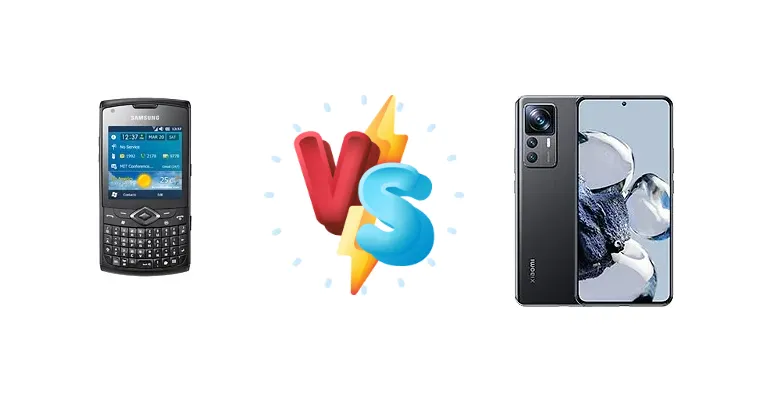
The Samsung B7350 Omnia PRO 4 represents a bygone era of Windows Mobile devices, while the Xiaomi 12T Pro embodies modern smartphone technology. This comparison explores how these two phones stack up against each other, highlighting the vast differences in capabilities and features.
🏆 Quick Verdict
The Xiaomi 12T Pro is the clear winner. Its cutting-edge processor, stunning display, impressive camera, and blazing-fast charging simply outclass the Omnia PRO 4. The Omnia PRO 4 holds nostalgic value, but for modern use, the 12T Pro is the superior choice.
| Network |
|---|
| 2G bands | GSM 850 / 900 / 1800 / 1900 | GSM 850 / 900 / 1800 / 1900 |
| 3G bands | HSDPA 900 / 2100 | HSDPA 800 / 850 / 900 / 1700(AWS) / 1900 / 2100 |
| 4G bands | - | 1, 2, 3, 4, 5, 7, 8, 12, 13, 17, 18, 19, 20, 25, 26, 28, 32, 38, 39, 40, 41, 42, 48, 66 |
| 5G bands | - | 1, 3, 5, 7, 8, 20, 28, 38, 40, 41, 66, 77, 78, 75 SA/NSA |
| Speed | HSPA 7.2/0.384 Mbps | HSPA, LTE, 5G |
| Technology | GSM / HSPA | GSM / HSPA / LTE / 5G |
| Launch |
|---|
| Announced | 2010, June. Released 2010, October | 2022, October 04 |
| Status | Discontinued | Available. Released 2022, October 06 |
| Body |
|---|
| Dimensions | 117.7 x 59.8 x 11.9 mm (4.63 x 2.35 x 0.47 in) | 163.1 x 75.9 x 8.6 mm (6.42 x 2.99 x 0.34 in) |
| Keyboard | QWERTY | - |
| SIM | Mini-SIM | · Nano-SIM + eSIM· Nano-SIM + Nano-SIM |
| Weight | 122 g (4.30 oz) | 205 g (7.23 oz) |
| | - | IP53, dust and splash resistant |
| Display |
|---|
| Protection | - | Corning Gorilla Glass 5 |
| Resolution | 320 x 320 pixels, 1:1 ratio (~173 ppi density) | 1220 x 2712 pixels, 20:9 ratio (~446 ppi density) |
| Size | 2.62 inches, 22.1 cm2 (~31.5% screen-to-body ratio) | 6.67 inches, 107.4 cm2 (~86.7% screen-to-body ratio) |
| Type | TFT resistive touchscreen, 65K colors | AMOLED, 68B colors, 120Hz, Dolby Vision, HDR10+, 500 nits (typ), 900 nits (peak) |
| Platform |
|---|
| CPU | - | Octa-core (1x3.19 GHz Cortex-X2 & 3x2.75 GHz Cortex-A710 & 4x2.0 GHz Cortex-A510) |
| Chipset | - | Qualcomm SM8475 Snapdragon 8+ Gen 1 (4 nm) |
| GPU | - | Adreno 730 |
| OS | Microsoft Windows Mobile 6.5 Professional | Android 12, upgradable to Android 14, HyperOS |
| Memory |
|---|
| Card slot | microSDHC (dedicated slot) | No |
| Internal | 200MB | 128GB 8GB RAM, 256GB 8GB RAM, 256GB 12GB RAM |
| | - | UFS 3.1 |
| Main Camera |
|---|
| Features | - | Color spectrum sensor, Dual-LED dual-tone flash, HDR, panorama |
| Single | 3.15 MP, AF | - |
| Triple | - | 200 MP, f/1.7, (wide), 1/1.22", 0.64µm, PDAF, OIS
8 MP, f/2.2, 120˚ (ultrawide), 1/4.0", 1.12µm
2 MP (macro) |
| Video | 320p@15fps | 8K@24fps, 4K@30/60fps, 1080p@30/60/120/240fps, HDR10+ |
| Selfie camera |
|---|
| Features | - | HDR, panorama |
| Single | - | 20 MP, f/2.2, (wide), 1/3.47", 0.8µm |
| Video | - | 1080p@30/60fps, HDR |
| | CIF | - |
| Sound |
|---|
| 3.5mm jack | Yes | No |
| 35mm jack | Yes | No |
| Loudspeaker | Yes | Yes, with stereo speakers |
| | - | Tuned by Harman Kardon
24-bit/192kHz audio |
| Comms |
|---|
| Bluetooth | 2.1, A2DP | 5.2, A2DP, LE, aptX HD |
| Infrared port | - | Yes |
| NFC | - | Yes (market/region dependent) |
| Positioning | GPS, A-GPS | GPS (L1+L5), GLONASS (L1), BDS (B1I+B1c+B2a), GALILEO (E1+E5a), QZSS (L1+L5), NavIC (L5) |
| Radio | Stereo FM radio, RDS | No |
| USB | microUSB 2.0 | USB Type-C 2.0, OTG |
| WLAN | Wi-Fi 802.11 b/g | Wi-Fi 802.11 a/b/g/n/ac/6, dual-band, Wi-Fi Direct |
| Features |
|---|
| Browser | WAP 2.0 / xHTML, HTML, Adobe Flash Lite | - |
| Sensors | - | Fingerprint (under display, optical), accelerometer, gyro, proximity, compass |
| | MP3/WMA/WAV/eAAC+ player
MP4/WMV9/H.264 player
Windows Live, Yahoo!
Microsoft Outlook Mobile
Pocket Office
Voice memo
Predictive text input | - |
| Battery |
|---|
| Charging | - | 120W wired, 100% in 19 min |
| Stand-by | Up to 500 h (2G) / Up to 400 h (3G) | - |
| Talk time | Up to 9 h 20 min (2G) / Up to 5 h 40 min (3G) | - |
| Type | Removable Li-Ion 1500 mAh battery | Li-Po 5000 mAh |
| Misc |
|---|
| Colors | Black | Black, Silver, Blue |
| Models | - | 22081212UG, 22081212G |
| Price | About 150 EUR | $ 208.76 / € 167.62 |
| SAR | 0.42 W/kg (head) 0.43 W/kg (body) | 1.08 W/kg (head) 1.07 W/kg (body) |
| SAR EU | 0.64 W/kg (head) | 1.00 W/kg (head) 1.00 W/kg (body) |
| Tests |
|---|
| Battery life | - | Endurance rating 91h |
| Camera | - | Photo / Video |
| Display | - | Contrast ratio: Infinite (nominal) |
| Loudspeaker | - | -24.1 LUFS (Very good) |
| Performance | - | AnTuTu: 1032185 (v9)
GeekBench: 4081 (v5.1)
GFXBench: 65fps (ES 3.1 onscreen) |
Samsung B7350 Omnia PRO 4
- Nostalgic Windows Mobile experience
- Compact form factor (likely)
- Physical keyboard (likely)
- Outdated hardware
- Limited app availability
- Poor performance by modern standards
- Low-resolution display
- Slow charging
Xiaomi 12T Pro
- High-performance Snapdragon 8+ Gen 1
- Stunning display with high brightness
- Excellent camera system
- Blazing-fast 120W charging
- Modern features and software
- May lack expandable storage (depending on variant)
- Software updates may eventually cease
Display Comparison
The Xiaomi 12T Pro boasts a significantly superior display. Its 913 nits max brightness and infinite contrast ratio offer vibrant colors and excellent visibility, even in direct sunlight. The Omnia PRO 4's display, typical of its era, is likely smaller, lower resolution, and lacks the modern features of the 12T Pro.
Camera Comparison
The Xiaomi 12T Pro's camera system is far more advanced, offering higher resolution images, improved low-light performance, and a wider range of features. The Omnia PRO 4's camera, while functional for its time, is significantly outdated.
Performance
The Xiaomi 12T Pro's Snapdragon 8+ Gen 1 chipset is a powerhouse, delivering exceptional speed and responsiveness. The Omnia PRO 4, running Windows Mobile, will feel sluggish by comparison, struggling with modern apps and multitasking.
Battery Life
While the Omnia PRO 4 is reported to have an endurance rating of 91h, this is likely a misinterpretation or an extremely conservative estimate. The Xiaomi 12T Pro's 120W charging allows for incredibly fast charging, while the Omnia PRO 4's charging capabilities are likely much slower.
Buying Guide
Who should buy the Samsung Omnia PRO 4? Primarily collectors or those seeking a nostalgic experience with a Windows Mobile device. Who should buy the Xiaomi 12T Pro? Anyone looking for a high-performance, feature-rich smartphone with excellent camera capabilities and fast charging.
Frequently Asked Questions
❓ Is the Samsung Omnia PRO 4 still usable today?
While technically usable, the Omnia PRO 4's outdated hardware and software make it impractical for modern use. App compatibility is limited, and performance will be significantly slower than contemporary smartphones.
❓ What operating system did the Samsung Omnia PRO 4 run?
The Samsung Omnia PRO 4 ran Windows Mobile, a now-discontinued mobile operating system.