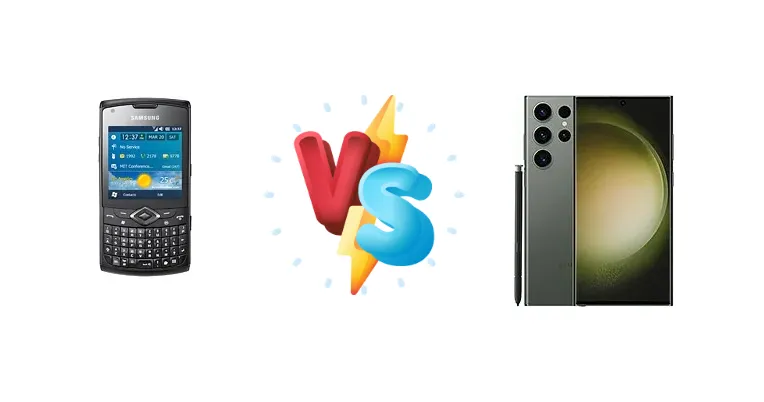
The Samsung B7350 Omnia PRO 4, released in 2009, was a pioneer in its time, blending smartphone and QWERTY keyboard functionality. Now, let's pit it against the 2023 flagship, the Samsung Galaxy S23 Ultra, a powerhouse of modern technology. This comparison highlights just how far mobile technology has advanced.
🏆 Quick Verdict
The Galaxy S23 Ultra utterly dominates this comparison. While the Omnia PRO 4 holds nostalgic value, the S23 Ultra's superior display, performance, camera, and battery life make it the clear winner for any modern user. It's a generational leap in every meaningful way.
| Network |
|---|
| 2G bands | GSM 850 / 900 / 1800 / 1900 | GSM 850 / 900 / 1800 / 1900 |
| 3G bands | HSDPA 900 / 2100 | HSDPA 850 / 900 / 1700(AWS) / 1900 / 2100 |
| 4G bands | - | 1, 2, 3, 4, 5, 7, 8, 12, 13, 17, 18, 19, 20, 25, 26, 28, 32, 38, 39, 40, 41, 66 - International |
| 5G bands | - | 1, 2, 3, 5, 7, 8, 12, 20, 25, 28, 38, 40, 41, 66, 75, 77, 78 SA/NSA/Sub6 - International |
| Speed | HSPA 7.2/0.384 Mbps | HSPA, LTE (up to 7CA), 5G |
| Technology | GSM / HSPA | GSM / CDMA / HSPA / EVDO / LTE / 5G |
| | - | 1, 7, 28, 41, 66, 71, 78, 258, 260, 261 SA/NSA/Sub6/mmWave - USA |
| Launch |
|---|
| Announced | 2010, June. Released 2010, October | 2023, February 01 |
| Status | Discontinued | Available. Released 2023, February 17 |
| Body |
|---|
| Build | - | Glass front (Gorilla Glass Victus 2), glass back (Gorilla Glass Victus 2), aluminum frame |
| Dimensions | 117.7 x 59.8 x 11.9 mm (4.63 x 2.35 x 0.47 in) | 163.4 x 78.1 x 8.9 mm (6.43 x 3.07 x 0.35 in) |
| Keyboard | QWERTY | - |
| SIM | Mini-SIM | · Nano-SIM + eSIM· Nano-SIM + Nano-SIM + eSIM (max 2 at a time) |
| Weight | 122 g (4.30 oz) | 234 g (8.25 oz) |
| | - | IP68 dust/water resistant (up to 1.5m for 30 min)
Armor aluminum frame with tougher drop and scratch resistance (advertised)
Stylus (Bluetooth integration, accelerometer, gyro) |
| Display |
|---|
| Protection | - | Corning Gorilla Glass Victus 2 |
| Resolution | 320 x 320 pixels, 1:1 ratio (~173 ppi density) | 1440 x 3088 pixels, 19.3:9 ratio (~500 ppi density) |
| Size | 2.62 inches, 22.1 cm2 (~31.5% screen-to-body ratio) | 6.8 inches, 114.7 cm2 (~89.9% screen-to-body ratio) |
| Type | TFT resistive touchscreen, 65K colors | Dynamic AMOLED 2X, 120Hz, HDR10+, 1200 nits (HBM), 1750 nits (peak) |
| | - | Always-on display |
| Platform |
|---|
| CPU | - | Octa-core (1x3.36 GHz Cortex-X3 & 2x2.8 GHz Cortex-A715 & 2x2.8 GHz Cortex-A710 & 3x2.0 GHz Cortex-A510) |
| Chipset | - | Qualcomm SM8550-AC Snapdragon 8 Gen 2 (4 nm) |
| GPU | - | Adreno 740 |
| OS | Microsoft Windows Mobile 6.5 Professional | Android 13, up to 4 major Android upgrades, One UI 8 |
| Memory |
|---|
| Card slot | microSDHC (dedicated slot) | No |
| Internal | 200MB | 256GB 8GB RAM, 256GB 12GB RAM, 512GB 12GB RAM, 1TB 12GB RAM |
| | - | UFS 4.0 |
| Main Camera |
|---|
| Features | - | Laser AF, LED flash, auto-HDR, panorama |
| Quad | - | 200 MP, f/1.7, 24mm (wide), 1/1.3", 0.6µm, multi-directional PDAF, OIS
10 MP, f/2.4, 70mm (telephoto), 1/3.52", 1.12µm, PDAF, OIS, 3x optical zoom
10 MP, f/4.9, 230mm (periscope telephoto), 1/3.52", 1.12µm, PDAF, OIS, 10x optical zoom
12 MP, f/2.2, 13mm, 120˚ (ultrawide), 1/2.55", 1.4µm, dual pixel PDAF, Super Steady video |
| Single | 3.15 MP, AF | 12 MP, f/2.2, 26mm (wide), Dual Pixel PDAF |
| Video | 320p@15fps | 8K@24/30fps, 4K@30/60fps, 1080p@30/60/120/240fps, HDR10+, stereo sound rec., gyro-EIS |
| Selfie camera |
|---|
| Features | - | HDR, HDR10+ |
| Single | - | 12 MP, f/2.2, 26mm (wide), 1/3.2", 1.12µm, dual pixel PDAF |
| Video | - | 4K@30/60fps, 1080p@30fps |
| | CIF | - |
| Sound |
|---|
| 3.5mm jack | Yes | No |
| 35mm jack | Yes | No |
| Loudspeaker | Yes | Yes, with stereo speakers |
| | - | 32-bit/384kHz audio
Tuned by AKG |
| Comms |
|---|
| Bluetooth | 2.1, A2DP | 5.3, A2DP, LE |
| NFC | - | Yes |
| Positioning | GPS, A-GPS | GPS, GALILEO, GLONASS, BDS, QZSS |
| Radio | Stereo FM radio, RDS | No |
| USB | microUSB 2.0 | USB Type-C 3.2, OTG |
| WLAN | Wi-Fi 802.11 b/g | Wi-Fi 802.11 a/b/g/n/ac/6e, tri-band, Wi-Fi Direct |
| Features |
|---|
| Browser | WAP 2.0 / xHTML, HTML, Adobe Flash Lite | - |
| Sensors | - | Fingerprint (under display, ultrasonic), accelerometer, gyro, proximity, compass, barometer |
| | MP3/WMA/WAV/eAAC+ player
MP4/WMV9/H.264 player
Windows Live, Yahoo!
Microsoft Outlook Mobile
Pocket Office
Voice memo
Predictive text input | Samsung DeX, Samsung Wireless DeX (desktop experience support)
Bixby natural language commands and dictation
Samsung Pay (Visa, MasterCard certified)
Ultra Wideband (UWB) support |
| Battery |
|---|
| Charging | - | 45W wired, PD3.0, 65% in 30 min
15W wireless (Qi)
4.5W reverse wireless |
| Stand-by | Up to 500 h (2G) / Up to 400 h (3G) | - |
| Talk time | Up to 9 h 20 min (2G) / Up to 5 h 40 min (3G) | - |
| Type | Removable Li-Ion 1500 mAh battery | Li-Ion 5000 mAh |
| Misc |
|---|
| Colors | Black | Phantom Black, Green, Cream, Lavender, Graphite, Sky Blue, Lime, Red, BMW M Edition |
| Models | - | SM-S918B, SM-S918B/DS, SM-S918U, SM-S918U1, SM-S918W, SM-S918N, SM-S9180, SM-S918E, SM-S918E/DS |
| Price | About 150 EUR | € 549.90 / $ 454.99 / £ 433.00 |
| SAR | 0.42 W/kg (head) 0.43 W/kg (body) | 1.12 W/kg (head) 0.92 W/kg (body) |
| SAR EU | 0.64 W/kg (head) | 0.96 W/kg (head) 1.40 W/kg (body) |
| Tests |
|---|
| Battery life | - |
Endurance rating 126h
|
| Camera | - |
Photo / Video |
| Display | - |
Contrast ratio: Infinite (nominal) |
| Loudspeaker | - |
-25.6 LUFS (Very good)
|
| Performance | - |
AnTuTu: 1241531 (v9)
GeekBench: 4927 (v5.1)
GFXBench: 67fps (ES 3.1 onscreen) |
Samsung B7350 Omnia PRO 4
- Compact size
- QWERTY keyboard (for some)
- Nostalgic value
- Outdated technology
- Poor performance
- Low-resolution display
- Limited camera capabilities
- Short battery life
Samsung Galaxy S23 Ultra
- Exceptional display
- Blazing-fast performance
- Outstanding camera system
- Long battery life
- Fast charging
- Modern features
- Expensive
- Large size (may not suit everyone)
Display Comparison
The Omnia PRO 4 featured a relatively small, lower-resolution display (likely around 3.7 inches) with limited brightness. The Galaxy S23 Ultra boasts a massive 6.8-inch Dynamic AMOLED 2X display with a peak brightness of 1274 nits, offering vibrant colors, incredible clarity, and excellent outdoor visibility. The contrast ratio is essentially infinite on the S23 Ultra, a world apart from the Omnia PRO 4.
Camera Comparison
The Omnia PRO 4's camera was rudimentary by today's standards, likely offering a few megapixels with limited features. The Galaxy S23 Ultra features a sophisticated multi-lens camera system with incredible resolution and advanced features like Space Zoom. Image quality and video recording are vastly superior on the S23 Ultra.
Performance
The Omnia PRO 4 ran on an older processor, likely a Qualcomm Snapdragon or similar, struggling by today's standards. The Galaxy S23 Ultra is powered by the Snapdragon 8 Gen 2, a blazing-fast chipset capable of handling demanding games and applications with ease. The difference in processing power is astronomical.
Battery Life
The Omnia PRO 4 likely had a small battery offering limited talk time. The Galaxy S23 Ultra packs a large battery with an active use score of 13:24h and an endurance rating of 126h, providing all-day battery life and beyond. Fast charging capabilities are also a significant advantage for the S23 Ultra.
Buying Guide
Who should buy the Samsung B7350 Omnia PRO 4? Primarily collectors or those seeking a retro mobile experience. Who should buy the Samsung Galaxy S23 Ultra? Anyone needing a top-tier smartphone with exceptional camera capabilities, performance, and a stunning display.
Frequently Asked Questions
❓ Is the Omnia PRO 4 worth anything today?
Primarily as a collector's item or for those interested in retro mobile technology. It's not a practical daily driver.
❓ Can the Omnia PRO 4 run modern apps?
No. Its outdated operating system and processor are not compatible with modern apps.