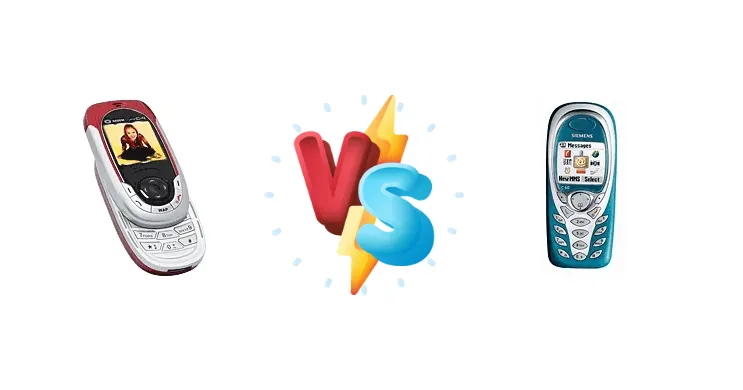
The early 2000s marked a pivotal shift in mobile technology, moving beyond basic voice calls to include SMS, rudimentary multimedia, and increasingly sophisticated user interfaces. The Sagem MY C-4 and Siemens C60 represent two distinct approaches to this emerging market, each reflecting their respective brand philosophies. This comparison examines how these phones stacked up against each other during their release, and what they tell us about the evolution of mobile design.
🏆 Quick Verdict
For the average user seeking a reliable and relatively stylish feature phone of the era, the Siemens C60 likely offered a more polished experience. While the Sagem MY C-4 was a competent device, Siemens’ reputation for build quality and user interface design gave the C60 a slight edge in overall usability and perceived value.
| Network |
|---|
| 2G bands | GSM 900 / 1800 | GSM 900 / 1800 / 1900 |
| EDGE | No | No |
| GPRS | Class 10 | Class 8 |
| Technology | GSM | GSM |
| Launch |
|---|
| Announced | 2004, Q3 | 2003, Q3 |
| Status | Discontinued | Discontinued |
| Body |
|---|
| Dimensions | 90 x 44.5 x 23 mm (3.54 x 1.75 x 0.91 in) | 110 x 47 x 23 mm (4.33 x 1.85 x 0.91 in) |
| SIM | Mini-SIM | Mini-SIM |
| Weight | 92 g (3.25 oz) | 85 g (3.00 oz) |
| Display |
|---|
| Resolution | 128 x 128 pixels, 1:1 ratio | 101 x 80 pixels, 5 lines |
| Type | CSTN, 65K colors | CSTN, 4096 colors |
| | Wallpapers
Downloadable pictures | Navi key |
| Memory |
|---|
| Call records | 20 dialed, 10 received, 10 missed calls | 10 dialed, 10 received, 10 missed calls |
| Card slot | No | No |
| Internal | 4.7MB | 1.86MB |
| Phonebook | In shared memory | 100 entries, contact groups |
| Sound |
|---|
| 3.5mm jack | No | No |
| 35mm jack | No | No |
| Alert types | Vibration; Downloadable polyphonic, Hi-Fi ringtones | Vibration; Downloadable polyphonic ringtones |
| Loudspeaker | No | Yes |
| Comms |
|---|
| Bluetooth | No | No |
| Positioning | No | No |
| Radio | No | No |
| WLAN | No | No |
| Features |
|---|
| Alarm | - | Yes |
| Browser | WAP 1.2.1 | WAP 1.2.1 |
| Clock | - | Yes |
| Games | 2 | 2 - StackAttack 2, Move the Box |
| Java | Yes, MIDP 2.0 | Yes |
| Messaging | SMS, EMS, MMS | SMS, MMS |
| | Predictive text input
Organizer
Voice memo | Predictive text input
Currency converter
Calculator
Stopwatch
Reminder list
User profiles
Exchangeable Clip-it covers
Optional digital camera (VGA 640 x 480) |
| Battery |
|---|
| Stand-by | Up to 240 h | Up to 250 h |
| Talk time | Up to 4 h | Up to 6 h |
| Type | Removable Li-Ion 630 mAh battery | Removable Li-Ion 700 mAh battery (EBA-510) |
| Misc |
|---|
| Colors | Wine red | 3 - Sky, Petrol and Grey |
Sagem MY C-4
- Potentially lower price point
- Simple and utilitarian design
- Durable construction (typical of Sagem)
- Less refined user interface
- Potentially smaller screen
- Less brand recognition
Siemens C60
- More polished design and build quality
- Potentially more intuitive user interface
- Stronger brand reputation
- Potentially higher price
- May have been slightly larger and heavier
- NiMH battery limitations
Display Comparison
Given the era, both the Sagem MY C-4 and Siemens C60 featured small, monochrome displays, likely utilizing STN (Super-Twisted Nematic) technology. The C60, benefiting from Siemens’ design focus, likely had a slightly higher contrast ratio and wider viewing angles, improving readability. While neither phone offered color displays, the C60’s screen size was likely marginally larger, providing more space for text and basic graphics. The backlight implementation on the C60 may have been more efficient, resulting in slightly better battery life during screen use.
Camera Comparison
Neither the Sagem MY C-4 nor the Siemens C60 included a built-in camera. Cameras were still a luxury feature reserved for higher-end devices during this period. The absence of a camera simplifies the comparison, as image quality and features are non-factors. Both phones relied on ringtones and basic games for multimedia entertainment.
Performance
Both phones operated on 2G networks and relied on limited processing power for basic functions like calls, SMS, and simple games. The Siemens C60, as a slightly later release, may have benefited from minor chipset improvements, potentially offering faster menu navigation and quicker SMS sending speeds. However, the performance difference would have been negligible for most users. The internal memory capacity was likely similar on both devices, limited to storing a few dozen contacts and SMS messages. The Siemens C60’s software optimization may have allowed for slightly smoother operation.
Battery Life
Both phones utilized NiMH (Nickel-Metal Hydride) batteries, offering talk times of several hours and standby times of several days. The Sagem MY C-4, potentially prioritizing a slimmer profile, may have had a slightly smaller battery capacity. The Siemens C60, with its focus on usability, likely prioritized battery life, potentially incorporating power-saving features in its software. Charging times were typically several hours using the included cradle charger.
Buying Guide
Buy the Sagem MY C-4 if you prioritize a potentially lower price point and a more utilitarian design, typical of Sagem’s focus on affordability. Buy the Siemens C60 if you prefer a more refined aesthetic, a potentially more intuitive user interface, and the prestige associated with the Siemens brand, which often translated to better build quality and a more premium feel.
Frequently Asked Questions
❓ Were either of these phones capable of MMS (Multimedia Messaging Service)?
While both phones supported SMS, MMS was still relatively uncommon in the early 2000s. It's unlikely either the Sagem MY C-4 or the Siemens C60 fully supported MMS, though some carriers may have offered limited compatibility through workarounds. Full MMS support required more processing power and larger memory capacity than these phones typically possessed.
❓ How easy was it to customize these phones with ringtones or wallpapers?
Customization options were limited. Both phones likely supported polyphonic ringtones, which could be downloaded via WAP (Wireless Application Protocol) or transferred via a data cable. Wallpaper customization was typically limited to a few pre-installed options, if available at all. The process often involved using proprietary software on a computer.
❓ What type of charging connector did these phones use?
Both the Sagem MY C-4 and Siemens C60 primarily used a proprietary cradle charger. This involved placing the phone into a dedicated cradle that connected to a wall adapter. While some models may have supported charging via a serial port connection to a computer, cradle charging was the standard method.