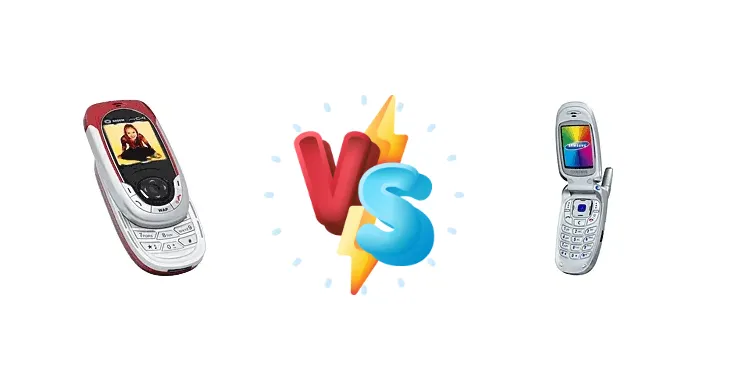
The Sagem MY C-4 and Samsung E100 represent a pivotal moment in mobile phone history – the transition from bulky handsets to more pocketable, user-friendly devices. Both phones emerged in the early 2000s, a period defined by SMS messaging, basic games, and the burgeoning adoption of 2G networks. This comparison analyzes their design, usability, and historical significance, acknowledging the limited availability of detailed specifications.
🏆 Quick Verdict
For the average user interested in experiencing early 21st-century mobile technology, the Samsung E100 likely offers a slightly more refined experience due to Samsung’s established manufacturing and design expertise. However, the Sagem MY C-4 holds appeal for collectors seeking a less common and potentially more robust device.
| Network |
|---|
| 2G bands | GSM 900 / 1800 | GSM 900 / 1800 |
| EDGE | No | No |
| GPRS | Class 10 | Class 10 |
| Technology | GSM | GSM |
| Launch |
|---|
| Announced | 2004, Q3 | 2003, Q3 |
| Status | Discontinued | Discontinued |
| Body |
|---|
| Dimensions | 90 x 44.5 x 23 mm (3.54 x 1.75 x 0.91 in) | 83 x 46 x 21 mm (3.27 x 1.81 x 0.83 in) |
| SIM | Mini-SIM | Mini-SIM |
| Weight | 92 g (3.25 oz) | 80 g (2.82 oz) |
| Display |
|---|
| Resolution | 128 x 128 pixels, 1:1 ratio | 128 x 160 pixels, 8 lines |
| Type | CSTN, 65K colors | TFD, 65K colors |
| | Wallpapers
Downloadable pictures | Second external display B/W LCD (96 x 64 pixels)
Four way navigation keys
Wallpaper |
| Memory |
|---|
| Call records | 20 dialed, 10 received, 10 missed calls | 10 dialed, 10 received, 10 missed calls |
| Card slot | No | No |
| Internal | 4.7MB | - |
| Phonebook | In shared memory | 500 |
| | - | 600 KB memory for Java apps |
| Sound |
|---|
| 3.5mm jack | No | No |
| 35mm jack | No | No |
| Alert types | Vibration; Downloadable polyphonic, Hi-Fi ringtones | Vibration; Downloadable polyphonic ringtones |
| Loudspeaker | No | No |
| Comms |
|---|
| Bluetooth | No | No |
| Infrared port | - | Yes |
| Positioning | No | No |
| Radio | No | No |
| WLAN | No | No |
| Features |
|---|
| Browser | WAP 1.2.1 | WAP 2.0/xHTML |
| Games | 2 | Yes - Honey ball, Go! hamster, Bowling + Java downloadable |
| Java | Yes, MIDP 2.0 | No |
| Messaging | SMS, EMS, MMS | SMS, EMS, MMS |
| | Predictive text input
Organizer
Voice memo | Predictive text input
Organizer
Menu shortcuts |
| Battery |
|---|
| Stand-by | Up to 240 h | Up to 230 h |
| Talk time | Up to 4 h | Up to 3 h 30 min |
| Type | Removable Li-Ion 630 mAh battery | Removable Li-Ion 720 mAh battery |
| Misc |
|---|
| Colors | Wine red | - |
| SAR EU | - | 0.71 W/kg (head) |
Sagem MY C-4
- Potentially more robust build quality (Sagem reputation)
- Unique and less common design
- May appeal to collectors of vintage phones
- Limited availability of information and accessories
- Likely less refined user interface compared to Samsung
Samsung E100
- Established brand reputation (Samsung)
- Potentially wider availability of accessories
- Likely more polished user interface
- More common, potentially less collectible
- Build quality may not be as robust as Sagem
Display Comparison
Given the era, both the Sagem MY C-4 and Samsung E100 likely featured monochrome LCD screens with limited resolution. The Samsung E100, benefiting from Samsung’s display technology advancements at the time, may have offered slightly better contrast and viewing angles. The screen size on both was likely constrained by the desire for a compact form factor, prioritizing portability over readability. Bezels were substantial on both devices, as display technology hadn't yet minimized them.
Camera Comparison
Neither the Sagem MY C-4 nor the Samsung E100 included a camera. Cameras were still a premium feature in the early 2000s, reserved for higher-end devices. The absence of a camera simplifies the comparison, removing a significant point of differentiation. Image capture wasn't a primary function for these phones; their focus was on communication and basic utility.
Performance
Performance is a relative term for these devices. Both relied on basic processors designed for handling calls, SMS, and simple applications. The Samsung E100, as a later model, may have benefited from slightly improved processor efficiency, resulting in marginally better battery life. However, neither phone was capable of multitasking or running complex applications. RAM capacity was extremely limited, sufficient only for the basic operating system and a few active applications.
Battery Life
Both phones utilized Nickel-Metal Hydride (NiMH) batteries, common for the era. Battery life was a key selling point, with both devices likely offering several days of standby time and several hours of talk time. The Samsung E100, potentially benefiting from more efficient components, might have offered slightly longer battery life. Charging times were significantly longer than modern smartphones, requiring several hours to fully charge.
Buying Guide
Buy the Sagem MY C-4 if you prioritize a potentially more durable build quality and a unique, less-common design for collection purposes. Buy the Samsung E100 if you prefer a more polished user experience, a potentially wider availability of accessories, and a brand with a longer history in mobile phone manufacturing. Both are best suited for collectors or those seeking a nostalgic experience, not daily use.
Frequently Asked Questions
❓ Are these phones still functional on modern networks?
No. Both the Sagem MY C-4 and Samsung E100 are 2G phones. 2G networks are being phased out globally, making them increasingly difficult to use for calls or texts. Functionality is limited to areas where 2G remains active.
❓ What kind of accessories are available for these phones today?
Accessories are extremely limited. Original chargers may be found on auction sites, but finding replacement batteries or other parts is challenging. Compatibility with modern chargers is unlikely without adapters.
❓ Is it possible to unlock these phones for use with different carriers?
Unlocking these phones is generally not possible or practical. The methods for unlocking phones were less standardized in the early 2000s, and the software tools required are often unavailable.
❓ What was the typical price of these phones when they were released?
The Sagem MY C-4 and Samsung E100 were entry-level phones, typically priced between $100 and $200 USD at launch, often subsidized by carrier contracts. Prices varied depending on the region and carrier.