
Realme X7 vs Motorola Edge 20 Fusion: A Detailed Comparison of Dimensity 800U Power
| Phones Images | |||||
|---|---|---|---|---|---|
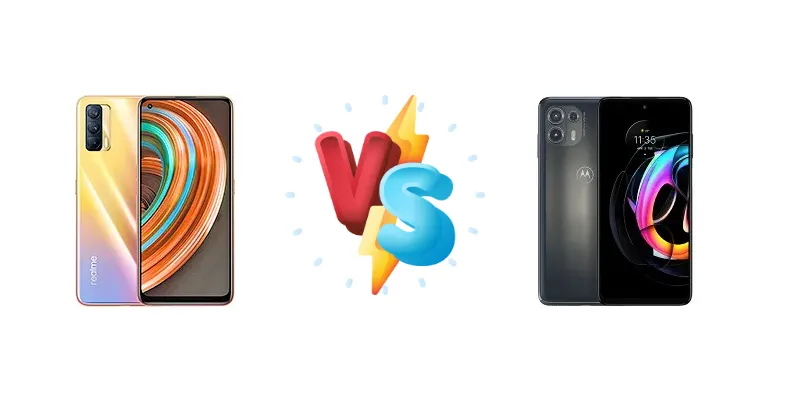
|
🏆 Quick Verdict
For the average user prioritizing rapid replenishment, the Realme X7 emerges as the winner. Its 50W charging significantly reduces downtime compared to the Motorola Edge 20 Fusion’s 30W solution, despite both phones sharing the same core processing power. This makes the X7 ideal for those constantly on the move.
| PHONES | ||
|---|---|---|
| Phone Names | Realme X7 (India) | Motorola Edge 20 Fusion |
| Network | ||
|---|---|---|
| 2G bands | GSM 850 / 900 / 1800 / 1900 | GSM 850 / 900 / 1800 / 1900 |
| 3G bands | HSDPA 850 / 900 / 1700(AWS) / 1900 / 2100 | HSDPA 850 / 900 / 1700(AWS) / 1900 / 2100 |
| 4G bands | 1, 2, 3, 4, 5, 8, 18, 19, 26, 34, 38, 39, 40, 41 | 1, 2, 3, 4, 5, 7, 8, 12, 13, 17, 18, 19, 20, 26, 28, 32, 34, 38, 39, 40, 41, 42, 43, 66 |
| 5G bands | 1, 41, 77, 78 SA/NSA | 1, 3, 5, 7, 8, 20, 28, 38, 40, 41, 77, 78, 66 SA/NSA/Sub6 |
| Speed | HSPA, LTE, 5G 2.3 Gbps DL | HSPA 42.2/5.76 Mbps, LTE Cat18 1200/150 Mbps, 5G |
| Technology | GSM / HSPA / LTE / 5G | GSM / HSPA / LTE / 5G |
| Launch | ||
|---|---|---|
| Announced | 2021, February 04 | 2021, August 17 |
| Status | Available. Released 2021, February 12 | Available. Released 2021, August 27 |
| Body | ||
|---|---|---|
| Build | - | Glass front |
| Dimensions | 160.9 x 74.4 x 8.1 mm / 8.3 mm | 166 x 76 x 8.3 mm (6.54 x 2.99 x 0.33 in) |
| SIM | Nano-SIM + Nano-SIM | Nano-SIM + Nano-SIM |
| Weight | 176 g / 179 g (6.21 oz) | 185 g (6.53 oz) |
| - | Water-repellent design | |
| Display | ||
|---|---|---|
| Resolution | 1080 x 2400 pixels, 20:9 ratio (~411 ppi density) | 1080 x 2400 pixels, 20:9 ratio (~393 ppi density) |
| Size | 6.4 inches, 98.9 cm2 (~82.6% screen-to-body ratio) | 6.7 inches, 108.4 cm2 (~85.9% screen-to-body ratio) |
| Type | Super AMOLED, 430 nits (typ), 600 nits (peak) | OLED, 1B colors, 90Hz, HDR10+ |
| Platform | ||
|---|---|---|
| CPU | Octa-core (2x2.4 GHz Cortex-A76 & 6x2.0 GHz Cortex-A55) | Octa-core (2x2.4 GHz Cortex-A76 & 6x2.0 GHz Cortex-A55) |
| Chipset | Mediatek Dimensity 800U (7 nm) | Mediatek Dimensity 800U (7 nm) |
| GPU | Mali-G57 MC3 | Mali-G57 MC3 |
| OS | Android 10, Realme UI | Android 11 |
| Memory | ||
|---|---|---|
| Card slot | No | microSDXC |
| Internal | 128GB 6GB RAM, 128GB 8GB RAM | 128GB 6GB RAM, 128GB 8GB RAM |
| UFS 2.1 | - | |
| Main Camera | ||
|---|---|---|
| Features | LED flash, HDR, panorama | LED flash, HDR, panorama |
| Single | 16 MP, f/2.5, 26mm (wide), 1/3.1", 1.0µm | - |
| Triple | 64 MP, f/1.8, 26mm (wide), 1/1.7", 0.8µm, PDAF 8 MP, f/2.3, 119˚, 16mm (ultrawide), 1/4.0", 1.12µm 2 MP (macro) | 108 MP, f/1.9, (wide), 1/1.52", 0.7µm, PDAF 8 MP, f/2.2, 118˚ (ultrawide) Auxiliary lens |
| Video | 4K@30fps, 1080p@30/60/120fps, gyro-EIS | 4K@30fps, 1080p@30/60/120fps, gyro-EIS |
| Selfie camera | ||
|---|---|---|
| Features | Panorama | HDR |
| Single | 16 MP, f/2.5, 26mm (wide), 1/3.1", 1.0µm | 32 MP, f/2.3, (wide), 0.7µm |
| Video | 1080p@30/120fps, gyro-EIS | 1080p@30fps |
| Sound | ||
|---|---|---|
| 3.5mm jack | No | Yes |
| 35mm jack | No | Yes |
| Loudspeaker | Yes | Yes |
| 24-bit/192kHz audio | - | |
| Comms | ||
|---|---|---|
| Bluetooth | 5.1, A2DP, LE | 5.0, A2DP, LE |
| NFC | No | Yes |
| Positioning | GPS, GLONASS, GALILEO, BDS, QZSS | GPS, GLONASS, GALILEO |
| Radio | No | FM radio |
| USB | USB Type-C 2.0, OTG | USB Type-C 2.0 |
| WLAN | Wi-Fi 802.11 a/b/g/n/ac, dual-band, Wi-Fi Direct | Wi-Fi 802.11 a/b/g/n/ac, dual-band, Wi-Fi Direct |
| Features | ||
|---|---|---|
| Sensors | Fingerprint (under display, optical), accelerometer, gyro, proximity, compass | Fingerprint (side-mounted), accelerometer, gyro, proximity, compass |
| Battery | ||
|---|---|---|
| Charging | 50W wired, 50% in 18 min, 100% in 47 min | 30W wired |
| Type | 4310 mAh | Li-Po 5000 mAh |
| Misc | ||
|---|---|---|
| Colors | Space Silver, Nebula | Electric Graphite, Cyber Teal |
| Models | RMX3092 | - |
| Price | About 230 EUR | About 250 EUR |
Realme X7 (India)
- Significantly faster 50W charging
- Identical Dimensity 800U performance
- Potentially more aggressive pricing (India market)
- Realme UI may not appeal to all users
- Lack of detailed display specifications
Motorola Edge 20 Fusion
- Near-stock Android experience (Motorola)
- Potentially better software optimization
- Clean and minimalist design
- Slower 30W charging
- Identical Dimensity 800U performance
- May be priced higher than the Realme X7
Display Comparison
While both devices likely feature similar LCD or AMOLED panels (data unavailable), the absence of specific display specs necessitates a focus on other areas. The user experience will likely hinge on software calibration and color accuracy, areas where Motorola historically excels with its near-stock Android implementation. Realme’s UI, while feature-rich, can sometimes exhibit less accurate color reproduction out of the box.
Camera Comparison
Without detailed camera specifications, a direct comparison is limited. However, the market positioning suggests both phones will feature multi-camera systems geared towards versatility. The absence of information regarding sensor sizes and lens apertures makes it difficult to assess image quality. It’s reasonable to assume both will include a primary sensor, ultrawide, and potentially a macro lens, but the quality of these components will be the deciding factor. Motorola’s image processing tends towards natural colors, while Realme often boosts saturation for a more vibrant look.
Performance
Both the Realme X7 and Motorola Edge 20 Fusion are powered by the Mediatek Dimensity 800U (7nm). This translates to an identical CPU configuration – an octa-core setup with 2x2.4 GHz Cortex-A76 cores and 6x2.0 GHz Cortex-A55 cores. Consequently, CPU-bound tasks like app loading and web browsing will perform similarly on both devices. The real-world performance difference will likely be minimal, with thermal management potentially becoming a differentiating factor under sustained load. The 7nm process node helps with efficiency, but the effectiveness of each manufacturer’s cooling solution will dictate whether throttling occurs during extended gaming sessions.
Battery Life
The Realme X7’s 50W wired charging is the standout feature here. It’s advertised to reach 50% charge in 18 minutes and 100% in 47 minutes. The Motorola Edge 20 Fusion, with its 30W charging, will take considerably longer to fully replenish. While battery capacity isn’t specified, the faster charging of the Realme X7 effectively mitigates any potential disadvantage from a slightly smaller battery. This is a significant benefit for users who prioritize convenience and minimal downtime.
Buying Guide
Buy the Realme X7 (India) if you need the fastest possible charging speeds and prioritize minimizing time tethered to a wall outlet. It’s the better choice for power users and those who frequently find themselves with low battery. Buy the Motorola Edge 20 Fusion if you prefer a potentially cleaner software experience (based on Motorola’s near-stock Android approach) and are less concerned about maximizing charging speed. It’s a solid all-rounder for everyday tasks.