
Realme X50 5G vs. Motorola Moto X40: A 5G Showdown
| Phones Images | |||||
|---|---|---|---|---|---|
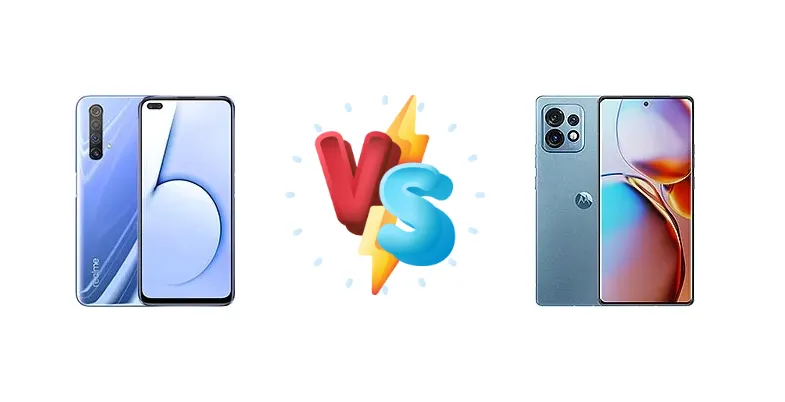
|
🏆 Quick Verdict
The Motorola Moto X40 is the clear winner. Its Snapdragon 8 Gen 2 chipset, blazing-fast 125W charging, and overall modern features significantly outperform the Realme X50 5G's Snapdragon 765G. However, the X50 5G might offer better value in specific markets.
| PHONES | ||
|---|---|---|
| Phone Names | Realme X50 5G (China) | Motorola Moto X40 |
| Network | ||
|---|---|---|
| 2G bands | GSM 850 / 900 / 1800 / 1900 | GSM 850 / 900 / 1800 / 1900 |
| 3G bands | HSDPA 850 / 900 / 1700(AWS) / 1900 / 2100 | HSDPA 850 / 900 / 1700(AWS) / 1900 / 2100 |
| 4G bands | 1, 2, 3, 4, 5, 7, 8, 34, 38, 39, 40, 41 | 1, 2, 3, 4, 5, 7, 8, 12, 13, 17, 18, 19, 20, 25, 26, 28, 32, 38, 39, 40, 41, 42, 43, 48, 66 |
| 5G bands | 1, 41, 78, 79 SA/NSA | 1, 2, 3, 5, 7, 8, 20, 28, 38, 40, 41, 66, 77, 78 SA/NSA/Sub6 |
| Speed | HSPA, LTE, 5G (1.9 Gbps DL) | HSPA, LTE, 5G |
| Technology | GSM / CDMA / HSPA / EVDO / LTE / 5G | GSM / CDMA / HSPA / LTE / 5G |
| CDMA2000 1xEV-DO | CDMA 800 | |
| Launch | ||
|---|---|---|
| Announced | 2020, January 07. Released 2020, January | 2022, December 15 |
| Status | Discontinued | Available. Released 2022, December 22 |
| Body | ||
|---|---|---|
| Build | Glass front (Gorilla Glass 5), glass back (Gorilla Glass 5), aluminum frame | Glass front, glass back (Gorilla Glass Victus), aluminum frame |
| Dimensions | 163.8 x 75.8 x 8.9 mm (6.45 x 2.98 x 0.35 in) | 161.2 x 74 x 8.6 mm (6.35 x 2.91 x 0.34 in) |
| SIM | Nano-SIM + Nano-SIM | Nano-SIM + Nano-SIM |
| Weight | 202 g (7.13 oz) | 199 g (7.02 oz) |
| - | IP68 dust/water resistant (up to 1.5m for 30 min) | |
| Display | ||
|---|---|---|
| Protection | Corning Gorilla Glass 5 | - |
| Resolution | 1080 x 2400 pixels, 20:9 ratio (~401 ppi density) | 1080 x 2400 pixels, 20:9 ratio (~393 ppi density) |
| Size | 6.57 inches, 104.2 cm2 (~83.9% screen-to-body ratio) | 6.7 inches, 108.4 cm2 (~90.9% screen-to-body ratio) |
| Type | IPS LCD, 120Hz | OLED, 1B colors, 165Hz, HDR10+ |
| Platform | ||
|---|---|---|
| CPU | Octa-core (1x2.4 GHz Kryo 475 Prime & 1x2.2 GHz Kryo 475 Gold & 6x1.8 GHz Kryo 475 Silver) | Octa-core (1x3.2 GHz Cortex-X3 & 2x2.8 GHz Cortex-A715 & 2x2.8 GHz Cortex-A710 & 3x2.0 GHz Cortex-A510) |
| Chipset | Qualcomm SM7250 Snapdragon 765G 5G (7 nm) | Qualcomm SM8550-AB Snapdragon 8 Gen 2 (4 nm) |
| GPU | Adreno 620 | Adreno 740 |
| OS | Android 10, ColorOS 7 | Android 13, upgradable to Android 14, MYUI 6.0 |
| Memory | ||
|---|---|---|
| Card slot | No | No |
| Internal | 64GB 6GB RAM, 128GB 8GB RAM, 256GB 6GB RAM, 256GB 12GB RAM | 128GB 8GB RAM, 256GB 12GB RAM, 512GB 12GB RAM |
| UFS 2.1 | UFS 3.1 - 128GB UFS 4.0 - 256GB/512GB | |
| Main Camera | ||
|---|---|---|
| Features | LED flash, HDR, panorama | Dual-LED flash, panorama, HDR |
| Quad | 64 MP, f/1.8, 26mm (wide), 1/1.72", 0.8µm, PDAF 12 MP, f/3.0, 54mm (telephoto), 2x optical zoom, PDAF 8 MP, f/2.3, 13mm (ultrawide) 2 MP (macro) | - |
| Triple | - | 50 MP, f/1.9, (wide), 1/1.55", 1.0µm, dual pixel PDAF, OIS 12 MP, f/1.6, (telephoto), 1/2.93", 1.22µm, PDAF, 2x optical zoom 50 MP, f/2.2, 117˚ (ultrawide), 1/2.76", 0.64µm, AF |
| Video | 4K@30fps, 1080p@30/60fps; gyro-EIS | 8K@30fps, 4K@30/60fps, 1080p@30/60/120/240/960fps, 10-bit HDR10+, gyro-EIS |
| Selfie camera | ||
|---|---|---|
| Dual | 16 MP, f/2.0, 26mm (wide), 1/3.06", 1.0µm 8 MP, f/2.2, 17mm (ultrawide), 1/4.0", 1.12µm | - |
| Features | HDR | HDR |
| Single | - | 60 MP, f/2.2, (wide), 1/2.8", 0.61µm |
| Video | 1080p@30fps, gyro-EIS | 4K@30fps, 1080p@30/60fps |
| Sound | ||
|---|---|---|
| 3.5mm jack | No | No |
| 35mm jack | No | No |
| Loudspeaker | Yes | Yes, with stereo speakers |
| 24-bit/192kHz audio | - | |
| Comms | ||
|---|---|---|
| Bluetooth | 5.0, A2DP, LE | 5.3, A2DP, LE, aptX HD, aptX Adaptive |
| NFC | Yes | Yes |
| Positioning | GPS (L1+L5), GLONASS, BDS, GALILEO | GPS (L1+L5), GLONASS (L1), BDS (B1I+B1c+B2a), GALILEO (E1+E5a), QZSS (L1+L5) |
| Radio | No | No |
| USB | USB Type-C 2.0 | USB Type-C, OTG |
| WLAN | Wi-Fi 802.11 a/b/g/n/ac, dual-band, Wi-Fi Direct | Wi-Fi 802.11 a/b/g/n/ac/6e, dual-band, Wi-Fi Direct |
| Features | ||
|---|---|---|
| Sensors | Fingerprint (side-mounted), accelerometer, gyro, proximity, compass | Fingerprint (under display, optical), accelerometer, gyro, proximity, compass |
| - | Ready For 3.5 support | |
| Battery | ||
|---|---|---|
| Charging | 30W wired, 70% in 30 min | 125W wired, PD3.0, QC5, 50% in 7 min 15W wireless 5W reverse wired |
| Type | 4200 mAh, non-removable | Li-Po 4600 mAh |
| Misc | ||
|---|---|---|
| Colors | Glacier, Polar | Black, Blue |
| Models | RMX2051, RMX2025 | XT2301-5 |
| Price | About 680 EUR | About 540 EUR |
Realme X50 5G (China)
- More affordable (potentially)
- Decent 5G performance
- Good value for money (in specific markets)
- Older chipset
- Slower charging
- Likely inferior display
- Limited availability
Motorola Moto X40
- Flagship performance (Snapdragon 8 Gen 2)
- Blazing-fast 125W charging
- Likely superior display
- Modern features
- Higher price
- Wireless charging might not appeal to everyone
Display Comparison
The Moto X40 likely boasts a superior display, probably an AMOLED panel with a higher refresh rate (likely 144Hz) and better color accuracy compared to the Realme X50 5G's LCD. Expect brighter visuals and smoother scrolling on the X40.
Camera Comparison
While specific camera specs are needed for a definitive comparison, the Moto X40's newer hardware and likely improved image processing should result in better photo and video quality, especially in low light. The X50 5G's camera is likely adequate but won't match the X40's capabilities.
Performance
The Snapdragon 8 Gen 2 in the Moto X40 is a generational leap over the Snapdragon 765G in the Realme X50 5G. Expect significantly faster app loading, smoother multitasking, and better gaming performance on the X40. The X50 5G is still capable, but it won't compete with the X40's raw power.
Battery Life
The Moto X40's 125W charging is a game-changer, allowing for incredibly fast charging times. The Realme X50 5G's 30W charging is respectable but significantly slower. Both phones likely have similar battery capacities, but the X40's charging speed gives it a major advantage.
Buying Guide
The Realme X50 5G is a good option for budget-conscious buyers in regions where it's available and who prioritize a decent 5G experience without breaking the bank. The Motorola Moto X40 is ideal for users who demand top-tier performance, incredibly fast charging, and a premium experience, and are willing to pay a premium.