
Realme X2 vs OnePlus 7T Pro 5G McLaren: A Detailed Comparison of Mid-Range and Near-Flagship Power
| Phones Images | |||||
|---|---|---|---|---|---|
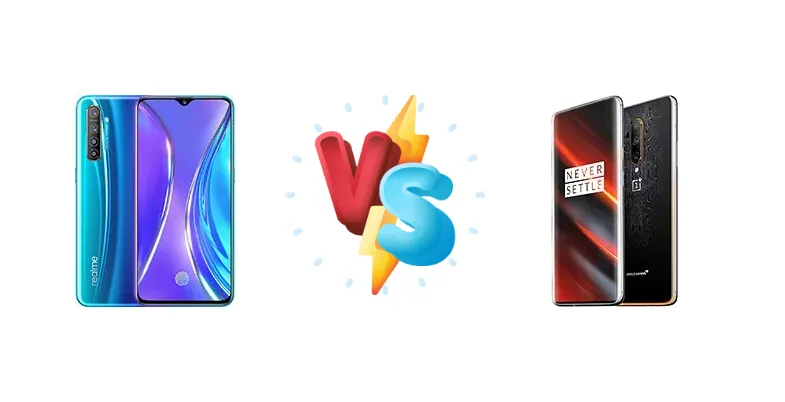
|
🏆 Quick Verdict
For the average user prioritizing sustained performance and 5G connectivity, the OnePlus 7T Pro 5G McLaren is the superior choice. Its Snapdragon 855+ chipset provides a noticeable performance uplift. However, the Realme X2 excels in battery endurance, making it a strong contender for users who prioritize longevity over raw speed.
| PHONES | ||
|---|---|---|
| Phone Names | Realme X2 | OnePlus 7T Pro 5G McLaren |
| Network | ||
|---|---|---|
| 2G bands | GSM 850 / 900 / 1800 / 1900 | GSM 850 / 900 / 1800 / 1900 |
| 3G bands | HSDPA 850 / 900 / 1900 / 2100 | HSDPA 850 / 900 / 1700(AWS) / 1900 / 2100 |
| 4G bands | 1, 3, 4, 5, 8, 34, 38, 39, 40, 41 - China | 1, 2, 3, 4, 5, 1, 2, 3, 4, 5, 7, 8, 12, 13, 17, 18, 19, 20, 25, 26, 28, 29, 30, 34, 38, 39, 40, 41, 46, 48, 66, 71 |
| 5G bands | - | 71 SA |
| Speed | HSPA, LTE | HSPA 42.2/5.76 Mbps, LTE (5CA) Cat18 1200/150 Mbps, 5G (2+ Gbps DL) |
| Technology | GSM / CDMA / HSPA / EVDO / LTE | GSM / CDMA / HSPA / LTE / 5G |
| 1, 3, 5, 7, 8, 20, 28, 38, 40, 41 - EMEA | CDMA 800 / 1900 & TD-SCDMA | |
| Launch | ||
|---|---|---|
| Announced | 2019, September 24. Released 2019, September | 2019, October 23. Released 2019, November 05 |
| Status | Discontinued | Discontinued |
| Body | ||
|---|---|---|
| Build | Glass front (Gorilla Glass 5), glass back (Gorilla Glass 5), plastic frame | Glass front (Gorilla Glass 6), glass back (Gorilla Glass 5), aluminum frame |
| Dimensions | 158.7 x 75.2 x 8.6 mm (6.25 x 2.96 x 0.34 in) | 162.6 x 75.9 x 8.8 mm (6.40 x 2.99 x 0.35 in) |
| SIM | Nano-SIM + Nano-SIM | Nano-SIM + Nano-SIM |
| Weight | 182 g (6.42 oz) | 206 g (7.27 oz) |
| Display | ||
|---|---|---|
| Protection | Corning Gorilla Glass 5 | Corning Gorilla Glass 6 |
| Resolution | 1080 x 2340 pixels, 19.5:9 ratio (~403 ppi density) | 1440 x 3120 pixels, 19.5:9 ratio (~516 ppi density) |
| Size | 6.4 inches, 100.5 cm2 (~84.3% screen-to-body ratio) | 6.67 inches, 108.8 cm2 (~88.1% screen-to-body ratio) |
| Type | Super AMOLED | Fluid AMOLED, 90Hz, HDR10+ |
| Platform | ||
|---|---|---|
| CPU | Octa-core (2x2.2 GHz Kryo 470 Gold & 6x1.8 GHz Kryo 470 Silver) | Octa-core (1x2.96 GHz Kryo 485 & 3x2.42 GHz Kryo 485 & 4x1.78 GHz Kryo 485) |
| Chipset | Qualcomm SDM730 Snapdragon 730G (8 nm) | Qualcomm SM8150 Snapdragon 855+ (7 nm) |
| GPU | Adreno 618 | Adreno 640 (700 MHz) |
| OS | Android 9.0 (Pie), upgradable to Android 10, Realme UI | Android 10, OxygenOS 10.0 |
| Memory | ||
|---|---|---|
| Card slot | microSDXC (dedicated slot) | No |
| Internal | 64GB 4GB RAM, 64GB 6GB RAM, 128GB 6GB RAM, 128GB 8GB RAM, 256GB 8GB RAM | 256GB 12GB RAM |
| UFS 2.1 | UFS 3.0 | |
| Main Camera | ||
|---|---|---|
| Features | LED flash, HDR, panorama | Laser AF, Dual-LED flash, HDR, panorama |
| Quad | 64 MP, f/1.8, (wide), 1/1.72", 0.8µm, PDAF 8 MP, f/2.3, 13mm (ultrawide) 2 MP (macro) Auxiliary lens | - |
| Triple | - | 48 MP, f/1.6, (wide), 1/2.0", 0.8µm, PDAF, OIS 8 MP, f/2.4, (telephoto), 1.0µm, PDAF, OIS, 3x optical zoom 16 MP, f/2.2, 13mm (ultrawide), AF |
| Video | 4K@30fps, 1080p@30/60/120fps, 720p@960fps, gyro-EIS | 4K@30/60fps, 1080p@30/60/240fps, 720p@960fps, Auto HDR, gyro-EIS |
| Selfie camera | ||
|---|---|---|
| Features | HDR | HDR |
| Single | 32 MP, f/2.0, 26mm (wide), 1/2.8", 0.8µm | Motorized pop-up 16 MP, f/2.0, 25mm (wide), 1/3.06", 1.0µm |
| Video | 1080p@30fps | 1080p@30fps, gyro-EIS |
| Sound | ||
|---|---|---|
| 3.5mm jack | Yes | No |
| 35mm jack | Yes | No |
| Loudspeaker | Yes | Yes, with stereo speakers |
| Comms | ||
|---|---|---|
| Bluetooth | 5.0, A2DP, LE | 5.1, A2DP, LE, aptX HD |
| NFC | Yes | Yes |
| Positioning | GPS, GLONASS, GALILEO, BDS | GPS (L1+L5), GLONASS (G1), BDS (B1), GALILEO (E1+E5a) |
| Radio | No | No |
| USB | USB Type-C 2.0, OTG | USB Type-C 3.1, OTG |
| WLAN | Wi-Fi 802.11 a/b/g/n/ac, dual-band, Wi-Fi Direct | Wi-Fi 802.11 a/b/g/n/ac, dual-band, Wi-Fi Direct, DLNA |
| Features | ||
|---|---|---|
| Sensors | Fingerprint (under display, optical), accelerometer, gyro, proximity, compass | Fingerprint (under display, optical), accelerometer, gyro, compass |
| - | Virtual proximity sensing | |
| Battery | ||
|---|---|---|
| Charging | 30W wired, 67% in 30 min | 30W wired |
| Type | 4000 mAh, non-removable | Li-Po 4085 mAh, non-removable |
| Misc | ||
|---|---|---|
| Colors | Pearl White, Pearl Blue, Pearl Green | Papaya Orange |
| Models | RMX1992, RMX1993, RMX1991 | HD1925 |
| Price | About 480 EUR | About 800 EUR |
| Tests | ||
|---|---|---|
| Audio quality | Noise -92.6dB / Crosstalk -88.1dB | - |
| Battery life | Endurance rating 105h | - |
| Camera | Photo / Video | - |
| Display | Contrast ratio: Infinite (nominal) | - |
| Loudspeaker | -28.0 LUFS (Good) | - |
| Performance | AnTuTu: 215578 (v7), 257443 (v8) GeekBench: 6926 (v4.4), 1750 (v5.1) GFXBench: 13fps (ES 3.1 onscreen) | - |
Realme X2
- Exceptional battery life (105h endurance)
- Fast 30W charging
- More affordable price point
- Less powerful Snapdragon 730G chipset
- Display brightness may be insufficient in direct sunlight
OnePlus 7T Pro 5G McLaren
- Significantly faster Snapdragon 855+ processor
- Likely superior display quality (AMOLED, potentially 90Hz)
- 5G connectivity
- Shorter battery life compared to the Realme X2
- Potentially higher price (depending on current deals)
Display Comparison
The Realme X2 features a display capable of 432 nits of peak brightness, which is adequate for indoor use but may struggle in direct sunlight. While the contrast ratio is listed as infinite (nominal), this is typical marketing language and doesn't reveal specifics about the panel technology. The OnePlus 7T Pro 5G McLaren, while lacking specific brightness data, benefits from OnePlus’s history of employing high-quality AMOLED displays. The 7T Pro’s display is likely to offer superior color accuracy and viewing angles. The absence of refresh rate data for the X2 suggests it likely operates at a standard 60Hz, while the 7T Pro is known for its 90Hz panel, contributing to a smoother user experience.
Camera Comparison
Both devices are listed with 'Photo / Video' capabilities, lacking specific details. However, given the market positioning, the OnePlus 7T Pro 5G McLaren likely features a more sophisticated camera system. While sensor size and aperture data are missing, OnePlus historically prioritizes camera quality in its Pro models. The Realme X2, focusing on value, likely employs a more cost-effective camera setup. The absence of details suggests neither phone features particularly groundbreaking camera technology, and reliance on software processing will be key to image quality.
Performance
The core difference lies in the chipsets. The Realme X2 utilizes the Qualcomm Snapdragon 730G (8nm), featuring an octa-core CPU with a 2x2.2 GHz Kryo 470 Gold and 6x1.8 GHz Kryo 470 Silver configuration. This is a capable mid-range processor. In contrast, the OnePlus 7T Pro 5G McLaren boasts the Snapdragon 855+ (7nm), a significantly more powerful chipset with an octa-core CPU peaking at 2.96 GHz. The 7nm process node of the 855+ offers improved thermal efficiency compared to the 8nm 730G, potentially leading to less throttling under sustained load. The 855+’s Adreno 640 GPU also provides a substantial graphics performance advantage, making it the clear winner for gaming.
Battery Life
The Realme X2 shines in battery endurance, achieving a measured 105-hour rating. This suggests excellent power efficiency from the Snapdragon 730G and optimized software. It also supports 30W wired charging, capable of reaching 67% charge in 30 minutes. The OnePlus 7T Pro 5G McLaren, while also supporting 30W charging, lacks a published endurance rating. Given the more power-hungry Snapdragon 855+ and 5G connectivity, its battery life is likely to be shorter than the X2. The X2’s longer endurance makes it ideal for users who frequently travel or have limited access to charging.
Buying Guide
Buy the Realme X2 if you need exceptional battery life and a reliable daily driver without breaking the bank. It’s ideal for users who prioritize efficiency and don’t demand the absolute highest performance. Buy the OnePlus 7T Pro 5G McLaren if you prefer a smoother, more responsive experience for demanding tasks like gaming and video editing, and if 5G connectivity is a must-have feature. It’s geared towards power users who want a premium feel without the flagship price tag.