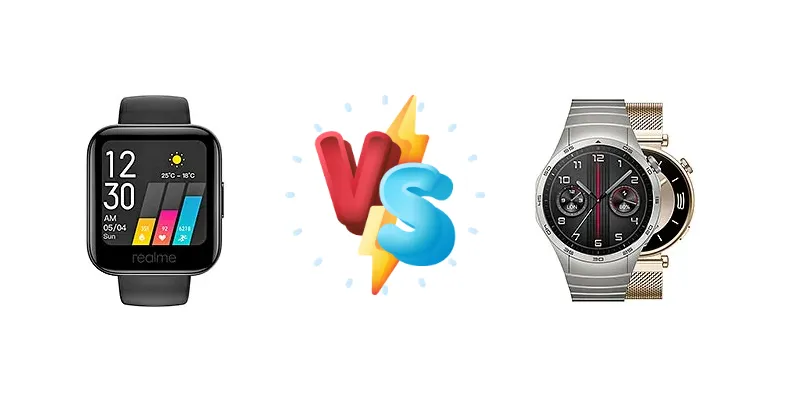
The smartwatch market is crowded, offering options from ultra-premium to incredibly affordable. We're pitting the Realme Watch, a budget-focused offering, against the Huawei Watch GT 4, a more feature-rich and premium device. This comparison aims to determine which smartwatch delivers the best value and functionality for your needs.
🏆 Quick Verdict
For the average user prioritizing comprehensive health tracking and a premium experience, the Huawei Watch GT 4 is the clear winner. Its wireless charging and likely more advanced sensor suite (based on brand positioning) justify the higher price. However, the Realme Watch remains a viable option for those on a strict budget.
| Network |
|---|
| 2G bands | N/A | N/A |
| 3G bands | N/A | N/A |
| 4G bands | N/A | N/A |
| EDGE | No | No |
| GPRS | No | No |
| Speed | No | No |
| Technology | No cellular connectivity | No cellular connectivity |
| Launch |
|---|
| Announced | 2020, May 25. Released 2020, June 05 | 2023, September 14 |
| Status | Discontinued | Available. Released 2023, October 02 |
| Body |
|---|
| Build | Glass front (Gorilla Glass 3), plastic back, plastic frame | Glass front, plastic back, stainless steel frame |
| Dimensions | 36.5 x 25.6 x 11.8 mm (1.44 x 1.01 x 0.46 in) | 46 x 46 x 10.9 mm (1.81 x 1.81 x 0.43 in) |
| SIM | No | No |
| Weight | 31 g (1.09 oz) | 37 g (41mm) / 48 g (46mm) (1.31 oz) |
| | IP68 dust/water resistant (up to 1.5m) | - |
| Display |
|---|
| Protection | Corning Gorilla Glass 3 | - |
| Resolution | 320 x 320 pixels (~323 ppi density) | 466 x 466 pixels (~326 ppi density) |
| Size | 1.4 inches | 1.43 inches |
| Type | IPS LCD, 380 nits (peak) | AMOLED |
| Platform |
|---|
| OS | Proprietary OS | HarmonyOS 4.0 |
| Memory |
|---|
| Card slot | No | No |
| Internal | - | Unspecified |
| | eMMC 4.5 | - |
| Sound |
|---|
| 3.5mm jack | No | - |
| 35mm jack | No | No |
| Loudspeaker | No | Yes |
| Comms |
|---|
| Bluetooth | 5.0, A2DP, LE | 5.2, A2DP, LE |
| NFC | No | Yes |
| Positioning | No | GPS (L1+L5), GLONASS, BDS, GALILEO, QZSS |
| Radio | No | No |
| USB | No | No |
| WLAN | No | No |
| Features |
|---|
| Sensors | Accelerometer, heart rate, SpO2 | Accelerometer, gyro, heart rate, barometer, compass, SpO2, thermometer (body temperature) |
| Battery |
|---|
| Charging | - | Wireless |
| Type | Li-Ion 160 mAh | Li-Ion 524 mAh |
| Misc |
|---|
| Colors | Black | Black, Steel, Silver, Gold |
| Models | RMA161 | ARA-B19, PNX-B19 |
| Price | About 60 EUR | About 270 EUR |
Realme Watch
- Likely very affordable price point
- Simple and easy-to-use interface
- Essential fitness tracking features
- Likely lacks advanced health tracking features
- Potentially lower build quality
- No wireless charging
Huawei Watch GT 4
- Wireless charging for added convenience
- Likely more accurate health tracking sensors
- Premium design and build quality
- Higher price point
- Potentially more complex interface
- May require Huawei ecosystem integration for full functionality
Display Comparison
Given the Realme Watch's position in the market, it likely utilizes a standard LCD panel, prioritizing cost-effectiveness over advanced display technology. The Huawei Watch GT 4, being a premium device, likely features an AMOLED display, offering superior contrast, color accuracy, and potentially better outdoor visibility. The absence of specific Realme Watch display specs suggests a focus on basic functionality rather than visual fidelity. The GT 4's display will benefit users who frequently view notifications or workout data in bright sunlight.
Camera Comparison
Neither device is expected to feature a camera, as this is not a common feature in smartwatches, particularly in the fitness-focused segment. Both devices will rely on connected smartphone cameras for photography.
Performance
Without specific chipset details for the Realme Watch, we can assume it employs a low-power processor sufficient for basic fitness tracking and notification mirroring. The Huawei Watch GT 4, while not focused on running complex apps, likely utilizes a more efficient processor to manage its advanced health tracking features and wireless charging capabilities. The GT 4’s processor architecture will likely prioritize power efficiency to maximize battery life, a key selling point for Huawei smartwatches.
Battery Life
The Huawei Watch GT 4’s inclusion of wireless charging is a significant advantage, offering convenience and a clutter-free charging experience. While the Realme Watch likely relies on a traditional charging cable, the actual battery life will depend on the mAh capacity of each device. However, Huawei’s history suggests a focus on maximizing battery life through software optimization and efficient hardware, potentially offsetting any capacity difference with the Realme Watch.
Buying Guide
Buy the Realme Watch if you need a basic, affordable fitness tracker with essential features like step counting and heart rate monitoring, and aren't concerned with advanced health metrics or premium build quality. Buy the Huawei Watch GT 4 if you prefer a more sophisticated smartwatch experience with wireless charging, potentially more accurate health data, and a more polished design, and are willing to invest in a higher price point.
Frequently Asked Questions
❓ Does the Huawei Watch GT 4 require a smartphone to function fully, or can it operate independently?
While the Huawei Watch GT 4 can track fitness data and display time independently, full functionality, including notifications and advanced health analysis, benefits from pairing with a smartphone. Huawei's ecosystem integration enhances the experience, but it's also compatible with Android and iOS devices, albeit with potentially limited features.
❓ Is the Realme Watch compatible with iPhones, or is it primarily designed for Android users?
The Realme Watch is likely compatible with iPhones via Bluetooth, but the level of integration may be limited compared to Android devices. Features like notification mirroring and data synchronization might not be as seamless on iOS.
❓ How does the health tracking accuracy of the Huawei Watch GT 4 compare to other premium smartwatches?
Huawei has invested heavily in health tracking technology, and the GT 4 likely utilizes advanced sensors for heart rate monitoring, SpO2 measurement, and sleep tracking. While independent testing is required for a definitive comparison, Huawei's sensors are generally considered to be competitive with other premium brands like Apple and Samsung.