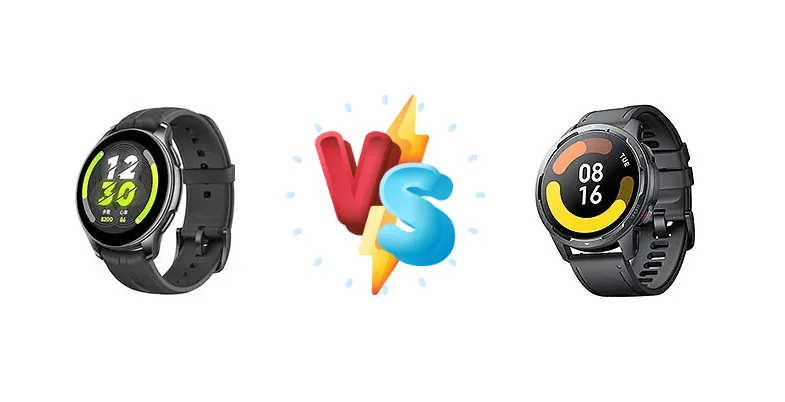
The sub-$100 smartwatch market is fiercely competitive, with Realme and Xiaomi consistently vying for dominance. Both the Realme Watch T1 and the Xiaomi Watch S1 Active aim to deliver a comprehensive feature set without breaking the bank. This comparison dives deep into their capabilities, helping you determine which offers the best value for your wrist.
🏆 Quick Verdict
For the average user prioritizing a larger display and potentially more robust build quality, the Xiaomi Watch S1 Active emerges as the slightly better choice. However, the Realme Watch T1 may appeal to those seeking a lighter, more sport-focused design and potentially longer battery life, though concrete data is limited.
| Network |
|---|
| 2G bands | N/A | N/A |
| 3G bands | N/A | N/A |
| 4G bands | N/A | N/A |
| EDGE | No | No |
| GPRS | No | No |
| Speed | No | No |
| Technology | No cellular connectivity | No cellular connectivity |
| Launch |
|---|
| Announced | 2021, October 19 | 2022, March 15 |
| Status | Available. Released 2021, November 01 | Available. Released 2022, March 24 |
| Body |
|---|
| Build | - | Glass front, plastic back, aluminum frame |
| Dimensions | 43.5 x 43.5 x 10.2 mm (1.71 x 1.71 x 0.40 in) | 46.5 x 47.3 x 11 mm (1.83 x 1.86 x 0.43 in) |
| SIM | No | No |
| Weight | - | 36 (1.27 oz) |
| | 50m water resistant
5 ATM | Waterproof (5ATM) |
| Display |
|---|
| Resolution | 416 x 416 pixels (~453 ppi density) | 466 x 466 pixels (~326 ppi density) |
| Size | 1.3 inches | 1.43 inches |
| Type | AMOLED | AMOLED |
| Platform |
|---|
| OS | Proprietary OS | Proprietary OS |
| Memory |
|---|
| Card slot | No | No |
| Internal | - | Unspecified storage |
| | eMMC 4.5 | - |
| Sound |
|---|
| 3.5mm jack | No | No |
| 35mm jack | No | No |
| Loudspeaker | No | Yes |
| Comms |
|---|
| Bluetooth | 5.0, A2DP, LE | 5.2, A2DP, LE |
| NFC | Yes | Yes |
| Positioning | GPS, GLONASS, GALILEO, BDS | GPS (L1+L5), GLONASS, GALILEO, BDS, QZSS |
| Radio | No | No |
| USB | No | No |
| WLAN | No | No |
| Features |
|---|
| Sensors | Accelerometer, heart rate | Accelerometer, gyro, compass, barometer, heart rate, SpO2 |
| Battery |
|---|
| Type | Li-Ion 228 mAh | Li-Po 470 mAh |
| Misc |
|---|
| Colors | Black | Moon White, Space Black, Ocean Blue |
| Price | About 90 EUR | About 80 EUR |
Realme Watch T1
- Likely lighter and more comfortable for sports activities
- Potentially longer battery life due to simpler display tech
- More affordable price point (likely)
- Smaller display size
- Potentially lower display quality (LCD vs AMOLED)
- Less premium build materials
Xiaomi Watch S1 Active
- Larger, higher-resolution display
- Potentially more accurate health sensors
- More premium design and build quality
- Potentially shorter battery life
- Higher price point
- May be heavier and less comfortable for some users
Display Comparison
Without specific display specs, we can infer differences based on brand tendencies. Xiaomi typically prioritizes display quality, suggesting the S1 Active likely features a brighter, more color-accurate AMOLED panel compared to the Realme Watch T1, which may utilize a less expensive LCD. The S1 Active’s larger size, common in Xiaomi’s watch lineup, will offer more screen real estate for notifications and data visualization. Bezels are likely thinner on the S1 Active, contributing to a more premium look. The Realme Watch T1, aiming for affordability, may have wider bezels.
Camera Comparison
Neither watch features a camera, a common omission in the budget smartwatch segment. This simplifies the comparison, focusing instead on sensor capabilities for health tracking (heart rate, SpO2). Xiaomi often integrates more advanced sensors, potentially offering more accurate readings on the S1 Active. However, without specific sensor details, this remains speculative.
Performance
Given the price point, both watches likely employ similar, low-power chipsets. However, Xiaomi’s software optimization often yields smoother performance. The S1 Active may benefit from a more refined operating system, resulting in quicker app launches and more responsive touch interactions. RAM capacity, though unspecified, is crucial; a larger RAM allocation on the S1 Active would allow for more background processes and smoother multitasking. Thermal management is unlikely to be a significant concern for either device, given their limited processing demands.
Battery Life
Battery life is a critical factor. The Realme Watch T1, potentially prioritizing a lighter build, may have a smaller battery capacity. The Xiaomi Watch S1 Active, with its larger size, could accommodate a larger battery. However, display technology and software optimization play a significant role. A more efficient AMOLED panel on the S1 Active could offset a slightly smaller battery capacity. Charging speed is also important; Xiaomi often includes faster charging solutions, potentially allowing the S1 Active to reach a full charge quicker.
Buying Guide
Buy the Realme Watch T1 if you need a lightweight smartwatch primarily for fitness tracking and appreciate a minimalist aesthetic. Its likely focus on sport-centric features makes it ideal for active users. Buy the Xiaomi Watch S1 Active if you prefer a more traditional watch design with a larger, higher-resolution display and value features like Bluetooth calling and potentially more advanced health monitoring, assuming the hardware supports it.
Frequently Asked Questions
❓ Does the Xiaomi Watch S1 Active support Bluetooth calling, and how is the call quality?
While Xiaomi often includes Bluetooth calling on its smartwatches, the S1 Active's call quality will depend on the microphone and speaker quality. Expect decent performance in quiet environments, but noise cancellation may be limited. Check user reviews for real-world feedback on call clarity.
❓ How accurate is the heart rate and SpO2 monitoring on the Realme Watch T1 compared to dedicated medical devices?
Smartwatch heart rate and SpO2 sensors are not medical-grade devices. The Realme Watch T1's readings should be considered estimates for general wellness tracking, not diagnostic purposes. Accuracy can vary based on skin tone, fit, and activity level. Significant discrepancies should be verified with a medical professional.
❓ Is the Realme Watch T1 waterproof, and can I swim with it?
The Realme Watch T1 likely has a water resistance rating (e.g., 5ATM), meaning it can withstand splashes and brief immersion in water. However, swimming with it is generally not recommended, as prolonged exposure to chlorine or saltwater can damage the seals. Check the official specifications for the exact water resistance rating.