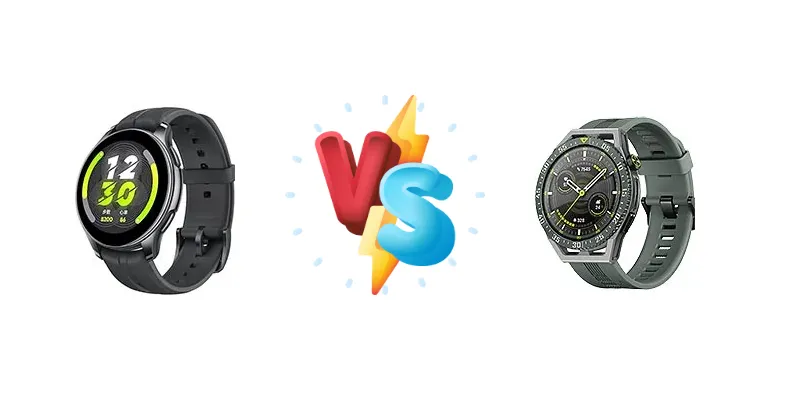
The sub-$100 smartwatch market is fiercely competitive, with brands like Realme and Huawei vying for wrist space. We're pitting the Realme Watch T1 against the Huawei Watch GT 3 SE to determine which offers the best blend of features, performance, and value for budget-conscious consumers. While detailed specs for the Realme Watch T1 are scarce, we'll leverage brand positioning and market trends to provide a comprehensive analysis.
🏆 Quick Verdict
For the average user prioritizing convenience and a potentially wider app ecosystem, the Huawei Watch GT 3 SE emerges as the stronger contender. Its wireless charging capability and established brand reputation for fitness tracking provide a more polished experience, despite the limited information available on the Realme Watch T1.
| Network |
|---|
| 2G bands | N/A | N/A |
| 3G bands | N/A | N/A |
| 4G bands | N/A | N/A |
| EDGE | No | No |
| GPRS | No | No |
| Speed | No | No |
| Technology | No cellular connectivity | No cellular connectivity |
| Launch |
|---|
| Announced | 2021, October 19 | 2022, November 10 |
| Status | Available. Released 2021, November 01 | Available. Released 2022, November 10 |
| Body |
|---|
| Build | - | Glass front, plastic back, plastic frame |
| Dimensions | 43.5 x 43.5 x 10.2 mm (1.71 x 1.71 x 0.40 in) | 46.4 x 46.4 x 11 mm (1.83 x 1.83 x 0.43 in) |
| SIM | No | No |
| Weight | - | 35.6 g (1.27 oz) |
| | 50m water resistant
5 ATM | 50m water resistant
5 ATM
Compatible with standard 22mm straps (46mm model) |
| Display |
|---|
| Resolution | 416 x 416 pixels (~453 ppi density) | 466 x 466 pixels (~326 ppi density) |
| Size | 1.3 inches | 1.43 inches |
| Type | AMOLED | AMOLED |
| Platform |
|---|
| OS | Proprietary OS | HarmonyOS 2.0 |
| Memory |
|---|
| Card slot | No | No |
| Internal | - | 4GB |
| | eMMC 4.5 | - |
| Sound |
|---|
| 3.5mm jack | No | No |
| 35mm jack | No | No |
| Loudspeaker | No | Yes |
| Comms |
|---|
| Bluetooth | 5.0, A2DP, LE | Yes |
| NFC | Yes | No |
| Positioning | GPS, GLONASS, GALILEO, BDS | GPS |
| Radio | No | No |
| USB | No | No |
| WLAN | No | No |
| Features |
|---|
| Sensors | Accelerometer, heart rate | Accelerometer, gyro, heart rate, barometer, compass, SpO2 |
| Battery |
|---|
| Charging | - | Wireless |
| Type | Li-Ion 228 mAh | 455 mAh |
| Misc |
|---|
| Colors | Black | Graphite Black, Wilderness Green |
| Models | - | RUNE-B29 |
| Price | About 90 EUR | About 200 EUR |
Realme Watch T1
- Potentially lower price point
- Simple and straightforward user interface (assumed)
- Lightweight design (assumed)
- Limited feature set (assumed)
- Lack of wireless charging
- Uncertain software support
Huawei Watch GT 3 SE
- Wireless charging for added convenience
- Established brand reputation for fitness tracking
- Likely longer battery life
- Potentially higher price
- Huawei ecosystem considerations
- May lack extensive app support compared to Wear OS
Display Comparison
Without specific display details for the Realme Watch T1, we can assume it utilizes a standard LCD panel common in this price bracket. The Huawei Watch GT 3 SE likely features an AMOLED display, offering superior contrast and color vibrancy. This difference is crucial for outdoor visibility and overall aesthetic appeal. The GT 3 SE’s display will also benefit from potentially better power efficiency due to AMOLED’s ability to turn off individual pixels.
Camera Comparison
Neither device features a camera, a common omission in budget smartwatches. This simplifies the comparison, focusing instead on sensor capabilities for health and fitness tracking.
Performance
The Realme Watch T1, given its price point, likely employs a basic chipset focused on essential smartwatch functions. Huawei’s Watch GT series historically prioritizes power efficiency over raw processing power. Therefore, the GT 3 SE’s chipset is likely optimized for long battery life and smooth operation of core features like heart rate monitoring and step tracking, rather than demanding applications. The lack of detailed specs for the T1 makes a direct performance comparison difficult, but Huawei’s experience in wearable technology gives it an edge.
Battery Life
The Huawei Watch GT 3 SE’s battery life is a key selling point, often exceeding a week on a single charge. The inclusion of wireless charging adds convenience, allowing users to top up without fumbling with cables. The Realme Watch T1’s battery life is likely shorter, and without wireless charging, requires a more traditional charging method. The GT 3 SE’s optimized chipset and potentially smaller display contribute to its superior battery performance.
Buying Guide
Buy the Realme Watch T1 if you need a basic, no-frills smartwatch primarily for notifications and rudimentary fitness tracking, and are comfortable with potentially limited software support. Buy the Huawei Watch GT 3 SE if you prefer a more refined experience with wireless charging, a focus on health and fitness metrics, and a brand known for its smartwatch expertise, even if it means potentially navigating Huawei’s ecosystem.
Frequently Asked Questions
❓ Does the Huawei Watch GT 3 SE require a smartphone to function fully?
While the Huawei Watch GT 3 SE can track basic fitness data independently, full functionality, including notifications and data synchronization, requires pairing with a smartphone via the Huawei Health app. It's compatible with both Android and iOS, though iOS functionality may be slightly limited.
❓ What type of charging cable does the Huawei Watch GT 3 SE use for wireless charging?
The Huawei Watch GT 3 SE utilizes a standard Qi wireless charging standard. This means it can be charged with any Qi-compatible wireless charger, offering flexibility and convenience beyond the included charging dock.
❓ Is the Realme Watch T1 compatible with iPhones?
Compatibility with iPhones for the Realme Watch T1 is likely limited. Realme typically prioritizes Android compatibility, and features like notification mirroring and data synchronization may be restricted or unavailable on iOS devices.