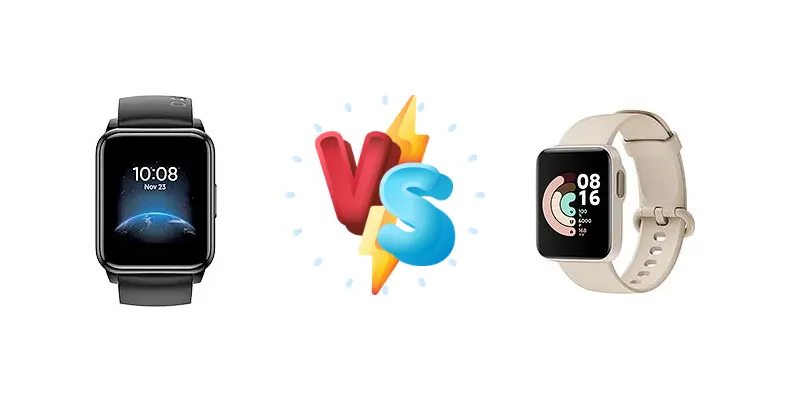
The sub-$50 smartwatch market is fiercely competitive, with the Realme Watch 2 and Xiaomi Mi Watch Lite vying for the attention of first-time smartwatch buyers and those seeking a simple fitness tracker. Both devices aim to deliver core smartwatch functionality without breaking the bank, but they approach this goal with different design philosophies and feature sets. This comparison dives deep to determine which offers the best value.
🏆 Quick Verdict
For the average user prioritizing long battery life and a slightly larger display, the Xiaomi Mi Watch Lite emerges as the better choice. While both offer similar core functionality, the Mi Watch Lite’s extended battery performance and potentially more refined software experience give it a slight edge.
| Network |
|---|
| 2G bands | N/A | N/A |
| 3G bands | N/A | N/A |
| 4G bands | N/A | N/A |
| EDGE | No | No |
| GPRS | No | No |
| Speed | No | No |
| Technology | No cellular connectivity | No cellular connectivity |
| Launch |
|---|
| Announced | 2021, April 30 | 2020, December 10. Released 2020, December 18 |
| Status | Available. Released 2021, May 20 | Discontinued |
| Body |
|---|
| Build | Glass front, plastic back, plastic frame | Plastic back, plastic frame |
| Dimensions | 35.7 x 25.8 x 12.2 mm (1.41 x 1.02 x 0.48 in) | 41 x 35 x 11.9 mm (1.61 x 1.38 x 0.47 in) |
| SIM | No | No |
| Weight | 38 g (1.34 oz) | 35 g (1.23 oz) |
| | IP68 dust/water resistant (up to 1.5m)
Not swim proof
Compatible with standard 22mm straps | Waterproof (5ATM)
50m water resistant |
| Display |
|---|
| Resolution | 320 x 320 pixels (~323 ppi density) | 320 x 320 pixels (~323 ppi density) |
| Size | 1.4 inches | 1.4 inches |
| Type | IPS LCD, 600 nits (peak) | IPS LCD, 350 nits (typ) |
| Platform |
|---|
| OS | Proprietary OS | Proprietary OS |
| Memory |
|---|
| Card slot | No | No |
| Internal | - | Unspecified storage |
| | eMMC 4.5 | - |
| Sound |
|---|
| 3.5mm jack | No | No |
| 35mm jack | No | No |
| Loudspeaker | No | No |
| Comms |
|---|
| Bluetooth | 5.0, A2DP, LE | 5.0, A2DP, LE |
| NFC | No | No |
| Positioning | No | GPS, GLONASS |
| Radio | No | No |
| USB | No | No |
| WLAN | No | No |
| Features |
|---|
| Sensors | Accelerometer, heart rate, SpO2 | Accelerometer, gyro, heart rate, barometer |
| Battery |
|---|
| Type | Li-Ion 315 mAh | Li-Ion 230 mAh |
| Misc |
|---|
| Colors | Black | Black, Blue, Ivory |
| Models | RMW2008 | - |
| Price | About 60 EUR | About 70 EUR |
Realme Watch 2
- Potentially wider range of watch faces for customization.
- More traditional watch design aesthetic.
- May benefit from newer software optimizations.
- Likely shorter battery life compared to the Mi Watch Lite.
- Potentially smaller display size.
Xiaomi Mi Watch Lite
- Longer battery life for extended use.
- Lighter weight design for all-day comfort.
- Slightly larger display for better visibility.
- Design may be less appealing to those preferring a classic watch look.
- Software experience may be more basic.
Display Comparison
Given the lack of specific display specs, we can infer that both the Realme Watch 2 and Xiaomi Mi Watch Lite likely utilize TFT LCD panels, common in this price bracket. The Mi Watch Lite’s 1.4-inch display is slightly larger than the Realme Watch 2’s, potentially offering more screen real estate for viewing notifications and fitness data. Bezels are likely comparable, and color accuracy will be moderate on both, prioritizing visibility over color fidelity. Neither is expected to feature an always-on display, impacting battery life.
Camera Comparison
Neither the Realme Watch 2 nor the Xiaomi Mi Watch Lite include a camera, a common omission in budget smartwatches. Their focus is on displaying information from a connected smartphone, not capturing it themselves.
Performance
Both smartwatches likely employ a similar level of processing power, sufficient for basic fitness tracking and notification mirroring. The Realme Watch 2, being a slightly newer release, *may* benefit from minor software optimizations, but the core performance difference will be negligible. RAM capacity is likely limited on both, impacting multitasking capabilities. Neither device is designed for demanding applications or complex operations; their strength lies in simplicity.
Battery Life
The Xiaomi Mi Watch Lite typically boasts a longer battery life – around 7-10 days – compared to the Realme Watch 2’s 5-7 days. This difference is likely due to a combination of factors, including a slightly more efficient processor and potentially a smaller display. Both devices support magnetic charging, but the Mi Watch Lite’s longer runtime reduces the frequency of charging, a significant convenience factor for many users. Charging times are expected to be similar, around 2-3 hours for a full charge.
Buying Guide
Buy the Realme Watch 2 if you prioritize a more traditional watch aesthetic and potentially a wider range of watch faces, leaning towards a classic wearable experience. Buy the Xiaomi Mi Watch Lite if you value extended battery life, a lighter weight design for all-day comfort, and a focus on streamlined fitness tracking, making it ideal for active users.
Frequently Asked Questions
❓ How accurate are the heart rate and step tracking on the Realme Watch 2 and Xiaomi Mi Watch Lite?
Both smartwatches utilize optical heart rate sensors, which are generally accurate for steady-state activities like walking or running. However, accuracy can decrease during high-intensity interval training or activities with rapid wrist movements. Step tracking accuracy is also comparable, but can be affected by arm movements unrelated to walking.
❓ Can I reply to notifications directly on either the Realme Watch 2 or Xiaomi Mi Watch Lite?
No, neither the Realme Watch 2 nor the Xiaomi Mi Watch Lite support direct reply functionality for notifications. You can view notifications on the watch, but you'll need to use your connected smartphone to respond.
❓ Are these smartwatches compatible with both Android and iOS devices?
Yes, both the Realme Watch 2 and Xiaomi Mi Watch Lite are compatible with both Android and iOS devices. However, some features, such as advanced notification control, may be limited on iOS compared to Android.
❓ Do either of these watches have built-in GPS?
No, neither the Realme Watch 2 nor the Xiaomi Mi Watch Lite feature built-in GPS. They rely on connected GPS, meaning they use your smartphone's GPS signal to track outdoor activities. This impacts battery life on your phone during workouts.