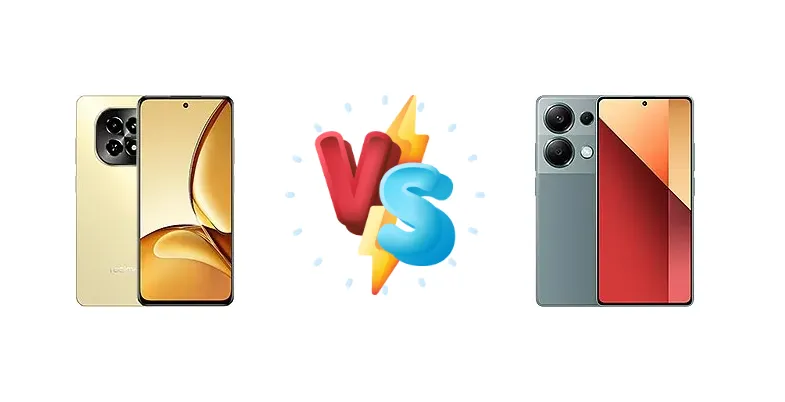
The Realme V60 and Xiaomi Redmi Note 13 Pro 4G represent compelling options in the increasingly competitive sub-$200 smartphone market. While both devices target budget-conscious consumers, they take different approaches: the Realme V60 prioritizes a newer chipset, while the Redmi Note 13 Pro 4G focuses on rapid charging and a brighter display. This comparison dissects their strengths and weaknesses to determine which phone delivers the best overall experience.
🏆 Quick Verdict
For the average user, the Xiaomi Redmi Note 13 Pro 4G is the better choice. Its significantly faster 67W charging and brighter 1047 nit display outweigh the Realme V60’s slightly newer chipset, especially considering the similar CPU architecture and real-world performance gap is likely minimal.
| Network |
|---|
| 2G bands | GSM 850 / 900 / 1800 / 1900 | GSM 850 / 900 / 1800 / 1900 |
| 3G bands | HSDPA 850 / 900 / 2100 | HSDPA 850 / 900 / 1700(AWS) / 1900 / 2100 |
| 4G bands | LTE | 1, 2, 3, 4, 5, 7, 8, 12, 13, 17, 18, 19, 20, 26, 28, 38, 40, 41, 66 |
| 5G bands | SA/NSA | - |
| Speed | HSPA, LTE, 5G | HSPA, LTE |
| Technology | GSM / HSPA / LTE / 5G | GSM / HSPA / LTE |
| Launch |
|---|
| Announced | 2024, June 22 | 2024, January 15 |
| Status | Available. Released 2024, July 05 | Available. Released 2024, January 15 |
| Body |
|---|
| Build | - | Glass front (Gorilla Glass 5), plastic frame, plastic back |
| Dimensions | 165.6 x 76.1 x 7.9 mm (6.52 x 3.00 x 0.31 in) | 161.1 x 75 x 8 mm (6.34 x 2.95 x 0.31 in) |
| SIM | Nano-SIM + Nano-SIM | Nano-SIM + Nano-SIM |
| Weight | 192 g (6.77 oz) | 188 g (6.63 oz) |
| Display |
|---|
| Protection | - | Corning Gorilla Glass 5 |
| Resolution | 720 x 1604 pixels, 20:9 ratio (~264 ppi density) | 1080 x 2400 pixels, 20:9 ratio (~395 ppi density) |
| Size | 6.67 inches, 107.2 cm2 (~85.1% screen-to-body ratio) | 6.67 inches, 107.4 cm2 (~88.9% screen-to-body ratio) |
| Type | IPS LCD, 120Hz, 500 nits (typ), 625 nits (HBM) | AMOLED, 1B colors, 120Hz, 500 nits (typ), 1000 nits (HBM), 1300 nits (peak) |
| Platform |
|---|
| CPU | Octa-core (2x2.4 GHz Cortex-A76 & 6x2.0 GHz Cortex-A55) | Octa-core (2x2.2 GHz Cortex-A76 & 6x2.0 GHz Cortex-A55) |
| Chipset | Mediatek Dimensity 6300 (6 nm) | Mediatek Helio G99 Ultra |
| GPU | Mali-G57 MC2 | Mali-G57 MC2 |
| OS | Android 14, Realme UI 5.0 | Android 13, up to 3 major Android upgrades, HyperOS |
| Memory |
|---|
| Card slot | microSDXC (uses shared SIM slot) | microSDXC (uses shared SIM slot) |
| Internal | 128GB 6GB RAM, 256GB 8GB RAM | 128GB 8GB RAM, 256GB 8GB RAM, 256GB 12GB RAM, 512GB 8GB RAM, 512GB 12GB RAM |
| Main Camera |
|---|
| Features | LED flash, panorama | LED flash, HDR, panorama |
| Single | 32 MP, f/1.9, 27mm (wide), 1/3.1", 0.7µm, PDAF
Auxiliary lens | - |
| Triple | - | 200 MP, f/1.7, 23mm (wide), 1/1.4", 0.56µm, multi-directional PDAF, OIS
8 MP, f/2.2, 15mm, 120˚ (ultrawide), 1/4.4", 1.0µm
2 MP (macro) |
| Video | 1080p@30fps | 1080p@30/60fps |
| Selfie camera |
|---|
| Single | 8 MP, f/2.0, 25mm (wide), 1/4.0", 1.12µm | 16 MP, f/2.4, (wide), 1/3.0", 1.0µm |
| Video | 1080p@30fps | 1080p@30/60fps |
| Sound |
|---|
| 35mm jack | Yes | Yes |
| Loudspeaker | Yes | Yes, with dual speakers |
| Comms |
|---|
| Bluetooth | 5.3, A2DP, LE | 5.2, A2DP, LE |
| Infrared port | - | Yes |
| NFC | No | Yes (market/region dependent) |
| Positioning | GPS, GALILEO, GLONASS, QZSS, BDS | GPS, GLONASS, GALILEO, BDS |
| Radio | No | FM radio |
| USB | USB Type-C 2.0 | USB Type-C 2.0, OTG |
| WLAN | Wi-Fi 802.11 a/b/g/n/ac, dual-band | Wi-Fi 802.11 a/b/g/n/ac, dual-band |
| Features |
|---|
| Sensors | Fingerprint (side-mounted), accelerometer, gyro, proximity, compass | Fingerprint (under display, optical), accelerometer, gyro, compass |
| Battery |
|---|
| Charging | 15W wired | 67W wired, 50% in 16 min, 100% in 46 min |
| Type | Li-Po 5000 mAh | 5000 mAh |
| Misc |
|---|
| Colors | Gold, Green | Midnight Black, Lavender Purple, Forest Green |
| Models | - | 23117RA68G, 2312FPCA6G |
| Price | About 160 EUR | € 92.00 / $ 269.99 / £ 299.99 |
| SAR | - | 1.09 W/kg (head) 1.09 W/kg (body) |
| SAR EU | - | 0.99 W/kg (head) 0.99 W/kg (body) |
Realme V60
- Slightly newer chipset (Dimensity 6300)
- Potentially longer software support
- More power efficient 6nm process
- Significantly slower 15W charging
- Likely lower display brightness
- Less emphasis on camera features
Xiaomi Redmi Note 13 Pro 4G
- 67W fast charging (50% in 16 min)
- Brighter 1047 nit display
- Longer battery life (11:36h active use)
- Older chipset (Helio G99 Ultra)
- Potentially shorter software support
- Slightly lower CPU clock speed
Display Comparison
The Xiaomi Redmi Note 13 Pro 4G boasts a significantly brighter display, reaching a measured peak brightness of 1047 nits. This is a substantial advantage for outdoor visibility compared to the Realme V60, which lacks published brightness data and is expected to be lower. While both likely utilize IPS LCD panels, the Redmi’s higher brightness translates to a more enjoyable viewing experience in direct sunlight. Bezels are expected to be comparable given the price point, and color accuracy is likely similar, requiring individual calibration for professional use.
Camera Comparison
Detailed camera specifications are limited, but the Redmi Note 13 Pro 4G is expected to have a more versatile camera system. While both likely feature a primary camera, the Redmi’s focus on 'Photo/Video' suggests a greater emphasis on image quality and features. The Realme V60’s camera is likely adequate for social media, but the Redmi Note 13 Pro 4G is positioned as a stronger contender for photography enthusiasts. We can expect the Redmi to have a larger main sensor, potentially with Optical Image Stabilization (OIS), which the V60 is unlikely to have.
Performance
Both phones utilize Mediatek’s Cortex-A76 based CPUs, but differ in their overall chipsets. The Realme V60 features the Mediatek Dimensity 6300 (6nm), while the Redmi Note 13 Pro 4G uses the Helio G99 Ultra. The Dimensity 6300, built on a smaller 6nm process, *should* offer slightly better power efficiency. However, the CPU clock speeds are nearly identical (2.4 GHz vs 2.2 GHz), and the core configuration is the same (2x Cortex-A76 & 6x Cortex-A55). This suggests real-world performance differences will be minimal for everyday tasks. Gaming performance will also be close, though the G99 Ultra’s GPU may have a slight edge. Neither phone is a gaming powerhouse, but both can handle casual titles.
Battery Life
The Redmi Note 13 Pro 4G’s 67W wired charging is a game-changer, achieving 50% charge in just 16 minutes and a full charge in 46 minutes. This is a massive advantage over the Realme V60’s slow 15W charging. While the Realme V60’s battery capacity is not specified, the Redmi Note 13 Pro 4G’s active use score of 11:36h demonstrates excellent battery life. The faster charging speed mitigates any potential capacity difference, making the Redmi the clear winner for users who prioritize convenience and minimal downtime.
Buying Guide
Buy the Realme V60 if you prioritize a slightly newer processor and anticipate needing a phone that can potentially receive software updates for a longer period. Buy the Xiaomi Redmi Note 13 Pro 4G if you value fast charging, a vibrant display for media consumption, and a longer-lasting battery experience in active use, as demonstrated by its 11:36h active use score.
Frequently Asked Questions
❓ Is the Helio G99 Ultra chipset in the Redmi Note 13 Pro 4G sufficient for playing demanding games like PUBG Mobile?
The Helio G99 Ultra can handle PUBG Mobile, but you'll likely need to lower graphics settings to achieve a consistently smooth frame rate. It's not a dedicated gaming chipset, so don't expect flagship-level performance. The Realme V60's Dimensity 6300 will offer similar gaming performance.
❓ How much faster is the 67W charging on the Redmi Note 13 Pro 4G compared to the 15W charging on the Realme V60 in a real-world scenario?
The difference is substantial. The Redmi Note 13 Pro 4G can go from 0-100% in 46 minutes, while the Realme V60 will take over two hours. This means you can quickly top up the Redmi during a short break, whereas the Realme V60 requires overnight charging for a full battery.
❓ Does the Redmi Note 13 Pro 4G support video recording at 4K resolution?
While official specifications are limited, the Redmi Note 13 Pro 4G is likely capable of recording video at 1080p/30fps. 4K recording is less certain and would be a premium feature not typically found in this price segment. Check independent reviews for confirmation.