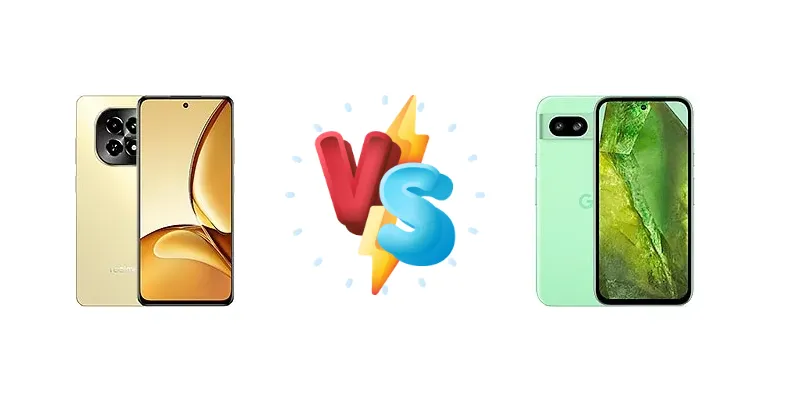
The Realme V60 and Google Pixel 8a represent distinct approaches to the budget and mid-range smartphone market. The V60 focuses on delivering solid core specs at an aggressive price point, while the Pixel 8a leverages Google’s Tensor G3 chip and renowned computational photography. This comparison dissects their key differences to determine which device best suits your priorities.
🏆 Quick Verdict
For the average user prioritizing camera quality and software experience, the Google Pixel 8a is the clear winner. Its Tensor G3 chip and exceptional image processing capabilities justify the price premium. However, the Realme V60 offers compelling value for those focused on basic performance and a lower upfront cost.
| Network |
|---|
| 2G bands | GSM 850 / 900 / 1800 / 1900 | GSM 850 / 900 / 1800 / 1900 |
| 3G bands | HSDPA 850 / 900 / 2100 | HSDPA 800 / 850 / 900 / 1700(AWS) / 1900 / 2100 |
| 4G bands | LTE | 1, 2, 3, 4, 5, 7, 8, 12, 17, 18, 19, 20, 26, 28, 32, 38, 40, 41, 42, 66 - G6GPR (International) |
| 5G bands | SA/NSA | 1, 2, 3, 5, 7, 8, 12, 20, 26, 28, 38, 40, 41, 66, 75, 76, 77, 78 SA/NSA/Sub6 - G6GPR (International) |
| Speed | HSPA, LTE, 5G | HSPA, LTE, 5G |
| Technology | GSM / HSPA / LTE / 5G | GSM / HSPA / LTE / 5G |
| Launch |
|---|
| Announced | 2024, June 22 | 2024, May 07 |
| Status | Available. Released 2024, July 05 | Available. Released 2024, May 14 |
| Body |
|---|
| Build | - | Glass front (Gorilla Glass 3), aluminum frame, plastic back |
| Dimensions | 165.6 x 76.1 x 7.9 mm (6.52 x 3.00 x 0.31 in) | 152.1 x 72.7 x 8.9 mm (5.99 x 2.86 x 0.35 in) |
| SIM | Nano-SIM + Nano-SIM | Nano-SIM + eSIM |
| Weight | 192 g (6.77 oz) | 188 g (6.63 oz) |
| Display |
|---|
| Protection | - | Corning Gorilla Glass 3, Mohs level 5 |
| Resolution | 720 x 1604 pixels, 20:9 ratio (~264 ppi density) | 1080 x 2400 pixels, 20:9 ratio (~430 ppi density) |
| Size | 6.67 inches, 107.2 cm2 (~85.1% screen-to-body ratio) | 6.1 inches, 90.3 cm2 (~81.6% screen-to-body ratio) |
| Type | IPS LCD, 120Hz, 500 nits (typ), 625 nits (HBM) | OLED, HDR, 120Hz, 2000 nits (peak) |
| Platform |
|---|
| CPU | Octa-core (2x2.4 GHz Cortex-A76 & 6x2.0 GHz Cortex-A55) | Nona-core (1x3.0 GHz Cortex-X3 & 4x2.45 GHz Cortex-A715 & 4x2.15 GHz Cortex-A510) |
| Chipset | Mediatek Dimensity 6300 (6 nm) | Google Tensor G3 (4 nm) |
| GPU | Mali-G57 MC2 | Immortalis-G715s MC10 |
| OS | Android 14, Realme UI 5.0 | Android 14, upgradable to Android 16, up to 7 major Android upgrades |
| Memory |
|---|
| Card slot | microSDXC (uses shared SIM slot) | No |
| Internal | 128GB 6GB RAM, 256GB 8GB RAM | 128GB 8GB RAM, 256GB 8GB RAM |
| Main Camera |
|---|
| Dual | - | 64 MP (16 MP eff.), f/1.9, 26mm (wide), 1/1.73", 0.8µm, dual pixel PDAF, OIS
13 MP, f/2.2, 120˚ (ultrawide), 1.12µm |
| Features | LED flash, panorama | Dual-LED flash, Pixel Shift, Ultra HDR, panorama, Best Take |
| Single | 32 MP, f/1.9, 27mm (wide), 1/3.1", 0.7µm, PDAF
Auxiliary lens | - |
| Video | 1080p@30fps | 4K@30/60fps, 1080p@30/60/120/240fps, OIS |
| Selfie camera |
|---|
| Features | - | HDR, panorama |
| Single | 8 MP, f/2.0, 25mm (wide), 1/4.0", 1.12µm | 13 MP, f/2.2, 20mm (ultrawide), 1.12µm |
| Video | 1080p@30fps | 4K@30fps, 1080p@30/60fps |
| Sound |
|---|
| 35mm jack | Yes | No |
| Loudspeaker | Yes | Yes, with stereo speakers |
| Comms |
|---|
| Bluetooth | 5.3, A2DP, LE | 5.3, A2DP, LE |
| NFC | No | Yes |
| Positioning | GPS, GALILEO, GLONASS, QZSS, BDS | GPS, GLONASS, GALILEO, BDS, QZSS, NavIC |
| Radio | No | No |
| USB | USB Type-C 2.0 | USB Type-C 3.2 |
| WLAN | Wi-Fi 802.11 a/b/g/n/ac, dual-band | Wi-Fi 802.11 a/b/g/n/ac/6e, dual/tri-band (market/region dependent) |
| Features |
|---|
| Sensors | Fingerprint (side-mounted), accelerometer, gyro, proximity, compass | Fingerprint (under display, optical), accelerometer, gyro, proximity, compass, barometer |
| Battery |
|---|
| Charging | 15W wired | 18W wired, PD3.0
7.5W wireless
Bypass charging |
| Type | Li-Po 5000 mAh | Li-Po 4492 mAh |
| Misc |
|---|
| Colors | Gold, Green | Obsidian, Porcelain, Bay, Aloe |
| Models | - | GKV4X, G6GPR, G8HHN, G576D |
| Price | About 160 EUR | $ 229.98 / C$ 417.99 / £ 279.00 / € 299.99 / ₹ 33,300 |
| EU LABEL |
|---|
| Battery | - | 40:06h endurance, 1000 cycles |
| Energy | - | Class B |
| Free fall | - | Class A (270 falls) |
| Repairability | - | Class B |
Realme V60
- More affordable price point
- Decent performance for everyday tasks
- Potentially longer physical battery life (depending on capacity)
- Slower charging speed (15W)
- Less powerful processor
- Inferior camera capabilities
Google Pixel 8a
- Superior camera quality and image processing
- Faster and more efficient processor (Tensor G3)
- Longer software support and updates
- Higher price tag
- May not offer significantly longer battery life in all scenarios
- Wireless charging may be slow at 7.5W
Display Comparison
The Google Pixel 8a boasts a significantly brighter display, reaching a measured peak of 1508 nits, compared to an unspecified brightness for the Realme V60. This higher brightness translates to better visibility outdoors under direct sunlight. While the V60’s panel technology isn’t detailed, the Pixel 8a’s likely OLED panel offers superior contrast and color accuracy. Bezels are expected to be tighter on the Pixel 8a, reflecting its more premium positioning. The absence of refresh rate information for the V60 suggests it likely operates at a standard 60Hz, while the Pixel 8a is expected to have a smoother experience.
Camera Comparison
The Pixel 8a’s strength lies in its computational photography, driven by the Tensor G3’s image signal processor. While specific sensor details are missing for both, Google’s software algorithms consistently deliver exceptional image quality, particularly in challenging lighting conditions. The V60 likely relies more on hardware specifications, and without details on sensor size or OIS, it’s difficult to assess its low-light performance. The Pixel 8a’s focus on software optimization means it will likely outperform the V60 in dynamic range and detail, even with potentially similar hardware. The absence of information regarding the V60’s camera features suggests a more basic photography experience.
Performance
The core difference lies in the chipsets: the Realme V60 utilizes the Mediatek Dimensity 6300 (6nm), while the Pixel 8a is powered by Google’s Tensor G3 (4nm). The Tensor G3’s 4nm process offers superior power efficiency and thermal performance compared to the V60’s 6nm Dimensity 6300. The Tensor G3’s nona-core architecture, featuring a Cortex-X3 prime core, provides a substantial performance advantage in demanding tasks and AI processing. The V60’s octa-core configuration, while capable, is geared towards everyday use. The Pixel 8a’s likely LPDDR5x RAM further enhances performance, while the V60’s RAM specification is unknown. This translates to faster app loading and smoother multitasking on the Pixel 8a.
Battery Life
The Pixel 8a demonstrates impressive battery endurance, achieving 40:06 hours of total usage and 11:25 hours of active use. This is supported by the Tensor G3’s 4nm efficiency. While the V60’s battery capacity is not specified, its 15W wired charging is significantly slower than the Pixel 8a’s 18W wired charging with PD3.0, and the addition of 7.5W wireless charging and bypass charging. The Pixel 8a’s battery is also rated for 1000 cycles, indicating long-term reliability. The slower charging speed of the V60 means longer downtime between charges.
Buying Guide
Buy the Realme V60 if you need a reliable daily driver for essential tasks, prioritize affordability, and aren't heavily invested in mobile photography or advanced AI features. Buy the Google Pixel 8a if you value a superior camera experience, benefit from Google’s software updates and AI-powered features, and are willing to spend more for a more polished and feature-rich smartphone.
Frequently Asked Questions
❓ Does the Mediatek Dimensity 6300 in the Realme V60 struggle with graphically intensive games like Genshin Impact?
The Dimensity 6300 is a capable chip for casual gaming, but demanding titles like Genshin Impact will likely require reduced graphics settings to maintain a playable frame rate. The Pixel 8a’s Tensor G3 offers a more consistent and smoother gaming experience due to its more powerful GPU and efficient thermal management.
❓ How does the Pixel 8a’s software support compare to the Realme V60, and for how long can I expect updates?
Google guarantees at least 7 years of software updates for the Pixel 8a, including Android OS upgrades and security patches. Realme’s update policy is typically shorter, usually offering 2-3 years of major Android updates and 3-4 years of security patches. This makes the Pixel 8a a more future-proof investment.
❓ Is the 7.5W wireless charging on the Pixel 8a worth considering, or is it too slow?
7.5W wireless charging is slower than wired charging, but it offers convenience for topping up the battery throughout the day. It's a useful feature for users who prefer not to deal with cables, but those needing a quick charge will still rely on the 18W wired option.