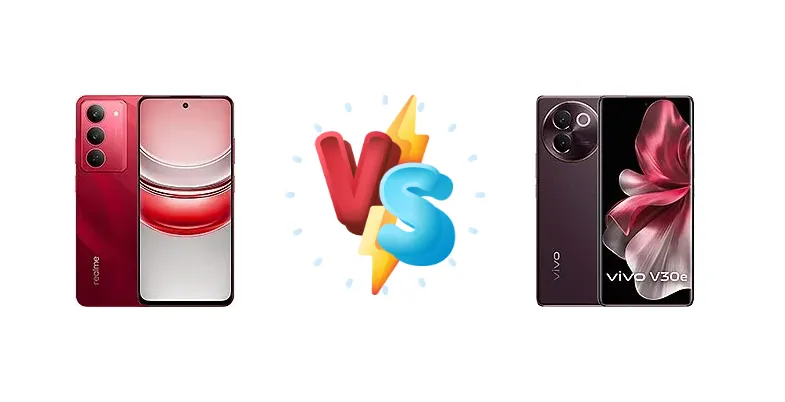
The Realme V60 Pro and vivo V30e represent compelling options in the increasingly competitive mid-range smartphone market. While both aim to deliver a balanced experience, they take different approaches to achieving it – the V60 Pro with MediaTek’s Dimensity 6300 and the V30e leveraging Qualcomm’s Snapdragon 6 Gen 1. This comparison will dissect their key differences to determine which device offers the best value for your money.
🏆 Quick Verdict
For the average user prioritizing sustained performance and potentially better long-term software support, the vivo V30e emerges as the stronger contender. Its Snapdragon 6 Gen 1, built on a more efficient 4nm process, offers a slight edge in CPU and GPU performance, coupled with the benefits of Qualcomm’s optimized software ecosystem.
| Network |
|---|
| 2G bands | GSM 850 / 900 / 1800 / 1900 | GSM 850 / 900 / 1800 / 1900 |
| 3G bands | HSDPA 800 / 850 / 900 / 2100 | HSDPA 850 / 900 / 1700(AWS) / 1900 / 2100 - Malaysia |
| 4G bands | 1, 3, 5, 7, 8, 19, 28, 34, 38, 39, 40, 41 | 1, 2, 3, 4, 5, 7, 8, 18, 19, 20, 26, 28, 38, 39, 40, 41 - Malaysia |
| 5G bands | 1, 5, 8, 28, 41, 77, 78 SA/NSA | 1, 3, 5, 7, 8, 20, 28, 38, 40, 41, 77, 78 SA/NSA - Malaysia |
| Speed | HSPA, LTE, 5G | HSPA, LTE, 5G |
| Technology | GSM / CDMA / HSPA / LTE / 5G | GSM / HSPA / LTE / 5G |
| Launch |
|---|
| Announced | 2024, November 28 | 2024, May 02 |
| Status | Available. Released 2024, November 28 | Available. Released 2024, May 09 |
| Body |
|---|
| Build | - | Glass front, plastic frame, glass back or plastic back |
| Dimensions | 165.7 x 76.2 x 8 mm (6.52 x 3.00 x 0.31 in) | 164.4 x 74.8 x 7.7 mm (6.47 x 2.94 x 0.30 in) |
| SIM | Nano-SIM + Nano-SIM | Nano-SIM + Nano-SIM |
| Weight | 197 g (6.95 oz) | 179 g or 188 g (6.31 oz) |
| Display |
|---|
| Protection | - | Schott Xensation |
| Resolution | 720 x 1604 pixels, 20:9 ratio (~264 ppi density) | 1080 x 2400 pixels, 20:9 ratio (~388 ppi density) |
| Size | 6.67 inches, 107.2 cm2 (~84.9% screen-to-body ratio) | 6.78 inches, 111.0 cm2 (~90.3% screen-to-body ratio) |
| Type | IPS LCD, 120Hz, 625 nits | AMOLED, 1B colors, 120Hz, 1300 nits (peak) |
| Platform |
|---|
| CPU | Octa-core (2x2.4 GHz Cortex-A76 & 6x2.0 GHz Cortex-A55) | Octa-core (4x2.2 GHz Cortex-A78 & 4x1.8 GHz Cortex-A55) |
| Chipset | Mediatek Dimensity 6300 (6 nm) | Qualcomm SM6450 Snapdragon 6 Gen 1 (4 nm) |
| GPU | Mali-G57 MC2 | Adreno 710 |
| OS | Android 14, Realme UI 5.0 | Android 14, Funtouch 14 |
| Memory |
|---|
| Card slot | microSDXC (uses shared SIM slot) | microSDXC (uses shared SIM slot) |
| Internal | 256GB 12GB RAM, 512GB 12GB RAM | 128GB 8GB RAM, 256GB 8GB RAM, 256GB 12GB RAM |
| Main Camera |
|---|
| Dual | - | 50 MP, f/1.8, 26mm (wide), 1/1.95", 0.8µm, PDAF, OIS (India only)
8 MP, f/2.2, 120˚ (ultrawide), 1/4.0", 1.12µm |
| Features | LED flash, HDR, panorama | Ring-LED flash, panorama, HDR |
| Single | 50 MP, f/1.8, 27mm (wide), 1/2.88", 0.61µm, PDAF | - |
| Video | 1080p@30fps | 4K@30fps, 1080p@30fps |
| Selfie camera |
|---|
| Single | 8 MP, (wide) | 50 MP, f/2.5, 25mm (wide), AF - India
32 MP, f/2.0, 24mm (wide) - Malaysia |
| Video | 1080p@30fps | 4K@30fps (India only), 1080p@30fps |
| Sound |
|---|
| 35mm jack | Yes | No |
| Loudspeaker | Yes | Yes |
| Comms |
|---|
| Bluetooth | 5.3, A2DP, LE | 5.1, A2DP, LE |
| NFC | No | Yes (market/region dependent) |
| Positioning | GPS, GALILEO, GLONASS, QZSS, BDS | GPS, GLONASS, GALILEO, BDS, QZSS, NavIC |
| Radio | No | No |
| USB | USB Type-C 2.0, OTG | USB Type-C 2.0, OTG |
| WLAN | Wi-Fi 802.11 a/b/g/n/ac, dual-band | Wi-Fi 802.11 a/b/g/n/ac, dual-band |
| Features |
|---|
| Sensors | Fingerprint (side-mounted), accelerometer, proximity, compass | Fingerprint (under display, optical), accelerometer, gyro, proximity, compass |
| Battery |
|---|
| Charging | 45W wired
5W reverse wired | 44W wired, PD
Reverse wired |
| Type | 5600 mAh | Li-Ion 5500 mAh |
| Misc |
|---|
| Colors | Crystal Black, Golden Glow, Jewel Red | Velvet Red (Coco Brown), Silk Blue, Sky Mirror |
| Models | - | V2339 |
| Price | About 210 EUR | ₹ 23,999 |
Realme V60 pro
- Faster 45W wired charging
- Potentially lower price point
- MediaTek’s software optimizations
- Less efficient 6nm Dimensity 6300 chipset
- Older Cortex-A76 CPU cores
- Potentially more thermal throttling
vivo V30e
- More efficient 4nm Snapdragon 6 Gen 1
- Newer Cortex-A78 CPU cores
- Qualcomm’s optimized software ecosystem
- Potentially better gaming performance
- Slightly slower 44W charging
- May be marginally more expensive
Display Comparison
Neither device boasts a standout display. While specific panel details (like peak brightness or color gamut coverage) are absent, the focus here is on the underlying processors. Display quality will likely be similar, leaning towards adequate for everyday use rather than exceptional. Bezels are expected to be comparable given the price bracket, and color accuracy will likely be tuned for vibrant, rather than strictly accurate, visuals.
Camera Comparison
Without detailed camera specs beyond the chipsets, a direct comparison is difficult. However, the image signal processor (ISP) within the Snapdragon 6 Gen 1 is generally considered more advanced, offering better noise reduction and dynamic range. The V30e will likely benefit from Qualcomm’s AI-powered image processing algorithms. The Realme V60 Pro’s ISP is capable, but may not match the Snapdragon’s refinement. Both phones likely include standard features like portrait mode and night mode, but the V30e has the potential to deliver more consistently pleasing results, especially in challenging lighting conditions. We can assume both will have a primary camera, ultrawide, and potentially a macro lens, but the quality of these secondary sensors will be heavily dependent on their individual specifications.
Performance
The core difference lies in the chipsets. The vivo V30e’s Snapdragon 6 Gen 1 (4nm) has a clear architectural advantage over the Realme V60 Pro’s Dimensity 6300 (6nm). The Snapdragon utilizes newer Cortex-A78 cores in its prime cluster (4x2.2 GHz) compared to the V60 Pro’s Cortex-A76 (2x2.4 GHz). While the V60 Pro’s cores are clocked slightly higher, the architectural improvements and smaller node of the Snapdragon 6 Gen 1 translate to better power efficiency and sustained performance. This means less thermal throttling during extended gaming sessions or demanding tasks. The V30e’s GPU will also likely offer a more consistent frame rate in graphically intensive games. Both phones feature 8GB of RAM, but the Snapdragon’s tighter integration with the software stack could lead to more efficient memory management.
Battery Life
Both phones offer similar charging speeds – 44W (vivo) and 45W (Realme). The slight advantage to the Realme V60 Pro is offset by the Snapdragon 6 Gen 1’s superior power efficiency. While battery capacity isn’t specified, the 4nm process of the Snapdragon will allow the V30e to extract more usage from a given battery size. Expect both phones to achieve a full charge in approximately 60-75 minutes. The inclusion of reverse wired charging on both devices is a welcome addition, though its utility is limited to topping up accessories or other phones in emergencies.
Buying Guide
Buy the Realme V60 Pro if you prioritize faster wired charging (45W vs 44W) and are comfortable with MediaTek’s software ecosystem. It’s a solid choice for users who frequently top up their phones and don’t heavily rely on demanding mobile games. Buy the vivo V30e if you value a more efficient chipset, potentially smoother gaming experiences, and the broader compatibility and optimization often associated with Qualcomm’s Snapdragon platform. It’s ideal for users who want a phone that feels responsive and capable for years to come.
Frequently Asked Questions
❓ Will the Snapdragon 6 Gen 1 in the vivo V30e handle demanding games like Genshin Impact or Call of Duty Mobile?
The Snapdragon 6 Gen 1 is capable of running these games, but you’ll likely need to compromise on graphics settings to maintain a stable frame rate. Expect medium settings to provide a smooth experience, while high settings may result in occasional stuttering. The 4nm process helps mitigate thermal throttling, allowing for more sustained performance compared to the Dimensity 6300.
❓ Does the Realme V60 Pro support any form of fast charging protocols beyond its 45W wired charging?
The context data only specifies 45W wired and 5W reverse wired charging. It’s unlikely to support advanced protocols like Power Delivery (PD) or Quick Charge, given its positioning in the mid-range segment. This means it may not charge as quickly with third-party chargers.
❓ How does the software experience differ between Realme UI and vivo’s Funtouch OS?
Realme UI is generally considered closer to stock Android, offering a cleaner and more customizable experience. Funtouch OS, while improved in recent iterations, historically has been more heavily customized and includes more pre-installed bloatware. However, both interfaces offer similar core functionality and features.