
Realme V60 Pro vs Google Pixel 8a: A Detailed Comparison of Mid-Range Champions
| Phones Images | |||||
|---|---|---|---|---|---|
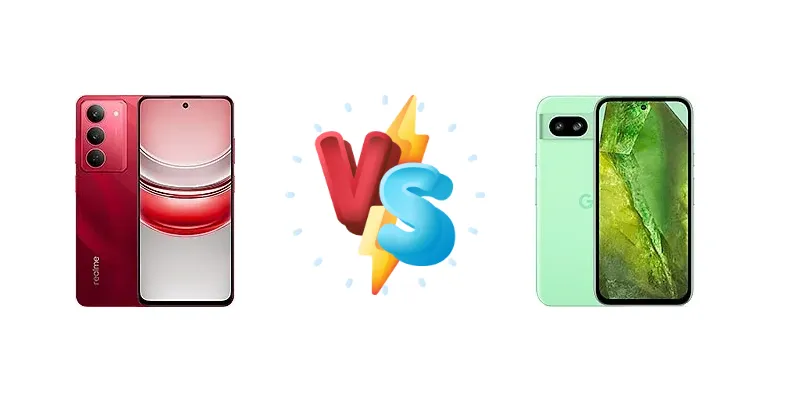
|
🏆 Quick Verdict
For the average user prioritizing camera quality and long-term software support, the Google Pixel 8a is the superior choice. Its Tensor G3 chip, combined with Google’s computational photography, consistently delivers excellent images. However, the Realme V60 Pro offers a compelling alternative for those who value faster charging and raw processing power for the price.
| PHONES | ||
|---|---|---|
| Phone Names | Realme V60 pro | Google Pixel 8a |
| Network | ||
|---|---|---|
| 2G bands | GSM 850 / 900 / 1800 / 1900 | GSM 850 / 900 / 1800 / 1900 |
| 3G bands | HSDPA 800 / 850 / 900 / 2100 | HSDPA 800 / 850 / 900 / 1700(AWS) / 1900 / 2100 |
| 4G bands | 1, 3, 5, 7, 8, 19, 28, 34, 38, 39, 40, 41 | 1, 2, 3, 4, 5, 7, 8, 12, 17, 18, 19, 20, 26, 28, 32, 38, 40, 41, 42, 66 - G6GPR (International) |
| 5G bands | 1, 5, 8, 28, 41, 77, 78 SA/NSA | 1, 2, 3, 5, 7, 8, 12, 20, 26, 28, 38, 40, 41, 66, 75, 76, 77, 78 SA/NSA/Sub6 - G6GPR (International) |
| Speed | HSPA, LTE, 5G | HSPA, LTE, 5G |
| Technology | GSM / CDMA / HSPA / LTE / 5G | GSM / HSPA / LTE / 5G |
| Launch | ||
|---|---|---|
| Announced | 2024, November 28 | 2024, May 07 |
| Status | Available. Released 2024, November 28 | Available. Released 2024, May 14 |
| Body | ||
|---|---|---|
| Build | - | Glass front (Gorilla Glass 3), aluminum frame, plastic back |
| Dimensions | 165.7 x 76.2 x 8 mm (6.52 x 3.00 x 0.31 in) | 152.1 x 72.7 x 8.9 mm (5.99 x 2.86 x 0.35 in) |
| SIM | Nano-SIM + Nano-SIM | Nano-SIM + eSIM |
| Weight | 197 g (6.95 oz) | 188 g (6.63 oz) |
| Display | ||
|---|---|---|
| Protection | - | Corning Gorilla Glass 3, Mohs level 5 |
| Resolution | 720 x 1604 pixels, 20:9 ratio (~264 ppi density) | 1080 x 2400 pixels, 20:9 ratio (~430 ppi density) |
| Size | 6.67 inches, 107.2 cm2 (~84.9% screen-to-body ratio) | 6.1 inches, 90.3 cm2 (~81.6% screen-to-body ratio) |
| Type | IPS LCD, 120Hz, 625 nits | OLED, HDR, 120Hz, 2000 nits (peak) |
| Platform | ||
|---|---|---|
| CPU | Octa-core (2x2.4 GHz Cortex-A76 & 6x2.0 GHz Cortex-A55) | Nona-core (1x3.0 GHz Cortex-X3 & 4x2.45 GHz Cortex-A715 & 4x2.15 GHz Cortex-A510) |
| Chipset | Mediatek Dimensity 6300 (6 nm) | Google Tensor G3 (4 nm) |
| GPU | Mali-G57 MC2 | Immortalis-G715s MC10 |
| OS | Android 14, Realme UI 5.0 | Android 14, upgradable to Android 16, up to 7 major Android upgrades |
| Memory | ||
|---|---|---|
| Card slot | microSDXC (uses shared SIM slot) | No |
| Internal | 256GB 12GB RAM, 512GB 12GB RAM | 128GB 8GB RAM, 256GB 8GB RAM |
| Main Camera | ||
|---|---|---|
| Dual | - | 64 MP (16 MP eff.), f/1.9, 26mm (wide), 1/1.73", 0.8µm, dual pixel PDAF, OIS 13 MP, f/2.2, 120˚ (ultrawide), 1.12µm |
| Features | LED flash, HDR, panorama | Dual-LED flash, Pixel Shift, Ultra HDR, panorama, Best Take |
| Single | 50 MP, f/1.8, 27mm (wide), 1/2.88", 0.61µm, PDAF | - |
| Video | 1080p@30fps | 4K@30/60fps, 1080p@30/60/120/240fps, OIS |
| Selfie camera | ||
|---|---|---|
| Features | - | HDR, panorama |
| Single | 8 MP, (wide) | 13 MP, f/2.2, 20mm (ultrawide), 1.12µm |
| Video | 1080p@30fps | 4K@30fps, 1080p@30/60fps |
| Sound | ||
|---|---|---|
| 35mm jack | Yes | No |
| Loudspeaker | Yes | Yes, with stereo speakers |
| Comms | ||
|---|---|---|
| Bluetooth | 5.3, A2DP, LE | 5.3, A2DP, LE |
| NFC | No | Yes |
| Positioning | GPS, GALILEO, GLONASS, QZSS, BDS | GPS, GLONASS, GALILEO, BDS, QZSS, NavIC |
| Radio | No | No |
| USB | USB Type-C 2.0, OTG | USB Type-C 3.2 |
| WLAN | Wi-Fi 802.11 a/b/g/n/ac, dual-band | Wi-Fi 802.11 a/b/g/n/ac/6e, dual/tri-band (market/region dependent) |
| Features | ||
|---|---|---|
| Sensors | Fingerprint (side-mounted), accelerometer, proximity, compass | Fingerprint (under display, optical), accelerometer, gyro, proximity, compass, barometer |
| Battery | ||
|---|---|---|
| Charging | 45W wired 5W reverse wired | 18W wired, PD3.0 7.5W wireless Bypass charging |
| Type | 5600 mAh | Li-Po 4492 mAh |
| Misc | ||
|---|---|---|
| Colors | Crystal Black, Golden Glow, Jewel Red | Obsidian, Porcelain, Bay, Aloe |
| Models | - | GKV4X, G6GPR, G8HHN, G576D |
| Price | About 210 EUR | $ 229.98 / C$ 417.99 / £ 279.00 / € 299.99 / ₹ 33,300 |
| EU LABEL | ||
|---|---|---|
| Battery | - | 40:06h endurance, 1000 cycles |
| Energy | - | Class B |
| Free fall | - | Class A (270 falls) |
| Repairability | - | Class B |
Realme V60 pro
- Faster 45W wired charging
- Potentially more raw processing power for the price
- Reverse wired charging capability
- Likely inferior camera performance
- Less guaranteed software support
- Display brightness likely lower than Pixel 8a
Google Pixel 8a
- Superior camera quality and image processing
- Long-term software support and updates
- Brighter and more vibrant display
- Slower 18W wired charging
- Less raw processing power compared to V60 Pro
- Higher price point
Display Comparison
The Google Pixel 8a boasts a significantly brighter display, reaching a measured peak of 1508 nits, making it far more usable in direct sunlight compared to the Realme V60 Pro (brightness data unavailable). While the V60 Pro’s panel specifics are unknown, the Pixel 8a’s OLED panel delivers vibrant colors and excellent contrast. The Pixel 8a’s display is likely to have a higher refresh rate, contributing to smoother scrolling and animations, a feature not confirmed for the V60 Pro. The Pixel 8a’s brightness advantage is particularly beneficial for outdoor photography and video consumption.
Camera Comparison
The Pixel 8a’s camera system is its standout feature, leveraging Google’s renowned computational photography algorithms. While specific sensor details are unavailable for the V60 Pro, the Pixel 8a’s image processing excels in dynamic range, detail preservation, and low-light performance. The Tensor G3’s dedicated image signal processor (ISP) plays a crucial role in these capabilities. The Pixel 8a’s software features, such as Magic Eraser and Photo Unblur, provide significant post-processing advantages. The V60 Pro likely relies more on hardware specifications, but without detailed information, it’s difficult to assess its camera performance against the Pixel 8a’s software-driven approach.
Performance
The core difference lies in the chipsets: the Realme V60 Pro utilizes the Mediatek Dimensity 6300 (6nm), while the Pixel 8a is powered by Google’s Tensor G3 (4nm). The Tensor G3’s 4nm process offers superior power efficiency, potentially leading to better sustained performance and thermal management. The Tensor G3’s nona-core architecture, featuring a Cortex-X3 prime core, provides a performance edge in AI-related tasks and demanding applications. While the Dimensity 6300’s octa-core configuration is capable, the Tensor G3’s architecture is designed for more complex workloads. The Pixel 8a’s performance advantage is further enhanced by Google’s software optimizations.
Battery Life
The Pixel 8a demonstrates impressive battery endurance, achieving a measured 40:06h endurance rating and 11:25h of active use. This suggests excellent power efficiency from the Tensor G3 and optimized software. While the Realme V60 Pro’s battery capacity is unknown, its 45W wired charging significantly surpasses the Pixel 8a’s 18W charging. This translates to much faster charging times for the V60 Pro, potentially reaching a full charge in under an hour. The Pixel 8a offers 7.5W wireless charging and bypass charging, a feature absent on the V60 Pro, allowing for charging without generating heat.
Buying Guide
Buy the Realme V60 Pro if you need a phone for demanding tasks like gaming or video editing and prioritize fast 45W charging. It’s ideal for users who frequently transfer large files or rely on their phone for productivity. Buy the Google Pixel 8a if you prefer a seamless software experience, exceptional camera performance, and guaranteed software updates, even if it means sacrificing some charging speed and raw CPU benchmarks.