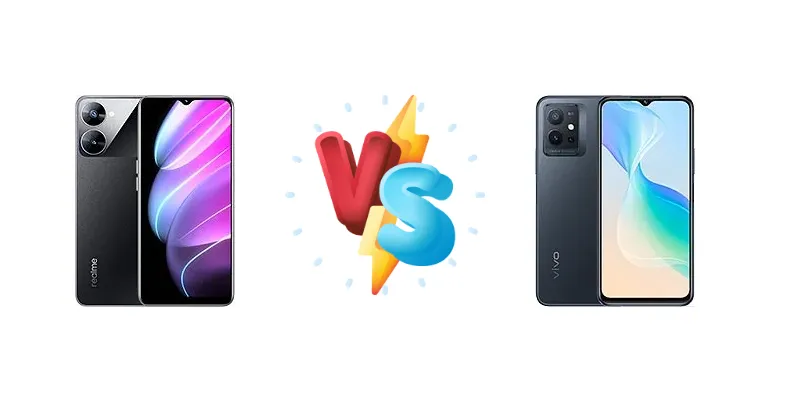
The Realme V30 and vivo T1 5G represent compelling options in the increasingly competitive budget 5G smartphone market. While both aim to deliver 5G connectivity at an accessible price point, they diverge significantly in their core hardware, particularly in their chipset choices. This comparison will dissect these differences to determine which device offers the best overall experience.
🏆 Quick Verdict
For the average user prioritizing consistent performance and a more efficient chipset, the vivo T1 5G (with Snapdragon 695) emerges as the better choice. Its 6nm process node and Kryo cores offer a smoother experience than the Realme V30's Mediatek chipset, despite the latter potentially offering slightly higher peak CPU clock speeds.
| Network |
|---|
| 2G bands | GSM 850 / 900 / 1800 / 1900 | GSM 850 / 900 / 1800 / 1900 |
| 3G bands | HSDPA 850 / 900 / 2100 | HSDPA 850 / 900 / 2100 |
| 4G bands | LTE | 1, 3, 5, 8, 38, 40, 41 - India |
| 5G bands | SA/NSA | 77, 78 SA/NSA - India |
| Speed | HSPA, LTE, 5G | HSPA, LTE, 5G |
| Technology | GSM / HSPA / LTE / 5G | GSM / HSPA / LTE / 5G |
| | - | 1, 3, 40 SA/NSA - Indonesia |
| Launch |
|---|
| Announced | 2023, February 09 | 2022, February 09 |
| Status | Available. Released 2023, March 20 | Available. Released 2022, February 14 |
| Body |
|---|
| Build | Glass front, plastic frame, plastic back | Glass front, plastic frame, plastic back |
| Dimensions | 8.1 mm thickness | 164 x 75.8 x 8.3 mm (6.46 x 2.98 x 0.33 in) |
| SIM | Nano-SIM + Nano-SIM | Nano-SIM + Nano-SIM |
| Weight | 186 g (6.56 oz) | 187 g (6.60 oz) |
| Display |
|---|
| Resolution | 720 x 1600 pixels, 20:9 ratio (~270 ppi density) | 1080 x 2408 pixels, 20:9 ratio (~401 ppi density) |
| Size | 6.5 inches, 102.0 cm2 | 6.58 inches, 104.3 cm2 (~83.9% screen-to-body ratio) |
| Type | IPS LCD, 600 nits | IPS LCD, 120Hz |
| Platform |
|---|
| CPU | - | Octa-core (2x2.2 GHz Kryo 660 Gold & 6x1.7 GHz Kryo 660 Silver)Octa-core (2x2.4 GHz Cortex-A76 & 6x2.0 GHz Cortex-A55) - Indonesia |
| Chipset | Mediatek | Qualcomm SM6375 Snapdragon 695 5G (6 nm)Mediatek Dimensity 810 (6 nm) - Indonesia |
| GPU | - | Adreno 619Mali-G57 MC2 - Indonesia |
| OS | Android 12, Realme UI 3.0 | Android 11, Funtouch 12 |
| Memory |
|---|
| Card slot | microSDXC | microSDXC (uses shared SIM slot) |
| Internal | 128GB 6GB RAM, 128GB 8GB RAM | 128GB 4GB RAM, 128GB 6GB RAM, 128GB 8GB RAM, 256GB 8GB RAM |
| | - | UFS 2.2 - India |
| Main Camera |
|---|
| Dual | 13 MP, (wide), AF
Auxiliary lens | - |
| Features | LED flash, HDR, panorama | Dual-LED flash, HDR, panorama |
| Single | 5 MP (wide) | 16 MP, f/2.0, (wide) |
| Triple | - | 50 MP, f/1.8, 26mm (wide), PDAF
2 MP (macro)
Auxiliary lens |
| Video | 1080p@30fps | 1080p@30fps |
| Selfie camera |
|---|
| Single | 5 MP (wide) | 16 MP, f/2.0, (wide) |
| Video | 720p@30fps | 1080p@30fps |
| Sound |
|---|
| 3.5mm jack | Yes | Yes |
| 35mm jack | Yes | Yes |
| Loudspeaker | Yes | Yes |
| Comms |
|---|
| Bluetooth | Yes | 5.1, A2DP, LE |
| NFC | Unspecified | Yes (market/region dependent) |
| Positioning | Yes | GPS, GLONASS, GALILEO, BDS, QZSS |
| Radio | No | FM radio |
| USB | USB Type-C 2.0 | USB Type-C 2.0, OTG |
| WLAN | Yes | Wi-Fi 802.11 a/b/g/n/ac, dual-band, Wi-Fi Direct |
| Features |
|---|
| Sensors | Fingerprint (side-mounted), accelerometer, proximity | Fingerprint (side-mounted), accelerometer, proximity, compass |
| Battery |
|---|
| Charging | - | 18W wired |
| Type | 5000 mAh | 5000 mAh |
| Misc |
|---|
| Colors | Black, Gold | Starlight Black, Rainbow Fantasy |
| Models | RMX3618 | V2141, V2157 |
| Price | About 150 EUR | About 180 EUR |
Realme V30
- Potentially higher peak CPU performance (Mediatek chipset)
- Likely competitive pricing
- May feature a more modern design
- Mediatek chipset may exhibit more thermal throttling
- Potentially lower power efficiency
- Camera performance is uncertain
vivo T1 5G
- More efficient Snapdragon 695 chipset (6nm)
- Smoother multitasking and sustained performance
- Indonesia variant with Dimensity 810 offers a performance boost
- Potentially lower peak CPU performance compared to Realme V30 (Snapdragon 695 version)
- 18W charging is relatively slow
- Camera performance is uncertain
Display Comparison
Display specifications are not provided for either device. However, given their price bracket, both likely feature LCD panels with FHD+ resolution. The Realme V30, being a newer release, *may* benefit from slightly improved color accuracy or brightness. The absence of details like refresh rate (60Hz vs 90Hz) or PWM dimming frequency makes a definitive comparison impossible, but users sensitive to flicker should investigate these specs before purchasing.
Camera Comparison
Camera details are limited. Both devices likely feature a multi-camera setup, but the quality will heavily depend on the primary sensor and image processing algorithms. Without sensor size or aperture information, it's difficult to assess image quality. The inclusion of a 2MP macro camera on either device is unlikely to significantly enhance the photography experience. The Snapdragon 695's ISP (Image Signal Processor) *may* offer slightly better image processing capabilities, but this is speculative without detailed testing.
Performance
The core difference lies in the chipsets. The vivo T1 5G utilizes the Qualcomm SM6375 Snapdragon 695 5G (6nm), featuring an octa-core CPU with 2x2.2 GHz Kryo 660 Gold and 6x1.7 GHz Kryo 660 Silver cores. This 6nm process offers superior power efficiency compared to the Mediatek chipset in the Realme V30. While the Realme V30's Mediatek chipset boasts potentially higher peak CPU clock speeds, the Snapdragon 695's architecture and efficiency translate to smoother multitasking and sustained performance. The Indonesia variant of the vivo T1 5G features a Mediatek Dimensity 810 (6nm) with a CPU configuration of 2x2.4 GHz Cortex-A76 and 6x2.0 GHz Cortex-A55. This variant offers a performance boost over the Snapdragon 695 version, making it the preferred choice if available. Both phones will likely pair their chipsets with 4GB or 6GB of RAM, impacting multitasking capabilities.
Battery Life
The Realme V30 and vivo T1 5G both feature 18W wired charging. Battery capacity is not specified, but given the target market, both are likely in the 5000mAh range. The Snapdragon 695's 6nm efficiency will contribute to longer battery life on the vivo T1 5G, even with a similar capacity battery. The 18W charging speed is relatively slow compared to faster charging solutions available on other devices, meaning both phones will take a considerable amount of time to fully charge.
Buying Guide
Buy the Realme V30 if you prioritize potentially higher raw CPU performance in benchmark tests and are comfortable with a chipset that may exhibit more thermal throttling under sustained load. Buy the vivo T1 5G if you value a more balanced and efficient chipset, better suited for everyday tasks, moderate gaming, and longer battery life, thanks to the Snapdragon 695's 6nm fabrication.
Frequently Asked Questions
❓ Will the Snapdragon 695 in the vivo T1 5G handle demanding games like PUBG Mobile?
The Snapdragon 695 is capable of running PUBG Mobile at medium settings with a stable frame rate. However, don't expect to max out the graphics settings. The 6nm process helps mitigate thermal throttling during extended gaming sessions, providing a more consistent experience than the Realme V30's Mediatek chipset.
❓ Is the 18W charging speed sufficient for daily use on either device?
18W charging is relatively slow by today's standards. Expect a full charge to take around 2-3 hours. While sufficient for overnight charging, it's not ideal for quick top-ups. The more efficient chipset in the vivo T1 5G may slightly offset this with reduced overall charging frequency.
❓ Which phone is better for users who frequently multitask between apps?
The vivo T1 5G, particularly the variant with the Dimensity 810, is better suited for multitasking. The Snapdragon 695's architecture and the Dimensity 810's higher core clock speeds provide a smoother experience when switching between multiple applications.