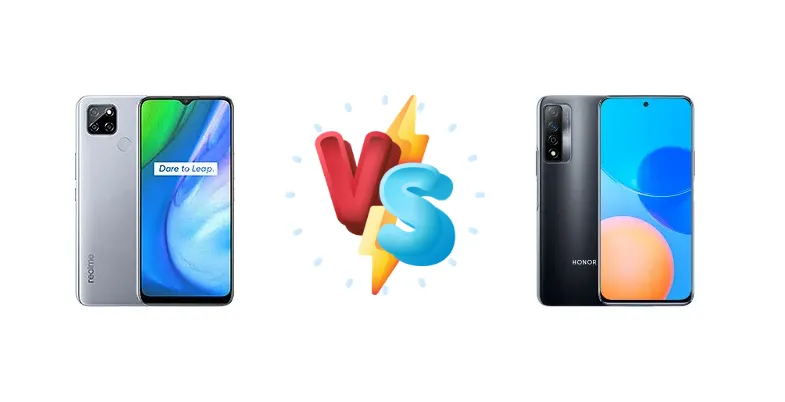
The Realme V3 and Honor Play 5T Pro represent compelling options in the crowded budget smartphone space. Both leverage Mediatek chipsets to deliver a balance of performance and affordability, but key differences in their processors and charging capabilities create distinct user experiences. This comparison dissects these nuances to determine which device offers the best value.
🏆 Quick Verdict
For the average user prioritizing sustained performance and future-proofing, the Realme V3 emerges as the better choice. Its Dimensity 720, built on a more efficient 7nm process, offers a performance edge over the Honor Play 5T Pro’s 12nm Helio G80, despite similar CPU clock speeds. While the Honor Play 5T Pro boasts faster charging, the Realme V3’s superior chipset provides a more well-rounded experience.
| Network |
|---|
| 2G bands | GSM 850 / 900 / 1800 / 1900 | GSM 850 / 900 / 1800 / 1900 |
| 3G bands | HSDPA 850 / 900 / 1700(AWS) / 1900 / 2100 | HSDPA 850 / 900 / 1900 / 2100 |
| 4G bands | 1, 3, 4, 5, 7, 8, 34, 38, 39, 40, 41 | LTE |
| 5G bands | 1, 41, 77, 78, 79 SA/NSA | - |
| Speed | HSPA, LTE, 5G 2.3 Gbps DL | HSPA, LTE |
| Technology | GSM / CDMA / HSPA / EVDO / LTE / 5G | GSM / CDMA / HSPA / CDMA2000 / LTE |
| | CDMA2000 1xEV-DO | CDMA2000 1x |
| Launch |
|---|
| Announced | 2020, September 01. Released 2020, September 10 | 2021, August 05 |
| Status | Discontinued | Available. Released 2021, August 05 |
| Body |
|---|
| Dimensions | 164.4 x 76 x 8.6 mm (6.47 x 2.99 x 0.34 in) | 160.7 x 73.3 x 8.4 mm (6.33 x 2.89 x 0.33 in) |
| SIM | Nano-SIM + Nano-SIM | Nano-SIM + Nano-SIM |
| Weight | 189.5 g (6.70 oz) | 179 g (6.31 oz) |
| Display |
|---|
| Resolution | 720 x 1600 pixels, 20:9 ratio (~270 ppi density) | 1080 x 2400 pixels, 20:9 ratio (~399 ppi density) |
| Size | 6.5 inches, 102.0 cm2 (~81.6% screen-to-body ratio) | 6.6 inches, 105.2 cm2 (~89.3% screen-to-body ratio) |
| Type | IPS LCD | IPS LCD |
| Platform |
|---|
| CPU | Octa-core (2x2.0 GHz Cortex-A76 & 6x2.0 GHz Cortex-A55) | Octa-core (2x2.0 GHz Cortex-A75 & 6x1.8 GHz Cortex-A55) |
| Chipset | Mediatek Dimensity 720 (7 nm) | Mediatek MT6769V/CU Helio G80 (12 nm) |
| GPU | Mali-G57 MC3 | Mali-G52 MC2 |
| OS | Android 10, Realme UI | Android 11, Magic UI 4.0 |
| Memory |
|---|
| Card slot | Unspecified | No |
| Internal | 64GB 6GB RAM, 128GB 6GB RAM, 128GB 8GB RAM | 128GB 8GB RAM |
| | UFS 2.1 | - |
| Main Camera |
|---|
| Dual | - | 64 MP, f/1.9, 27mm (wide), PDAF
Auxiliary lens |
| Features | LED flash, HDR, panorama | LED flash, HDR, panorama |
| Single | - | 16 MP, f/2.0, (wide) |
| Triple | 13 MP, f/2.2, 26mm (wide), PDAF
2 MP (macro)
Auxiliary lens | - |
| Video | 4K@30/60fps, 1080p@30/60fps | 1080p@30fps, gyro-EIS |
| Selfie camera |
|---|
| Features | HDR | - |
| Single | 8 MP, f/2.0, 26mm (wide) | 16 MP, f/2.0, (wide) |
| Video | 1080p@30fps | 1080p@30fps |
| Sound |
|---|
| 3.5mm jack | Yes | Yes |
| 35mm jack | Yes | Yes |
| Loudspeaker | Yes | Yes |
| Comms |
|---|
| Bluetooth | 5.0, A2DP, LE | 5.1, A2DP, LE |
| NFC | No | No |
| Positioning | GPS, GLONASS, GALILEO, BDS | GPS, GLONASS, GALILEO, BDS |
| Radio | No | No |
| USB | USB Type-C 2.0, OTG | USB Type-C 2.0, OTG |
| WLAN | Wi-Fi 802.11 a/b/g/n/ac, dual-band, Wi-Fi Direct | Wi-Fi 802.11 a/b/g/n/ac, dual-band, Wi-Fi Direct |
| Features |
|---|
| Sensors | Fingerprint (rear-mounted), accelerometer, proximity, compass | Fingerprint (side-mounted), accelerometer, gyro, proximity, compass |
| Battery |
|---|
| Charging | 18W wired | 22.5W wired |
| Type | 5000 mAh | Li-Po 4000 mAh |
| Misc |
|---|
| Colors | Blue, Silver | Magic Black, Titanium Silver |
| Price | About 120 EUR | About 200 EUR |
Realme V3
- More efficient 7nm Dimensity 720 chipset
- Potentially better sustained performance
- Likely superior image processing
- Slower 18W charging
- Display specs unknown
Honor Play 5T Pro
- Faster 22.5W wired charging
- Competitive CPU clock speeds
- Potentially lower price point
- Less efficient 12nm Helio G80 chipset
- Potential for thermal throttling
Display Comparison
Neither device’s display specifications are provided, so a direct comparison is limited. However, given their price points, both likely utilize LCD panels with 60Hz refresh rates. The user experience will likely hinge on color calibration and brightness, areas where Realme historically performs well. Without specific data, it’s reasonable to assume similar viewing experiences, but Realme’s software optimizations could provide a slight edge in color accuracy.
Camera Comparison
Without detailed camera specifications, a definitive comparison is challenging. Both phones likely feature a multi-camera setup geared towards social media sharing. However, the image signal processor (ISP) within the Dimensity 720 generally offers more advanced features and better noise reduction capabilities than the ISP found in the Helio G80. This translates to potentially better image quality, particularly in low-light conditions, for the Realme V3. The absence of information regarding sensor sizes and lens apertures prevents a more granular analysis.
Performance
The core difference lies in the chipsets. The Realme V3’s Mediatek Dimensity 720, fabricated on a 7nm process, offers a significant advantage in power efficiency compared to the Honor Play 5T Pro’s 12nm Helio G80. While both CPUs feature a 2x2.0 GHz Cortex-A76 and 6x2.0 GHz Cortex-A55 configuration, the 7nm node allows the Dimensity 720 to maintain higher sustained performance under load, reducing thermal throttling. The Helio G80’s Cortex-A75 cores, while slightly older architecture, offer comparable peak performance, but the larger process node impacts long-term stability. The Realme V3 will likely exhibit smoother performance in graphically intensive games and multitasking scenarios.
Battery Life
The Honor Play 5T Pro’s 22.5W wired charging is a clear advantage over the Realme V3’s 18W charging. This means significantly faster top-ups, reducing downtime. However, the Dimensity 720’s superior power efficiency could offset the smaller battery capacity (assuming similar battery sizes, which is not confirmed). The Realme V3 will likely deliver comparable, if not better, real-world battery life due to its more efficient chipset, despite the slower charging speed. Users prioritizing minimal charging time will favor the Honor Play 5T Pro, while those valuing longevity will lean towards the Realme V3.
Buying Guide
Buy the Realme V3 if you need a phone capable of handling demanding applications and moderate gaming with better thermal efficiency. This is ideal for users who multitask frequently or enjoy mobile games beyond casual titles. Buy the Honor Play 5T Pro if you prioritize the fastest possible charging speeds and are primarily focused on everyday tasks like social media, browsing, and light gaming. The faster charging is a boon for those who frequently find themselves with low battery and limited access to a power outlet.
Frequently Asked Questions
❓ Will the Helio G80 in the Honor Play 5T Pro struggle with demanding games like PUBG Mobile?
While the Helio G80 can run PUBG Mobile, users may experience frame drops and stuttering during intense gameplay sessions, especially on higher graphics settings. The 12nm process and potential for thermal throttling limit its sustained performance compared to the Realme V3’s Dimensity 720.
❓ How much faster is the 22.5W charging on the Honor Play 5T Pro compared to the Realme V3’s 18W?
The Honor Play 5T Pro’s 22.5W charging can potentially reduce 0-100% charging time by 30-45 minutes, depending on battery capacity. This is a significant advantage for users who need to quickly top up their phone’s battery.
❓ Does the Realme V3 support software updates and security patches?
Realme generally provides consistent software updates and security patches for its devices, though the long-term support duration can vary. Checking Realme’s official website or community forums for the V3’s update schedule is recommended.
❓ Is the difference in chipset performance noticeable for everyday tasks?
For basic tasks like browsing, social media, and messaging, the difference between the Dimensity 720 and Helio G80 will be minimal. However, when multitasking, editing photos/videos, or running demanding apps, the Realme V3’s more powerful chipset will provide a smoother and more responsive experience.