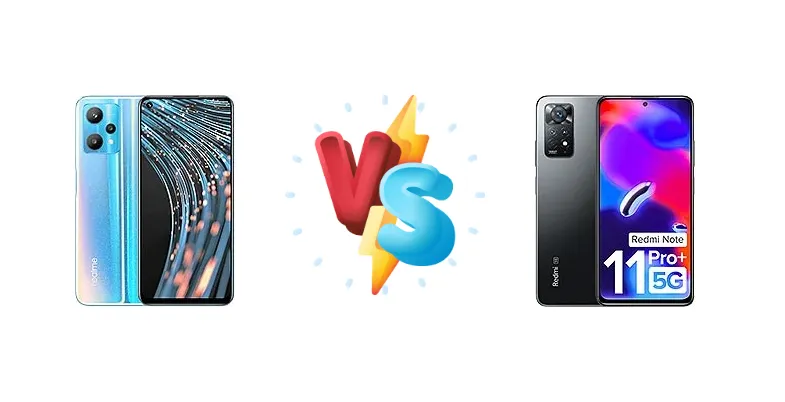
Both the Realme V25 and the Xiaomi Redmi Note 11 Pro+ 5G (India) target the competitive mid-range 5G market, offering a similar Qualcomm Snapdragon 695 5G chipset. However, a crucial difference emerges in their charging capabilities, with Xiaomi opting for significantly faster 67W charging compared to Realme’s 33W solution. This comparison will dissect these differences and determine which device delivers the best overall experience.
🏆 Quick Verdict
For the average user prioritizing convenience and minimizing downtime, the Xiaomi Redmi Note 11 Pro+ 5G (India) is the clear winner. Its 67W charging dramatically reduces charging times, offsetting the otherwise identical core performance offered by the Snapdragon 695. The Realme V25 remains a viable option for those on a tighter budget.
| Network |
|---|
| 2G bands | GSM 850 / 900 / 1800 / 1900 | GSM 850 / 900 / 1800 / 1900 - SIM 1 & SIM 2 |
| 3G bands | HSDPA 850 / 900 / 2100 | HSDPA 850 / 900 / 1900 / 2100 |
| 4G bands | LTE | 1, 3, 5, 8, 40, 41 |
| 5G bands | SA/NSA | 1, 3, 5, 8, 28, 40, 78 SA/NSA |
| Speed | HSPA, LTE, 5G | HSPA, LTE-A (CA), 5G |
| Technology | GSM / CDMA / HSPA / CDMA2000 / LTE / 5G | GSM / HSPA / LTE / 5G |
| | CDMA2000 1x | - |
| Launch |
|---|
| Announced | 2022, March 03 | 2022, March 09 |
| Status | Available. Released 2022, March 04 | Available. Released 2022, March 15 |
| Body |
|---|
| Build | - | Glass front (Gorilla Glass 5), glass back |
| Dimensions | 164.3 x 75.6 x 8.5 mm (6.47 x 2.98 x 0.33 in) | 164.2 x 76.1 x 8.1 mm (6.46 x 3.00 x 0.32 in) |
| SIM | Nano-SIM + Nano-SIM | Hybrid Dual SIM (Nano-SIM, dual stand-by) |
| Weight | 195 g (6.88 oz) | 202 g (7.13 oz) |
| | - | IP53, dust and splash resistant |
| Display |
|---|
| Protection | - | Corning Gorilla Glass 5 |
| Resolution | 1080 x 2412 pixels, 20:9 ratio (~400 ppi density) | 1080 x 2400 pixels, 20:9 ratio (~395 ppi density) |
| Size | 6.6 inches, 104.8 cm2 (~84.4% screen-to-body ratio) | 6.67 inches, 107.4 cm2 (~86.0% screen-to-body ratio) |
| Type | IPS LCD, 120Hz | Super AMOLED, 120Hz, 700 nits, 1200 nits (peak) |
| Platform |
|---|
| CPU | Octa-core (2x2.2 GHz Kryo 660 Gold & 6x1.7 GHz Kryo 660 Silver) | Octa-core (2x2.2 GHz Kryo 660 Gold & 6x1.7 GHz Kryo 660 Silver) |
| Chipset | Qualcomm SM6375 Snapdragon 695 5G (6 nm) | Qualcomm SM6375 Snapdragon 695 5G (6 nm) |
| GPU | Adreno 619 | Adreno 619 |
| OS | Android 12, Realme UI 3.0 | Android 11, MIUI 13 |
| Memory |
|---|
| Card slot | microSDXC (uses shared SIM slot) | microSDXC (uses shared SIM slot) |
| Internal | 256GB 12GB RAM | 64GB 6GB RAM, 128GB 6GB RAM, 128GB 8GB RAM, 256GB 8GB RAM |
| | - | UFS 2.2 |
| Main Camera |
|---|
| Features | LED flash, HDR, panorama | LED flash, HDR, panorama |
| Single | 16 MP, f/2.1, 26mm (wide), 1/3.09", 1.0µm | - |
| Triple | 64 MP, f/1.8, 26mm (wide), PDAF
2 MP (macro)
Auxiliary lens | 108 MP, f/1.9, 26mm (wide), 1/1.52", 0.7µm, PDAF
8 MP, f/2.2, 118˚ (ultrawide)
2 MP, f/2.4, (macro) |
| Video | 1080p@30fps | 1080p@30fps |
| Selfie camera |
|---|
| Features | HDR, panorama | - |
| Single | 16 MP, f/2.1, 26mm (wide), 1/3.09", 1.0µm | 16 MP, f/2.5, (wide), 1/3.06" 1.0µm |
| Video | 1080p@30fps | 1080p@30fps |
| Sound |
|---|
| 3.5mm jack | Yes | Yes |
| 35mm jack | Yes | - |
| Loudspeaker | Yes | Yes, with stereo speakers |
| | 24-bit/192kHz audio | 24-bit/192kHz audio |
| Comms |
|---|
| Bluetooth | 5.1, A2DP, LE, aptX HD | 5.1, A2DP, LE |
| Infrared port | - | Yes |
| NFC | No | No |
| Positioning | GPS, GLONASS, BDS | GPS, GLONASS, BDS, GALILEO |
| Radio | No | Unspecified |
| USB | USB Type-C 2.0, OTG | USB Type-C 2.0, OTG |
| WLAN | Wi-Fi 802.11 a/b/g/n/ac, dual-band | Wi-Fi 802.11 a/b/g/n/ac, dual-band, Wi-Fi Direct |
| Features |
|---|
| Sensors | Fingerprint (side-mounted), accelerometer, gyro, proximity, compass | Fingerprint (side-mounted), accelerometer, gyro, proximity, compass |
| Battery |
|---|
| Charging | 33W wired | 67W wired, PD3.0, QC3, 50% in 15 min, 100% in 42 min (advertised) |
| Type | 5000 mAh | Li-Po 5000 mAh, non-removable |
| Misc |
|---|
| Colors | Midnight Black, Aurora Green, Sunrise Blue | Mirage Blue, Phantom White, Stealth Black |
| Models | - | 2201116SI |
| Price | About 290 EUR | About 250 EUR |
Realme V25
- Potentially lower price point
- Reliable Snapdragon 695 performance
- Functional and adequate for basic tasks
- Slower 33W charging
- Likely less advanced camera system
- May lack features found on the Redmi Note 11 Pro+
Xiaomi Redmi Note 11 Pro+ 5G (India)
- Significantly faster 67W charging
- Potentially more versatile camera system
- Likely better overall feature set
- Higher price compared to the Realme V25
- Same Snapdragon 695 chipset as the Realme V25
- May have more bloatware (typical of Xiaomi)
Display Comparison
While both devices likely feature similar LCD panels given their price points, the context data doesn't provide specifics. We can infer that neither will offer the color accuracy or peak brightness of flagship OLED displays. The absence of high refresh rate information suggests both are likely 60Hz, impacting smoothness during scrolling and gaming. Bezels are expected to be comparable, typical of this segment.
Camera Comparison
The provided data lacks camera specifications beyond the chipset. Given the Redmi Note series' history, it's reasonable to expect a more comprehensive camera system on the Redmi Note 11 Pro+ 5G (India), potentially including a higher resolution main sensor and additional lenses. However, without specific sensor details (megapixel count, aperture, OIS), it’s impossible to definitively declare a winner. The Realme V25 likely focuses on providing a functional camera experience rather than pushing boundaries in image quality.
Performance
Both the Realme V25 and the Xiaomi Redmi Note 11 Pro+ 5G (India) are powered by the Qualcomm SM6375 Snapdragon 695 5G (6 nm) chipset, featuring an octa-core CPU configuration with the same Kryo 660 Gold and Silver core arrangement. This means CPU performance will be virtually identical in day-to-day tasks and most gaming scenarios. The GPU performance will also be the same. The real-world performance difference will likely come down to RAM management and thermal throttling, which are not specified in the provided data. However, the 6nm process node of the Snapdragon 695 is relatively efficient, minimizing the risk of significant throttling under sustained load.
Battery Life
The charging speed is the defining difference here. The Xiaomi Redmi Note 11 Pro+ 5G (India) boasts 67W wired charging, with advertised figures of 50% charge in 15 minutes and 100% in 42 minutes. This is a significant advantage over the Realme V25’s 33W charging. While battery capacity isn’t specified, the faster charging of the Redmi Note 11 Pro+ effectively mitigates any potential disadvantage from a slightly smaller battery. Users will spend considerably less time waiting for their phone to charge, a crucial benefit for those with active lifestyles.
Buying Guide
Buy the Realme V25 if you prioritize a lower upfront cost and are comfortable with slower charging speeds. It’s a solid choice for users who don’t mind topping up their phone overnight or less frequently. Buy the Xiaomi Redmi Note 11 Pro+ 5G (India) if you value rapid charging and want to spend less time tethered to a wall outlet. This phone is ideal for power users and those who frequently find themselves needing a quick battery boost.
Frequently Asked Questions
❓ How much faster is the 67W charging on the Redmi Note 11 Pro+ 5G compared to the 33W charging on the Realme V25 in real-world usage?
The 67W charging on the Redmi Note 11 Pro+ 5G can realistically shave off 30-45 minutes of charging time for a full charge compared to the Realme V25. While the Realme V25 will still charge overnight, the Redmi Note 11 Pro+ 5G allows for a substantial top-up in just 15-20 minutes, making it ideal for users who need a quick boost before heading out.
❓ Will I notice a difference in gaming performance between the Realme V25 and the Redmi Note 11 Pro+ 5G, given they both use the Snapdragon 695?
No, you likely won't notice a significant difference in gaming performance. Both phones utilize the same Snapdragon 695 5G chipset with identical CPU and GPU configurations. Any minor differences will be attributable to RAM management and thermal throttling, which are not specified in the provided data. Expect similar frame rates and overall gaming experience on both devices.
❓ Does the Redmi Note 11 Pro+ 5G (India) support Power Delivery (PD) charging with other USB-C chargers?
Yes, the Redmi Note 11 Pro+ 5G (India) supports Power Delivery (PD) 3.0 and Quick Charge (QC) 3.0, meaning it can be charged with a wider range of USB-C chargers beyond the included adapter. This provides flexibility and convenience for users who already own compatible chargers.