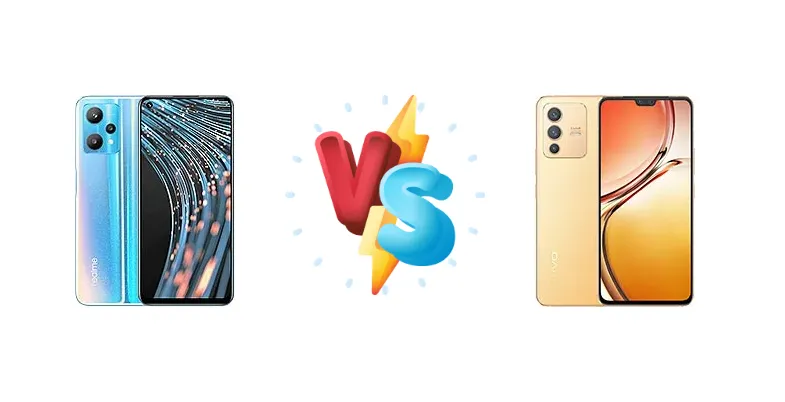
The Realme V25 and vivo V23 5G represent compelling options in the increasingly competitive mid-range 5G smartphone market. While both aim to deliver a balanced experience, they diverge significantly in their core hardware choices, particularly in their chipsets and charging capabilities. This comparison will dissect these differences to determine which device offers the best value for specific user needs.
🏆 Quick Verdict
For the average user prioritizing raw performance and faster charging, the vivo V23 5G emerges as the stronger contender. Its Mediatek Dimensity 920 chipset provides a noticeable performance uplift over the Snapdragon 695 in the Realme V25, and the 44W charging significantly reduces downtime. However, the Realme V25 remains a viable option for those on a tighter budget.
| Network |
|---|
| 2G bands | GSM 850 / 900 / 1800 / 1900 | GSM 850 / 900 / 1800 / 1900 |
| 3G bands | HSDPA 850 / 900 / 2100 | HSDPA 850 / 900 / 1700(AWS) / 1900 / 2100 |
| 4G bands | LTE | 1, 2, 3, 4, 5, 8, 18, 19, 26, 38, 39, 40, 41 |
| 5G bands | SA/NSA | 1, 3, 38, 40, 41, 77, 78 SA/NSA |
| Speed | HSPA, LTE, 5G | HSPA, LTE, 5G |
| Technology | GSM / CDMA / HSPA / CDMA2000 / LTE / 5G | GSM / HSPA / LTE / 5G |
| | CDMA2000 1x | 1, 3, 5, 8, 7, 20, 28, 38, 40, 41, 77, 78 SA/NSA |
| Launch |
|---|
| Announced | 2022, March 03 | 2022, January 05 |
| Status | Available. Released 2022, March 04 | Available. Released 2022, January 19 |
| Body |
|---|
| Build | - | Glass front (Schott Xensation Up), glass back |
| Dimensions | 164.3 x 75.6 x 8.5 mm (6.47 x 2.98 x 0.33 in) | 157.2 x 72.4 x 7.4 or 7.6 mm |
| SIM | Nano-SIM + Nano-SIM | Nano-SIM + Nano-SIM |
| Weight | 195 g (6.88 oz) | 179 g or 181 g (6.31 oz) |
| Display |
|---|
| Protection | - | Schott Xensation Up |
| Resolution | 1080 x 2412 pixels, 20:9 ratio (~400 ppi density) | 1080 x 2400 pixels, 20:9 ratio (~409 ppi density) |
| Size | 6.6 inches, 104.8 cm2 (~84.4% screen-to-body ratio) | 6.44 inches, 100.1 cm2 (~88.0% screen-to-body ratio) |
| Type | IPS LCD, 120Hz | AMOLED, 90Hz, HDR10+ |
| Platform |
|---|
| CPU | Octa-core (2x2.2 GHz Kryo 660 Gold & 6x1.7 GHz Kryo 660 Silver) | Octa-core (2x2.5 GHz Cortex-A78 & 6x2.0 GHz Cortex-A55) |
| Chipset | Qualcomm SM6375 Snapdragon 695 5G (6 nm) | Mediatek Dimensity 920 (6 nm) |
| GPU | Adreno 619 | Mali-G68 MC4 |
| OS | Android 12, Realme UI 3.0 | Android 12, upgradable to Android 14, Funtouch 14 |
| Memory |
|---|
| Card slot | microSDXC (uses shared SIM slot) | No |
| Internal | 256GB 12GB RAM | 128GB 8GB RAM, 256GB 12GB RAM |
| Main Camera |
|---|
| Dual | - | 50 MP, f/2.0, (wide), AF
8 MP, f/2.3, 105˚ (ultrawide) |
| Features | LED flash, HDR, panorama | Dual-LED flash, HDR, panorama |
| Single | 16 MP, f/2.1, 26mm (wide), 1/3.09", 1.0µm | - |
| Triple | 64 MP, f/1.8, 26mm (wide), PDAF
2 MP (macro)
Auxiliary lens | 64 MP, f/1.9, 26mm (wide), PDAF
8 MP, f/2.2, 120˚, 16mm (ultrawide), 1/4.0", 1.12µm
2 MP (macro) |
| Video | 1080p@30fps | 4K@30fps, 1080p@30fps, gyro-EIS |
| Selfie camera |
|---|
| Dual | - | 50 MP, f/2.0, (wide), AF
8 MP, f/2.3, 105˚ (ultrawide) |
| Features | HDR, panorama | Dual-LED dual-tone flash, HDR |
| Single | 16 MP, f/2.1, 26mm (wide), 1/3.09", 1.0µm | - |
| Video | 1080p@30fps | 4K@30fps, 1080p@30fps |
| Sound |
|---|
| 3.5mm jack | Yes | No |
| 35mm jack | Yes | No |
| Loudspeaker | Yes | Yes |
| | 24-bit/192kHz audio | 24-bit/192kHz audio |
| Comms |
|---|
| Bluetooth | 5.1, A2DP, LE, aptX HD | 5.2, A2DP, LE, aptX HD |
| NFC | No | Yes (market/region dependent) |
| Positioning | GPS, GLONASS, BDS | GPS, GLONASS, BDS, GALILEO, QZSS, NavIC |
| Radio | No | No |
| USB | USB Type-C 2.0, OTG | USB Type-C, OTG |
| WLAN | Wi-Fi 802.11 a/b/g/n/ac, dual-band | Wi-Fi 802.11 a/b/g/n/ac, Wi-Fi 6 (market dependent), dual-band, Wi-Fi Direct |
| Features |
|---|
| Sensors | Fingerprint (side-mounted), accelerometer, gyro, proximity, compass | Fingerprint (under display, optical), accelerometer, gyro, proximity, compass |
| | - | Color changing back panel when exposed to sunlight |
| Battery |
|---|
| Charging | 33W wired | 44W wired, 68% in 30 min |
| Type | 5000 mAh | 4200 mAh |
| Misc |
|---|
| Colors | Midnight Black, Aurora Green, Sunrise Blue | Sunshine Gold, Stardust Black |
| Models | - | V2130, V2303 |
| Price | About 290 EUR | About 280 EUR |
| SAR | - | 1.08 W/kg (head) 0.72 W/kg (body) |
| Tests |
|---|
| Battery life | - |
Endurance rating 103h
|
| Camera | - |
Photo / Video |
| Display | - |
Contrast ratio: Infinite (nominal) |
| Loudspeaker | - |
-28.5 LUFS (Average)
|
| Performance | - |
AnTuTu: 406498 (v8), 476058 (v9)
GeekBench: 8421 (v4.4), 2140 (v5.1)
GFXBench: 22fps (ES 3.1 onscreen) |
Realme V25
- More affordable price point
- Decent performance for everyday tasks
- Reliable 5G connectivity
- Slower charging speeds
- Less powerful chipset compared to the V23 5G
- Limited display brightness information
vivo V23 5G
- Faster and more powerful Dimensity 920 chipset
- Significantly faster 44W charging
- Brighter display for better outdoor visibility
- Generally higher price
- Battery life is similar to the Realme V25 despite faster charging
- Camera details are limited
Display Comparison
The vivo V23 5G boasts a measured peak brightness of 629 nits, suggesting a more visible display in outdoor conditions compared to the Realme V25, for which display brightness data is unavailable. While both likely utilize AMOLED panels (typical for this price bracket), the V23 5G’s higher brightness is a tangible advantage. The 'Infinite' contrast ratio specification on the V23 5G is a marketing term common to AMOLED displays, indicating perfect blacks. Without detailed display specs for the Realme V25, it's difficult to assess color accuracy or other panel characteristics beyond assuming a standard AMOLED experience.
Camera Comparison
Both devices offer photo and video capabilities, but detailed camera specifications are limited. Without sensor size or aperture information, a direct comparison is challenging. However, the Dimensity 920’s ISP (Image Signal Processor) in the vivo V23 5G is generally more capable than the Snapdragon 695’s ISP, potentially leading to better image processing, especially in low-light conditions. The presence of OIS (Optical Image Stabilization) on the V23 5G, if equipped, would further enhance image quality and video stabilization. We can assume both phones include standard features like portrait mode and night mode, but the V23 5G’s superior processing power likely delivers more refined results. The usefulness of a 2MP macro camera on either device is questionable, as image quality is typically limited.
Performance
The core difference lies in the chipsets: the Realme V25 utilizes the Qualcomm Snapdragon 695 5G (6nm), while the vivo V23 5G features the Mediatek Dimensity 920 (6nm). The Dimensity 920, with its Cortex-A78 performance cores clocked at 2.5 GHz, offers a significant CPU performance advantage over the Snapdragon 695’s Kryo 660 Gold cores at 2.2 GHz. This translates to snappier app launches, smoother multitasking, and better performance in demanding applications. While both are 6nm chips, the Dimensity 920’s architecture is more advanced. The V23 5G is likely to exhibit less throttling under sustained load. The Realme V25's Snapdragon 695 is still capable, but geared towards efficiency rather than outright speed.
Battery Life
Both phones share an endurance rating of 103 hours, suggesting similar real-world battery life despite potentially different battery capacities (not specified). However, the vivo V23 5G’s 44W wired charging is a significant advantage over the Realme V25’s 33W charging. The V23 5G can reach 68% charge in just 30 minutes, minimizing downtime. While the Realme V25 offers respectable charging speeds, it won’t replenish the battery as quickly. This faster charging capability makes the V23 5G more convenient for users who frequently need to top up their battery.
Buying Guide
Buy the Realme V25 if you need a reliable 5G smartphone with decent performance for everyday tasks and prioritize affordability. It's ideal for users who primarily browse, use social media, and occasionally game. Buy the vivo V23 5G if you prefer a smoother, more responsive experience, especially when multitasking or playing demanding games, and value faster charging to minimize interruptions. This phone caters to users who demand more from their smartphone.
Frequently Asked Questions
❓ Does the Mediatek Dimensity 920 in the vivo V23 5G get noticeably warmer during extended gaming sessions compared to the Snapdragon 695?
While both chips are 6nm, the Dimensity 920's higher performance ceiling means it *can* generate more heat under sustained load. However, vivo likely employs thermal management solutions to mitigate this. User reports suggest the V23 5G manages heat effectively, though it may become warm to the touch during prolonged gaming. The Snapdragon 695, being less powerful, will generally run cooler.
❓ Is the 44W charging on the vivo V23 5G compatible with Power Delivery (PD) chargers?
The vivo V23 5G utilizes vivo's proprietary FlashCharge technology, which is *not* fully compatible with standard Power Delivery (PD) chargers. While a PD charger may provide some charging, it won't deliver the full 44W speed. It's recommended to use the included charger for optimal charging performance.
❓ How does the Snapdragon 695's 5G modem compare to the Dimensity 920's in terms of network stability and speed?
Both chipsets support 5G connectivity, but the Dimensity 920 generally offers a more advanced 5G modem with broader band support and potentially better carrier aggregation capabilities. This *could* translate to slightly faster and more stable 5G connections in certain areas, but real-world performance will heavily depend on network conditions and carrier support.