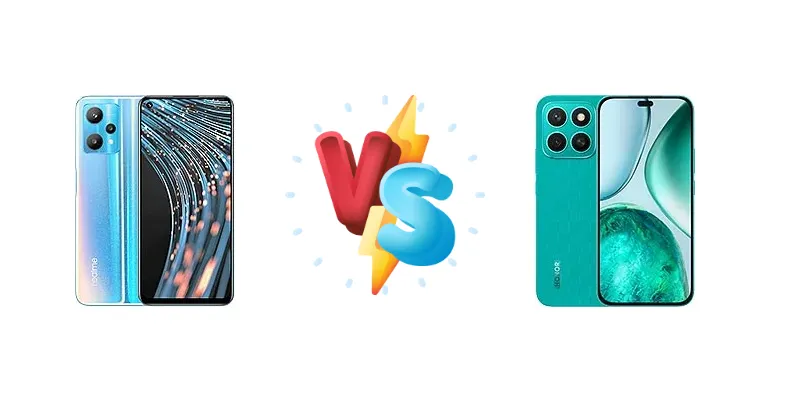
The Realme V25 and Honor X8c represent a growing segment of affordable 5G smartphones. Both aim to deliver connectivity without breaking the bank, but they achieve this with different chipsets and slightly varying approaches to features. This comparison dissects the core differences between the Snapdragon 695-powered Realme V25 and the Snapdragon 685-equipped Honor X8c, helping you determine which device best suits your needs.
🏆 Quick Verdict
For most users, the Realme V25 emerges as the slightly stronger choice. Its Snapdragon 695 offers a noticeable CPU performance advantage, particularly in multi-core tasks, making it better suited for multitasking and demanding applications. While the Honor X8c counters with slightly faster charging, the overall performance edge of the V25 is more impactful for daily use.
| Network |
|---|
| 2G bands | GSM 850 / 900 / 1800 / 1900 | GSM 850 / 900 / 1800 / 1900 |
| 3G bands | HSDPA 850 / 900 / 2100 | HSDPA 850 / 900 / 1900 / 2100 |
| 4G bands | LTE | LTE |
| 5G bands | SA/NSA | - |
| Speed | HSPA, LTE, 5G | HSPA, LTE |
| Technology | GSM / CDMA / HSPA / CDMA2000 / LTE / 5G | GSM / HSPA / LTE |
| | CDMA2000 1x | - |
| Launch |
|---|
| Announced | 2022, March 03 | 2025, January 14 |
| Status | Available. Released 2022, March 04 | Available. Released 2025, January 20 |
| Body |
|---|
| Build | - | Glass front, plastic frame, plastic back or silicone polymer back (eco leather) |
| Dimensions | 164.3 x 75.6 x 8.5 mm (6.47 x 2.98 x 0.33 in) | 161.1 x 74.6 x 7.1 mm (6.34 x 2.94 x 0.28 in) |
| SIM | Nano-SIM + Nano-SIM | Nano-SIM + Nano-SIM |
| Weight | 195 g (6.88 oz) | 174 g (6.14 oz) |
| Display |
|---|
| Resolution | 1080 x 2412 pixels, 20:9 ratio (~400 ppi density) | 1080 x 2412 pixels, 20:9 ratio (~394 ppi density) |
| Size | 6.6 inches, 104.8 cm2 (~84.4% screen-to-body ratio) | 6.7 inches, 108.0 cm2 (~89.9% screen-to-body ratio) |
| Type | IPS LCD, 120Hz | AMOLED, 120Hz, 1200 nits (HBM), 2800 nits (peak) |
| Platform |
|---|
| CPU | Octa-core (2x2.2 GHz Kryo 660 Gold & 6x1.7 GHz Kryo 660 Silver) | Octa-core (4x2.8 GHz Cortex-A73 & 4x1.9 GHz Cortex-A53) |
| Chipset | Qualcomm SM6375 Snapdragon 695 5G (6 nm) | Qualcomm SM6225 Snapdragon 685 (6 nm) |
| GPU | Adreno 619 | Adreno 610 |
| OS | Android 12, Realme UI 3.0 | Android 15, MagicOS 9 |
| Memory |
|---|
| Card slot | microSDXC (uses shared SIM slot) | No |
| Internal | 256GB 12GB RAM | 128GB 6GB RAM, 128GB 8GB RAM, 256GB 8GB RAM, 512GB 8GB RAM |
| Main Camera |
|---|
| Dual | - | 108 MP, f/1.8, 24mm (wide), 1/1.67", PDAF, OIS
5 MP, f/2.2, (ultrawide) |
| Features | LED flash, HDR, panorama | LED flash, HDR, panorama |
| Single | 16 MP, f/2.1, 26mm (wide), 1/3.09", 1.0µm | - |
| Triple | 64 MP, f/1.8, 26mm (wide), PDAF
2 MP (macro)
Auxiliary lens | - |
| Video | 1080p@30fps | 1080p@30fps, gyro-EIS |
| Selfie camera |
|---|
| Features | HDR, panorama | - |
| Single | 16 MP, f/2.1, 26mm (wide), 1/3.09", 1.0µm | 50 MP, f/2.1, (wide) |
| Video | 1080p@30fps | 1080p@30fps |
| Sound |
|---|
| 3.5mm jack | Yes | - |
| 35mm jack | Yes | No |
| Loudspeaker | Yes | Yes |
| | 24-bit/192kHz audio | - |
| Comms |
|---|
| Bluetooth | 5.1, A2DP, LE, aptX HD | 5.0/5.1, A2DP, LE |
| NFC | No | Yes (market/region dependent) |
| Positioning | GPS, GLONASS, BDS | GPS, GLONASS, GALILEO, BDS |
| Radio | No | No |
| USB | USB Type-C 2.0, OTG | USB Type-C 2.0, OTG |
| WLAN | Wi-Fi 802.11 a/b/g/n/ac, dual-band | Wi-Fi 802.11 a/b/g/n/ac, dual-band, Wi-Fi Direct |
| Features |
|---|
| Sensors | Fingerprint (side-mounted), accelerometer, gyro, proximity, compass | Fingerprint (under display, optical), accelerometer, gyro, compass, proximity (ultrasonic) |
| Battery |
|---|
| Charging | 33W wired | 35W wired |
| Type | 5000 mAh | Li-Po 5000 mAh |
| Misc |
|---|
| Colors | Midnight Black, Aurora Green, Sunrise Blue | Marrs Green, Midnight Black, Moonlight White, Cloud Purple |
| Models | - | ABR-LX1, ABR-LX2, ABR-LX3 |
| Price | About 290 EUR | € 190.78 / $ 213.42 / £ 159.00 |
Realme V25
- Stronger CPU performance with Snapdragon 695
- More efficient chipset for better battery life
- Potentially better thermal management
- Slightly slower charging speed (33W)
- Camera performance is unknown
Honor X8c
- Faster charging speed (35W)
- Potentially lower price point
- Good for basic smartphone tasks
- Less powerful CPU compared to Snapdragon 695
- Older Cortex-A73 architecture is less efficient
Display Comparison
Neither Realme nor Honor provide display specifications beyond the basic panel type. Given the price point, both likely utilize IPS LCD panels. The absence of high refresh rates or advanced features like LTPO suggests a focus on cost optimization. Bezels are expected to be moderate, typical for this segment. Color accuracy will likely be standard, requiring calibration for professional use. Without specific data, it's difficult to declare a clear winner; display quality will likely be similar.
Camera Comparison
Detailed camera specifications are unavailable. However, given the market positioning, both phones likely feature a primary camera around the 50MP mark, accompanied by depth and macro sensors. The quality of image processing will be a key differentiator. Realme’s image processing tends to be more vibrant and saturated, while Honor often aims for a more natural look. Without sample images or sensor size details, it’s difficult to assess which phone delivers superior image quality. The inclusion of a 2MP macro camera on both devices is largely a marketing tactic, offering limited practical benefit due to the low resolution and lack of autofocus.
Performance
The core difference lies in the chipsets. The Realme V25’s Snapdragon 695 (6nm) features a Kryo 660 CPU with a prime core clocked at 2.2 GHz, paired with six efficiency cores at 1.7 GHz. This architecture prioritizes sustained performance. Conversely, the Honor X8c utilizes the Snapdragon 685 (6nm) with a different core configuration: four Cortex-A73 cores at 2.8 GHz and four Cortex-A53 cores at 1.9 GHz. While the X8c boasts higher clock speeds on its prime cores, the older Cortex-A73 architecture is less efficient than the Kryo 660. The 695’s architecture and 6nm process node will likely translate to better thermal management and sustained performance under load, benefiting gamers and power users. The Realme V25 will likely exhibit less throttling during extended gaming sessions.
Battery Life
The Honor X8c’s 35W wired charging is a slight advantage over the Realme V25’s 33W charging. This translates to potentially faster 0-100% charge times, though the actual difference will depend on battery capacity (which is currently unknown for both devices). The Snapdragon 695’s improved efficiency in the Realme V25 could offset a potentially smaller battery capacity, resulting in comparable real-world battery life. The 6nm process node contributes to lower power consumption, extending usage time between charges.
Buying Guide
Buy the Realme V25 if you prioritize consistent performance for everyday tasks, occasional gaming, and future-proofing with a more capable 5G chipset. Buy the Honor X8c if you value slightly faster charging speeds and are primarily focused on basic smartphone functions like calling, texting, and light social media use, and are less concerned with demanding applications.
Frequently Asked Questions
❓ Will the Snapdragon 685 in the Honor X8c struggle with graphically intensive games like PUBG Mobile?
The Snapdragon 685 can run PUBG Mobile, but you'll likely need to lower the graphics settings to achieve a smooth frame rate. The older Cortex-A73 cores and GPU are less powerful than those found in the Snapdragon 695, meaning the Honor X8c may experience more frame drops and stuttering during intense gameplay.
❓ Does the Realme V25 support carrier aggregation for improved 5G speeds?
While not explicitly stated, the Snapdragon 695 generally supports carrier aggregation, which allows the phone to combine multiple 5G bands for faster download and upload speeds. This is a significant advantage in areas with strong 5G coverage, potentially providing a more reliable and consistent 5G experience compared to devices with limited carrier aggregation support.
❓ Is the difference in charging speed (35W vs 33W) between the Honor X8c and Realme V25 noticeable in real-world use?
The 2W difference in charging wattage is unlikely to be dramatically noticeable. Both phones offer relatively fast charging for their price range. You might shave off 5-10 minutes of charging time with the Honor X8c, but the overall experience will be similar.