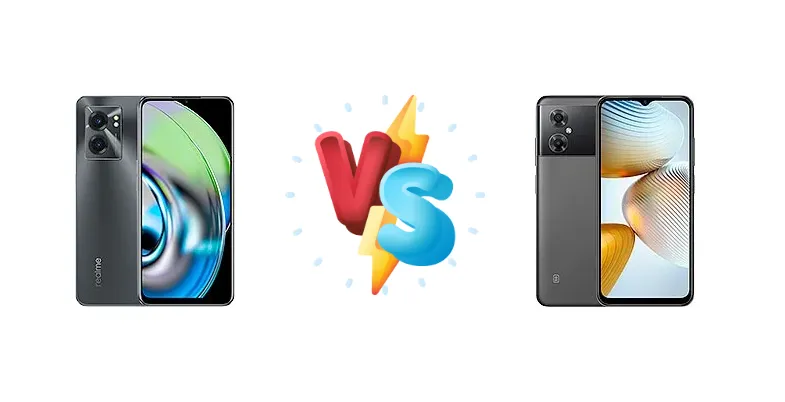
The Realme V23i and Xiaomi Poco M4 5G represent the increasingly competitive sub-$200 5G smartphone market. Both devices leverage the Mediatek Dimensity 700 chipset, promising accessible 5G connectivity. However, subtle differences in charging speed and potentially battery optimization separate these two, making a direct comparison crucial for budget-conscious consumers.
🏆 Quick Verdict
For the average user prioritizing convenience, the Xiaomi Poco M4 5G is the better choice. While both phones share the same Dimensity 700 chipset, the Poco M4 5G’s 18W charging significantly reduces downtime compared to the V23i’s slower 10W charging, and the endurance rating suggests similar real-world battery performance.
| Network |
|---|
| 2G bands | GSM 850 / 900 / 1800 / 1900 | GSM 850 / 900 / 1800 / 1900 |
| 3G bands | HSDPA 850 / 900 / 1900 / 2100 | HSDPA 850 / 900 / 1700(AWS) / 1900 / 2100 |
| 4G bands | LTE | 1, 2, 3, 4, 5, 7, 8, 20, 28, 38, 40, 41 |
| 5G bands | SA/NSA | 1, 3, 5, 7, 8, 20, 28, 38, 40, 41, 77, 78 SA/NSA |
| Speed | HSPA, LTE, 5G | HSPA, LTE, 5G |
| Technology | GSM / HSPA / LTE / 5G | GSM / HSPA / LTE / 5G |
| Launch |
|---|
| Announced | 2022, August 25 | 2022, August 15 |
| Status | Available. Released 2022, August 25 | Available. Released 2022, October 07 |
| Body |
|---|
| Build | Glass front, plastic frame, plastic back | Glass front (Gorilla Glass), plastic frame, plastic back |
| Dimensions | 163.8 x 75.1 x 8.1 mm (6.45 x 2.96 x 0.32 in) | 164 x 76.1 x 8.9 mm (6.46 x 3.00 x 0.35 in) |
| SIM | Nano-SIM + Nano-SIM | Nano-SIM + Nano-SIM |
| Weight | 185 g (6.53 oz) | 200 g (7.05 oz) |
| | - | Splash resistant |
| Display |
|---|
| Protection | - | Corning Gorilla Glass (unspecified version) |
| Resolution | 720 x 1612 pixels, 20:9 ratio (~268 ppi density) | 1080 x 2408 pixels, 20:9 ratio (~401 ppi density) |
| Size | 6.56 inches, 104.2 cm2 (~84.7% screen-to-body ratio) | 6.58 inches, 104.3 cm2 (~83.6% screen-to-body ratio) |
| Type | IPS LCD, 90Hz | IPS LCD, 90Hz, 500 nits (HBM) |
| Platform |
|---|
| CPU | Octa-core (2x2.2 GHz Cortex-A76 & 6x2.0 GHz Cortex-A55) | Octa-core (2x2.2 GHz Cortex-A76 & 6x2.0 GHz Cortex-A55) |
| Chipset | Mediatek Dimensity 700 (7 nm) | Mediatek Dimensity 700 (7 nm) |
| GPU | Mali-G57 MC2 | Mali-G57 MC2 |
| OS | Android 12, ColorOS 12 | Android 12, MIUI 13 |
| Memory |
|---|
| Card slot | microSDXC | microSDXC (dedicated slot) |
| Internal | 128GB 4GB RAM | 64GB 4GB RAM, 128GB 6GB RAM |
| | - | UFS 2.2 |
| Main Camera |
|---|
| Dual | 13 MP, (wide), AF
Auxiliary lens | 13 MP, f/2.2, (wide), PDAF
Auxiliary lens |
| Features | LED flash, HDR, panorama | LED flash, HDR, panorama |
| Single | 8 MP, (wide) | - |
| Video | 1080p@30fps | 1080p@30fps |
| Selfie camera |
|---|
| Features | - | HDR |
| Single | 8 MP, (wide) | 5 MP, f/2.2, (wide) |
| Video | 1080p@30fps | 1080p@30fps |
| Sound |
|---|
| 3.5mm jack | Yes | Yes |
| 35mm jack | Yes | Yes |
| Loudspeaker | Yes | Yes |
| | - | 24-bit/192kHz audio |
| Comms |
|---|
| Bluetooth | Yes | 5.1, A2DP, LE |
| Infrared port | - | Yes |
| NFC | No | Yes (market/region dependent) |
| Positioning | Yes | GPS, GLONASS, BDS |
| Radio | No | FM radio |
| USB | USB Type-C 2.0 | USB Type-C 2.0, OTG |
| WLAN | Yes | Wi-Fi 802.11 a/b/g/n/ac, dual-band, Wi-Fi Direct |
| Features |
|---|
| Sensors | Fingerprint (side-mounted), accelerometer, proximity | Fingerprint (side-mounted), accelerometer, proximity, compass |
| Battery |
|---|
| Charging | 10W wired | 18W wired |
| Type | 5000 mAh | Li-Po 5000 mAh |
| Misc |
|---|
| Colors | Black, Blue | Power Black, Cool Blue, Poco Yellow |
| Models | RMX2163C | 22041219PG |
| Price | About 270 EUR | About 180 EUR |
| SAR | - | 1.09 W/kg (head) 1.09 W/kg (body) |
| SAR EU | - | 0.60 W/kg (head) 0.99 W/kg (body) |
| Tests |
|---|
| Battery life | - |
Endurance rating 121h
|
| Camera | - |
Photo / Video |
| Display | - |
Contrast ratio: 1630:1 (nominal) |
| Loudspeaker | - |
-28.8 LUFS (Average)
|
| Performance | - |
AnTuTu: 336380 (v9)
GeekBench: 1730 (v5.1)
GFXBench: 12fps (ES 3.1 onscreen) |
Realme V23i
- Potentially lower price point
- Shares the same Dimensity 700 chipset as the Poco M4 5G
- Access to 5G connectivity
- Significantly slower 10W charging
- Missing battery capacity information
- Limited camera details
Xiaomi Poco M4 5G
- Faster 18W charging
- Strong endurance rating (121h)
- Potentially better battery optimization
- May be slightly more expensive than the Realme V23i
- Shares the same Dimensity 700 chipset as the Realme V23i
- Limited camera details
Display Comparison
Both the Realme V23i and Poco M4 5G share a nominal contrast ratio of 1630:1, suggesting similar visual pop. However, detailed display specifications like peak brightness, color gamut coverage, and panel type (IPS vs. AMOLED) are missing. Given the price point, both likely utilize IPS LCD panels. The absence of high refresh rate support (90Hz or 120Hz) is expected in this segment, focusing instead on power efficiency. Without further data, it’s difficult to declare a clear winner; display quality will likely be comparable.
Camera Comparison
Both phones feature 'Photo / Video' capabilities, but lack specific details regarding sensor size, aperture, or image processing algorithms. The absence of information suggests neither phone will excel in challenging lighting conditions. The prevalence of 2MP macro lenses in this price bracket is likely, and their utility is limited. Image quality will likely be similar, relying heavily on software processing to compensate for the limitations of the hardware. Without more data, a definitive camera comparison is impossible.
Performance
The core performance is identical: both devices are powered by the Mediatek Dimensity 700 (7nm) chipset with an octa-core CPU configuration (2x2.2 GHz Cortex-A76 & 6x2.0 GHz Cortex-A55). This means similar performance in everyday tasks like browsing, social media, and light gaming. The Dimensity 700 is a capable 5G SoC, but it's not a powerhouse. Thermal management will be key; however, without specific cooling solution details, it’s difficult to predict which phone will sustain peak performance for longer periods. RAM configurations are not specified, but will heavily influence multitasking capabilities.
Battery Life
The Xiaomi Poco M4 5G boasts an endurance rating of 121 hours, indicating strong battery life. While the Realme V23i’s battery capacity isn’t specified, the Poco M4 5G’s endurance rating suggests efficient power management. Crucially, the Poco M4 5G supports 18W wired charging, a significant advantage over the Realme V23i’s slower 10W charging. This translates to considerably faster top-up times, reducing downtime and improving overall usability. A full charge on the V23i will take noticeably longer.
Buying Guide
Buy the Realme V23i if your primary concern is absolute minimal upfront cost and you are willing to tolerate slower charging speeds. Buy the Xiaomi Poco M4 5G if you value faster charging, potentially better battery life optimization, and a slightly more refined user experience, even if it means spending a little more.
Frequently Asked Questions
❓ How will the 10W vs 18W charging difference impact daily use on the Realme V23i and Poco M4 5G?
The 18W charging on the Poco M4 5G will significantly reduce charging times. Expect a much faster top-up from 0-50% compared to the Realme V23i. This is particularly beneficial for users who frequently need to quickly recharge their phones throughout the day.
❓ Given both phones use the Dimensity 700, will I notice a performance difference in demanding games like PUBG Mobile?
While both phones share the same chipset, sustained performance may vary depending on thermal management. However, the Dimensity 700 is not designed for high-end gaming. Expect to play PUBG Mobile on medium settings for a playable experience on both devices, but don't anticipate consistently high frame rates.
❓ Is the 5G connectivity on these phones reliable, and what 5G bands do they support?
5G connectivity will depend on your carrier and location. The Dimensity 700 supports a wide range of 5G bands, but specific band support for each device isn't specified. Check with your carrier to ensure compatibility before purchasing.
❓ How does the lack of detailed camera specs affect the photo and video quality I can expect?
The limited camera information suggests neither phone will excel in photography. Expect decent results in good lighting conditions, but image quality will likely suffer in low light. Don't expect features like optical image stabilization (OIS) or advanced image processing.