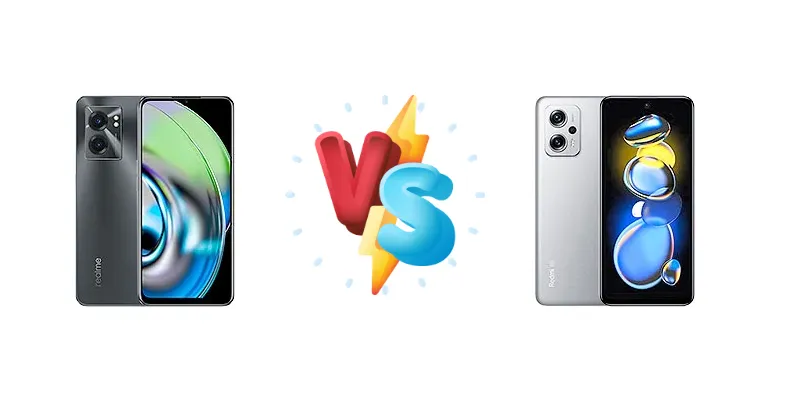
The Realme V23 and Xiaomi Redmi Note 11T Pro+ represent two approaches to the competitive mid-range smartphone market. The V23 aims for affordability with a capable Dimensity 810, while the 11T Pro+ throws down the gauntlet with the significantly more powerful Dimensity 8100 and incredibly fast 120W charging. This comparison dissects the trade-offs between these two devices, helping you determine which best suits your needs.
🏆 Quick Verdict
For the average user prioritizing raw performance and charging speed, the Xiaomi Redmi Note 11T Pro+ is the clear winner. Its Dimensity 8100 chipset delivers a substantial performance uplift over the Realme V23’s Dimensity 810, and the 120W charging is a game-changer. However, budget-conscious users will find the Realme V23 a compelling option.
| Network |
|---|
| 2G bands | GSM 850 / 900 / 1800 / 1900 | GSM 850 / 900 / 1800 / 1900 - SIM 1 & SIM 2 |
| 3G bands | HSDPA 850 / 900 / 1900 / 2100 | HSDPA 800 / 850 / 900 / 2100 |
| 4G bands | LTE | 1, 3, 5, 8, 19, 34, 38, 39, 40, 41, 42 |
| 5G bands | SA/NSA | 1, 3, 5, 8, 28, 38, 41, 77, 78 SA/NSA |
| Speed | HSPA, LTE, 5G | HSPA, LTE-A (CA), 5G |
| Technology | GSM / HSPA / LTE / 5G | GSM / CDMA / HSPA / EVDO / LTE / 5G |
| | - | CDMA2000 1xEV-DO |
| Launch |
|---|
| Announced | 2022, April 14 | 2022, May 24 |
| Status | Available. Released 2022, April 14 | Available. Released 2022, May 31 |
| Body |
|---|
| Build | Glass front, plastic frame, plastic back | - |
| Dimensions | 163.8 x 75.1 x 8.1 mm (6.45 x 2.96 x 0.32 in) | 163.6 x 74.3 x 8.9 mm (6.44 x 2.93 x 0.35 in) |
| SIM | Nano-SIM + Nano-SIM | Dual SIM (Nano-SIM, dual stand-by) |
| Weight | 190 g (6.70 oz) | 198 g (6.98 oz) |
| | - | IP53, dust and splash resistant |
| Display |
|---|
| Resolution | 1080 x 2408 pixels, 20:9 ratio (~401 ppi density) | 1080 x 2460 pixels (~407 ppi density) |
| Size | 6.58 inches, 104.3 cm2 (~84.8% screen-to-body ratio) | 6.6 inches, 103.4 cm2 (~85.1% screen-to-body ratio) |
| Type | IPS LCD, 90Hz, 600 nits (HBM) | IPS LCD, 144Hz, HDR10, Dolby Vision, 650 nits (typ) |
| Platform |
|---|
| CPU | Octa-core (2x2.4 GHz Cortex-A76 & 6x2.0 GHz Cortex-A55) | Octa-core (4x2.85 GHz Cortex-A78 & 4x2.0 GHz Cortex-A55) |
| Chipset | Mediatek Dimensity 810 (6 nm) | Mediatek Dimensity 8100 (5 nm) |
| GPU | Mali-G57 MC2 | Mali-G610 MC6 |
| OS | Android 12, Realme UI 3.0 | Android 12, MIUI 13 |
| Memory |
|---|
| Card slot | microSDXC | No |
| Internal | 256GB 8GB RAM, 256GB 12GB RAM | 128GB 8GB RAM, 256GB 8GB RAM, 512GB 8GB RAM |
| | - | UFS 3.1 |
| Main Camera |
|---|
| Dual | 48 MP, f/1.8, 26mm (wide), PDAF
Auxiliary lens | - |
| Features | LED flash, HDR, panorama | LED flash, HDR, panorama |
| Single | 8 MP, f/2.0, 26mm (wide) | 16 MP, (wide) |
| Triple | - | 64 MP, (wide), 1/1.72", 0.8µm, PDAF
8 MP, 120˚, (ultrawide)
2 MP, (macro) |
| Video | 1080p@30fps | 4K@30fps, 1080p@30/60/120fps, 720p@960fps |
| Selfie camera |
|---|
| Single | 8 MP, f/2.0, 26mm (wide) | 16 MP, (wide) |
| Video | 1080p@30fps | 1080p@30/60fps |
| Sound |
|---|
| 3.5mm jack | Yes | Yes |
| 35mm jack | Yes | - |
| Loudspeaker | Yes, with stereo speakers | Yes, with stereo speakers |
| | 24-bit/192kHz audio | 24-bit/192kHz audio |
| Comms |
|---|
| Bluetooth | 5.3, A2DP, LE | 5.3, A2DP, LE |
| Infrared port | - | Yes |
| NFC | No | Yes |
| Positioning | GPS, GLONASS, GALILEO, BDS | GPS (L1), GLONASS (G1), BDS (B1I+B1c), GALILEO (E1), QZSS (L1) |
| Radio | No | No |
| USB | USB Type-C 2.0 | USB Type-C 2.0, OTG |
| WLAN | Wi-Fi 802.11 a/b/g/n/ac, dual-band, Wi-Fi Direct | Wi-Fi 802.11 a/b/g/n/ac/6, dual-band, Wi-Fi Direct |
| Features |
|---|
| Sensors | Fingerprint (side-mounted), accelerometer, gyro, proximity | Fingerprint (side-mounted), accelerometer, proximity, gyro, compass, color spectrum |
| Battery |
|---|
| Charging | 33W wired, 50% in 28 min | 120W wired, PD3.0, 50% in 10 min, 100% in 19 min (advertised) |
| Type | 5000 mAh | Li-Po 4400 mAh, non-removable |
| Misc |
|---|
| Colors | Black, Gradient | Blue, Silver, Black |
| Models | - | 22041216UC |
| Price | About 240 EUR | About 300 EUR |
Realme V23
- More affordable price point
- Efficient Dimensity 810 chipset for everyday tasks
- Decent 33W charging
- Significantly less powerful than the Redmi Note 11T Pro+
- May struggle with demanding games
- Slower charging speeds
Xiaomi Redmi Note 11T Pro+
- Powerful Dimensity 8100 chipset for excellent performance
- Blazing-fast 120W charging
- PD3.0 support for versatile charging
- Higher price tag
- Potentially more heat generation under heavy load (though 5nm helps)
- May be overkill for basic users
Display Comparison
While both phones likely feature LCD panels given their price points, specific display details are missing. However, the focus should be on the processing power needed to drive higher refresh rates. The Dimensity 8100 in the Redmi Note 11T Pro+ has the headroom to comfortably handle a 120Hz or 144Hz display, potentially offering a smoother visual experience than the V23, which may be limited to 60Hz or 90Hz due to the Dimensity 810's lower processing capabilities.
Camera Comparison
Without specific camera sensor details, it's difficult to make a definitive comparison. However, the processing power of the Dimensity 8100 in the Redmi Note 11T Pro+ will likely enable more sophisticated image processing algorithms, potentially resulting in better dynamic range and noise reduction. The V23’s Dimensity 810 will still be capable, but will likely lag behind in complex scenarios. We anticipate both phones will feature a primary camera, ultrawide, and potentially a macro lens, but the Redmi Note 11T Pro+ is more likely to have a higher resolution main sensor.
Performance
The core difference lies in the chipsets. The Xiaomi Redmi Note 11T Pro+ boasts the Mediatek Dimensity 8100, fabricated on a 5nm process, featuring four high-performance Cortex-A78 cores clocked at 2.85 GHz. This is a significant upgrade over the Realme V23’s Dimensity 810 (6nm) with its two Cortex-A76 cores at 2.4 GHz. The 5nm process node of the Dimensity 8100 translates to improved power efficiency and reduced thermal throttling under sustained loads, making it the superior choice for gamers and power users. The CPU architecture difference – A78 vs A76 – also contributes to a noticeable performance gain in the Redmi Note 11T Pro+.
Battery Life
The Redmi Note 11T Pro+’s 120W charging is the standout feature. Advertised to reach 100% in just 19 minutes, it drastically reduces downtime. The Realme V23’s 33W charging, while respectable, takes significantly longer – 28 minutes to reach 50%. While battery capacity isn’t specified, the faster charging of the Redmi Note 11T Pro+ effectively mitigates any potential disadvantage from a slightly smaller battery, as users can quickly top up throughout the day. The power delivery (PD3.0) support on the Redmi Note 11T Pro+ also adds versatility.
Buying Guide
Buy the Realme V23 if you need a reliable, everyday smartphone for basic tasks, social media, and light gaming, and prioritize value for money. You'll appreciate its efficient chipset and decent battery life. Buy the Xiaomi Redmi Note 11T Pro+ if you demand faster performance for demanding games and applications, and value the convenience of incredibly rapid charging – especially if you frequently find yourself needing to top up quickly.
Frequently Asked Questions
❓ Will the Redmi Note 11T Pro+ get noticeably hot during extended gaming sessions?
While the Dimensity 8100 is a powerful chip, the 5nm fabrication process helps mitigate heat generation. However, sustained gaming will inevitably lead to some warming. The Redmi Note 11T Pro+ likely incorporates thermal management solutions, but users should expect some heat during prolonged, demanding gameplay.
❓ Is the 120W charging safe for the battery's long-term health?
Xiaomi employs various safety mechanisms to protect the battery during 120W charging, including optimized charging curves and temperature control. While fast charging *can* theoretically contribute to faster battery degradation over years of use, the benefits of convenience and reduced downtime generally outweigh the potential risks for most users. The phone's charging IC will manage the process to minimize stress on the battery.
❓ Does the Realme V23 support VoLTE/VoWiFi on all major carriers?
Carrier compatibility can vary. It's crucial to check with your specific carrier to confirm VoLTE and VoWiFi support for the Realme V23 in your region before purchasing, as these features are essential for modern voice call quality and functionality.
❓ How does the Dimensity 8100's performance compare to a Snapdragon 778G+?
The Dimensity 8100 is significantly more powerful than the Snapdragon 778G+. The Dimensity 8100's Cortex-A78 cores and 5nm process provide a substantial performance advantage in both CPU and GPU tasks, making it a better choice for demanding applications and gaming.