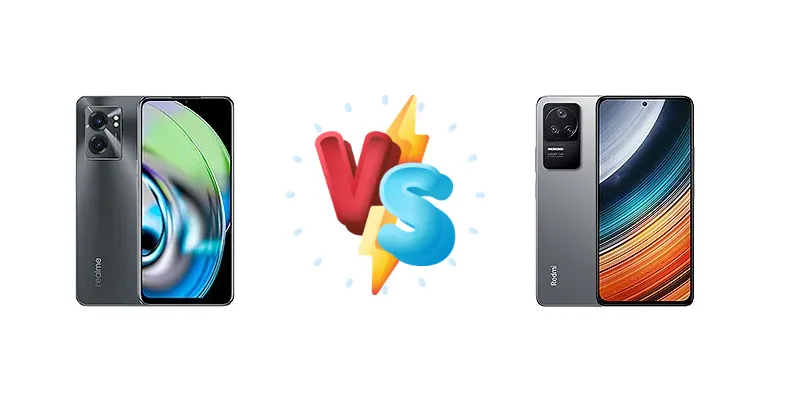
The Xiaomi Redmi K40S and Realme V23 represent compelling options in the increasingly competitive mid-range smartphone market. While both aim to deliver a solid experience without breaking the bank, they take distinctly different approaches to achieving that goal, primarily revolving around their chipset choices: Qualcomm’s Snapdragon 870 versus MediaTek’s Dimensity 810. This comparison will dissect the key differences to help you determine which device best suits your needs.
🏆 Quick Verdict
For most users, the Xiaomi Redmi K40S emerges as the stronger choice. Its Snapdragon 870 chipset provides a significant performance advantage over the Realme V23’s Dimensity 810, particularly in demanding tasks like gaming and video editing. While the Realme V23 offers a respectable experience, the K40S’s superior processing power and faster charging justify the potential price difference.
| Network |
|---|
| 2G bands | GSM 850 / 900 / 1800 / 1900 | GSM 850 / 900 / 1800 / 1900 |
| 3G bands | HSDPA 850 / 900 / 1900 / 2100 | HSDPA 850 / 900 / 1700(AWS) / 1900 / 2100 |
| 4G bands | LTE | 1, 2, 3, 4, 5, 8, 18, 19, 26, 34, 38, 39, 40, 41, 42 |
| 5G bands | SA/NSA | 1, 3, 5, 8, 28, 38, 40, 41, 77, 78 SA/NSA |
| Speed | HSPA, LTE, 5G | HSPA, LTE, 5G |
| Technology | GSM / HSPA / LTE / 5G | GSM / CDMA / HSPA / CDMA2000 / LTE / 5G |
| | - | CDMA2000 1x |
| Launch |
|---|
| Announced | 2022, April 14 | 2022, March 17 |
| Status | Available. Released 2022, April 14 | Available. Released 2022, March 17 |
| Body |
|---|
| Build | Glass front, plastic frame, plastic back | Glass front (Gorilla Glass 5), plastic back |
| Dimensions | 163.8 x 75.1 x 8.1 mm (6.45 x 2.96 x 0.32 in) | 163.2 x 76 x 7.7 mm (6.43 x 2.99 x 0.30 in) |
| SIM | Nano-SIM + Nano-SIM | Nano-SIM + Nano-SIM |
| Weight | 190 g (6.70 oz) | 195 g (6.88 oz) |
| | - | Splash resistant |
| Display |
|---|
| Protection | - | Corning Gorilla Glass 5 |
| Resolution | 1080 x 2408 pixels, 20:9 ratio (~401 ppi density) | 1080 x 2400 pixels, 20:9 ratio (~395 ppi density) |
| Size | 6.58 inches, 104.3 cm2 (~84.8% screen-to-body ratio) | 6.67 inches, 107.4 cm2 (~86.6% screen-to-body ratio) |
| Type | IPS LCD, 90Hz, 600 nits (HBM) | AMOLED, 120Hz, HDR10+, 1300 nits (peak) |
| Platform |
|---|
| CPU | Octa-core (2x2.4 GHz Cortex-A76 & 6x2.0 GHz Cortex-A55) | Octa-core (1x3.2 GHz Kryo 585 & 3x2.42 GHz Kryo 585 & 4x1.80 GHz Kryo 585) |
| Chipset | Mediatek Dimensity 810 (6 nm) | Qualcomm SM8250-AC Snapdragon 870 5G (7 nm) |
| GPU | Mali-G57 MC2 | Adreno 650 |
| OS | Android 12, Realme UI 3.0 | Android 12, MIUI 13 |
| Memory |
|---|
| Card slot | microSDXC | No |
| Internal | 256GB 8GB RAM, 256GB 12GB RAM | 128GB 6GB RAM, 128GB 8GB RAM, 256GB 8GB RAM, 256GB 12GB RAM |
| | - | UFS 3.1 |
| Main Camera |
|---|
| Dual | 48 MP, f/1.8, 26mm (wide), PDAF
Auxiliary lens | - |
| Features | LED flash, HDR, panorama | Color spectrum sensor, Dual-LED dual-tone flash, HDR, panorama |
| Single | 8 MP, f/2.0, 26mm (wide) | 20 MP, (wide) |
| Triple | - | 48 MP, f/1.8, (wide), 1/2.0", 0.8µm, PDAF, OIS
8 MP, 119˚ (ultrawide)
2 MP (macro) |
| Video | 1080p@30fps | 4K@30fps, 1080p@30/60/120fps, 720p@960fps; gyro-EIS |
| Selfie camera |
|---|
| Single | 8 MP, f/2.0, 26mm (wide) | 20 MP, (wide) |
| Video | 1080p@30fps | 1080p@30/120fps |
| Sound |
|---|
| 3.5mm jack | Yes | No |
| 35mm jack | Yes | No |
| Loudspeaker | Yes, with stereo speakers | Yes, with stereo speakers |
| | 24-bit/192kHz audio | 24-bit/192kHz audio |
| Comms |
|---|
| Bluetooth | 5.3, A2DP, LE | 5.2, A2DP, LE |
| NFC | No | Yes |
| Positioning | GPS, GLONASS, GALILEO, BDS | GPS (L1+L5), GLONASS (L1), BDS (B1I+B1c+B2a), GALILEO (E1+E5a), QZSS (L1+L5), NavIC (L5) |
| Radio | No | No |
| USB | USB Type-C 2.0 | USB Type-C 2.0, OTG |
| WLAN | Wi-Fi 802.11 a/b/g/n/ac, dual-band, Wi-Fi Direct | Wi-Fi 802.11 a/b/g/n/ac/6, dual-band, Wi-Fi Direct |
| Features |
|---|
| Sensors | Fingerprint (side-mounted), accelerometer, gyro, proximity | Fingerprint (side-mounted), accelerometer, gyro, proximity, compass |
| Battery |
|---|
| Charging | 33W wired, 50% in 28 min | 67W wired, PD3.0, QC3, 100% in 38 min |
| Type | 5000 mAh | Li-Po 4500 mAh |
| Misc |
|---|
| Colors | Black, Gradient | Black, Gray, Blue, Green |
| Price | About 240 EUR | About 260 EUR |
Realme V23
- More affordable price point
- Respectable performance for everyday tasks
- Efficient 6nm Dimensity 810 chipset
- Significantly weaker performance compared to Snapdragon 870
- Slower charging speeds (33W)
- Likely a less advanced camera system
Xiaomi Redmi K40S
- Powerful Snapdragon 870 5G chipset
- Ultra-fast 67W charging with PD3.0/QC3
- Likely a superior camera system with OIS
- Potentially higher price tag
- May run slightly warmer under heavy load
- Software experience can be feature-heavy
Display Comparison
Neither device’s display specifications are provided, so a direct comparison is limited. However, given the Redmi K40S’s positioning, it likely features an AMOLED panel with a 120Hz refresh rate, common in its price bracket. The Realme V23, targeting a more budget-conscious segment, may utilize an LCD panel. The K40S’s potential for higher peak brightness and color accuracy would be a significant advantage for media consumption. Bezels are likely comparable, but the K40S may benefit from slightly more refined design elements.
Camera Comparison
Without specific camera sensor details, analysis is limited. However, the Redmi K40S, positioned as a more premium device, likely features a larger main sensor with optical image stabilization (OIS), resulting in better low-light performance and sharper images. The Realme V23 likely employs a more basic camera setup. Image processing algorithms will also differ, with Xiaomi typically favoring vibrant, saturated colors, while Realme often aims for a more natural look. The absence of details prevents a definitive judgment, but the K40S is expected to offer a more versatile and capable camera system.
Performance
The core difference lies in the chipsets. The Xiaomi Redmi K40S’s Snapdragon 870 5G (7nm) boasts a prime core clocked at 3.2 GHz, alongside three performance cores at 2.42 GHz and four efficiency cores at 1.80 GHz. This configuration delivers significantly higher CPU and GPU performance compared to the Realme V23’s MediaTek Dimensity 810 (6nm). The Dimensity 810, with its 2x2.4 GHz Cortex-A76 and 6x2.0 GHz Cortex-A55 cores, is adequate for daily tasks but will struggle with graphically intensive games and demanding applications. The 7nm process of the Snapdragon 870 also contributes to better thermal efficiency, reducing the likelihood of throttling during sustained workloads. The K40S will provide a noticeably smoother and more responsive experience.
Battery Life
The Realme V23 supports 33W wired charging, reaching 50% charge in 28 minutes. The Xiaomi Redmi K40S significantly outpaces this with 67W wired charging, achieving a full charge in 38 minutes, and supporting PD3.0 and QC3 standards. While battery capacity isn’t specified, the faster charging of the K40S is a substantial benefit, minimizing downtime. The 6nm Snapdragon 870 is also more power efficient than the 6nm Dimensity 810, potentially offsetting any capacity differences.
Buying Guide
Buy the Realme V23 if you prioritize a lower price point and are a casual smartphone user who primarily focuses on everyday tasks like browsing, social media, and light multimedia consumption. Buy the Xiaomi Redmi K40S if you demand smoother performance for gaming, multitasking, or content creation, and value faster charging speeds for minimal downtime. The K40S is the better option for power users.
Frequently Asked Questions
❓ Will the Snapdragon 870 in the Redmi K40S handle demanding games like Genshin Impact at high settings?
Yes, the Snapdragon 870 is well-equipped to handle Genshin Impact and other graphically intensive games at high settings. While you might need to adjust some settings for sustained 60fps gameplay, the K40S provides a significantly smoother gaming experience compared to the Dimensity 810-powered Realme V23.
❓ How much faster is the 67W charging on the Redmi K40S compared to the 33W charging on the Realme V23 in real-world use?
The 67W charging on the Redmi K40S will noticeably reduce your charging time. While the Realme V23 takes 28 minutes to reach 50%, the K40S can fully charge in 38 minutes. This means you can get a substantial charge in a shorter amount of time, making it ideal for users who are always on the go.
❓ Is the Dimensity 810 in the Realme V23 sufficient for everyday tasks like browsing, social media, and video streaming?
Yes, the Dimensity 810 is perfectly capable of handling everyday tasks without issue. You won't experience lag or slowdowns during typical smartphone usage. However, it will struggle with more demanding applications and graphically intensive games.
❓ Does the Redmi K40S support 5G connectivity, and what bands are supported?
Yes, the Redmi K40S supports 5G connectivity thanks to the Snapdragon 870 5G modem. Specific band support will vary by region, so it's crucial to check compatibility with your carrier before purchasing.