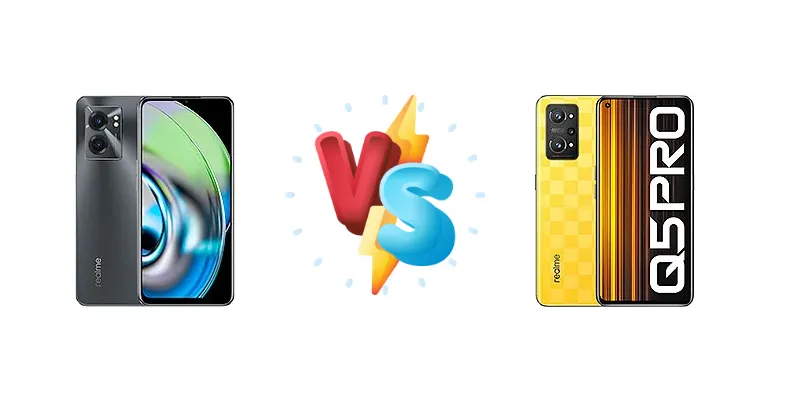
Realme's V and Q series often overlap in target audience, offering compelling specs at competitive prices. The V23 and Q5 Pro represent distinct approaches: the V23 prioritizes affordability with a Mediatek Dimensity 810, while the Q5 Pro aims for a more premium experience with the Qualcomm Snapdragon 870. This comparison dissects the key differences to help you choose the right device.
🏆 Quick Verdict
For most users, the Realme Q5 Pro is the superior choice. Its Snapdragon 870 chipset delivers significantly better performance, and the 80W charging is a game-changer. However, the V23 remains a viable option for those on a tighter budget who prioritize efficiency over raw power.
| Network |
|---|
| 2G bands | GSM 850 / 900 / 1800 / 1900 | GSM 850 / 900 / 1800 / 1900 |
| 3G bands | HSDPA 850 / 900 / 1900 / 2100 | HSDPA 800 / 850 / 900 / 1700(AWS) / 1900 / 2100 |
| 4G bands | LTE | 1, 2, 3, 4, 5, 7, 8, 18, 19, 26, 28, 34, 38, 39, 40, 41 |
| 5G bands | SA/NSA | 1, 3, 5, 8, 28, 41, 77, 78 SA/NSA |
| Speed | HSPA, LTE, 5G | HSPA, LTE, 5G |
| Technology | GSM / HSPA / LTE / 5G | GSM / CDMA / HSPA / CDMA2000 / LTE / 5G |
| | - | CDMA2000 1x |
| Launch |
|---|
| Announced | 2022, April 14 | 2022, April 20 |
| Status | Available. Released 2022, April 14 | Available. Released 2022, April 28 |
| Body |
|---|
| Build | Glass front, plastic frame, plastic back | - |
| Dimensions | 163.8 x 75.1 x 8.1 mm (6.45 x 2.96 x 0.32 in) | 162.9 x 75.8 x 8.7 mm (6.41 x 2.98 x 0.34 in) |
| SIM | Nano-SIM + Nano-SIM | Nano-SIM + Nano-SIM |
| Weight | 190 g (6.70 oz) | 194.5 g (6.88 oz) |
| Display |
|---|
| Resolution | 1080 x 2408 pixels, 20:9 ratio (~401 ppi density) | 1080 x 2400 pixels, 20:9 ratio (~398 ppi density) |
| Size | 6.58 inches, 104.3 cm2 (~84.8% screen-to-body ratio) | 6.62 inches, 105.8 cm2 (~85.7% screen-to-body ratio) |
| Type | IPS LCD, 90Hz, 600 nits (HBM) | AMOLED, 120Hz, HDR10+, 1300 nits (peak) |
| Platform |
|---|
| CPU | Octa-core (2x2.4 GHz Cortex-A76 & 6x2.0 GHz Cortex-A55) | Octa-core (1x3.2 GHz Kryo 585 & 3x2.42 GHz Kryo 585 & 4x1.80 GHz Kryo 585) |
| Chipset | Mediatek Dimensity 810 (6 nm) | Qualcomm SM8250-AC Snapdragon 870 5G (7 nm) |
| GPU | Mali-G57 MC2 | Adreno 650 |
| OS | Android 12, Realme UI 3.0 | Android 12, Realme UI 3.0 |
| Memory |
|---|
| Card slot | microSDXC | No |
| Internal | 256GB 8GB RAM, 256GB 12GB RAM | 128GB 6GB RAM, 128GB 8GB RAM, 256GB 8GB RAM |
| | - | UFS 3.1 |
| Main Camera |
|---|
| Dual | 48 MP, f/1.8, 26mm (wide), PDAF
Auxiliary lens | - |
| Features | LED flash, HDR, panorama | LED flash, HDR, panorama |
| Single | 8 MP, f/2.0, 26mm (wide) | 16 MP, f/2.5, 26mm (wide), 1/3.09", 1.0µm |
| Triple | - | 64 MP, f/1.8, 25mm (wide), 1/1.73", 0.8µm, PDAF
8 MP, f/2.3, 16mm, 119˚ (ultrawide), 1/4.0", 1.12µm
2 MP (macro) |
| Video | 1080p@30fps | 4K@30/60fps, 1080p@30fps, gyro-EIS |
| Selfie camera |
|---|
| Features | - | HDR, panorama |
| Single | 8 MP, f/2.0, 26mm (wide) | 16 MP, f/2.5, 26mm (wide), 1/3.09", 1.0µm |
| Video | 1080p@30fps | 1080p@30fps, gyro-EIS |
| Sound |
|---|
| 3.5mm jack | Yes | No |
| 35mm jack | Yes | No |
| Loudspeaker | Yes, with stereo speakers | Yes, with stereo speakers |
| | 24-bit/192kHz audio | 24-bit/192kHz audio |
| Comms |
|---|
| Bluetooth | 5.3, A2DP, LE | 5.2, A2DP, LE, aptX HD |
| NFC | No | No |
| Positioning | GPS, GLONASS, GALILEO, BDS | GPS (L1+L5), GLONASS, BDS, GALILEO, QZSS, NavIC |
| Radio | No | No |
| USB | USB Type-C 2.0 | USB Type-C 2.0 |
| WLAN | Wi-Fi 802.11 a/b/g/n/ac, dual-band, Wi-Fi Direct | Wi-Fi 802.11 a/b/g/n/ac/6, dual-band, Wi-Fi Direct |
| Features |
|---|
| Sensors | Fingerprint (side-mounted), accelerometer, gyro, proximity | Fingerprint (under display, optical), accelerometer, gyro, proximity, compass |
| Battery |
|---|
| Charging | 33W wired, 50% in 28 min | 80W wired |
| Type | 5000 mAh | 5000 mAh |
| Misc |
|---|
| Colors | Black, Gradient | Black, White, Yellow |
| Models | - | RMX3372 |
| Price | About 240 EUR | About 330 EUR |
Realme V23
- More affordable price point
- Potentially better battery efficiency due to the Dimensity 810
- Sufficient for everyday tasks and light gaming
- Significantly less powerful processor than the Q5 Pro
- Slower charging speed (33W)
- Likely a less advanced camera system
Realme Q5 Pro
- Superior performance with the Snapdragon 870
- Ultra-fast 80W charging
- Likely a better camera system with advanced features
- Higher price tag
- Potentially slightly lower battery efficiency due to the more powerful processor
- May run slightly warmer under heavy load
Display Comparison
Neither device's display specifications are provided, so a direct comparison is limited. However, given the Q5 Pro's positioning, it likely features a higher quality panel with potentially a higher refresh rate. The V23, targeting a lower price bracket, may utilize a more cost-effective LCD panel. Color accuracy and peak brightness will likely favor the Q5 Pro, assuming similar panel technology.
Camera Comparison
Without detailed camera specifications, a precise comparison is difficult. However, the Q5 Pro, being the higher-tier device, likely features a more capable main sensor and potentially additional features like optical image stabilization (OIS). The Snapdragon 870’s image signal processor (ISP) also offers more advanced image processing capabilities, resulting in better dynamic range and low-light performance. The V23 will likely rely on software optimizations to compensate for a potentially less powerful camera system.
Performance
The core difference lies in the chipsets. The Realme Q5 Pro’s Snapdragon 870 5G (7nm) is a substantial upgrade over the V23’s Mediatek Dimensity 810 (6nm). The Snapdragon 870’s Kryo 585 cores, with a prime core clocked at 3.2 GHz, offer significantly higher single-core and multi-core performance. This translates to faster app loading times, smoother multitasking, and a more responsive user experience. The 7nm process node also contributes to better thermal efficiency, potentially reducing throttling during sustained workloads. Gamers will particularly benefit from the Snapdragon 870’s superior GPU performance.
Battery Life
The Realme Q5 Pro’s 80W wired charging is a standout feature, capable of charging the battery from 0% to 100% in a significantly shorter time than the V23’s 33W charging. While battery capacity isn’t specified for either device, the Q5 Pro’s faster charging mitigates concerns about a potentially smaller battery. The V23’s 33W charging is still respectable, reaching 50% in 28 minutes, but it doesn’t offer the same level of convenience as the Q5 Pro’s ultra-fast charging.
Buying Guide
Buy the Realme V23 if you need a reliable daily driver for basic tasks, social media, and light gaming, and value battery life and a lower price point. Buy the Realme Q5 Pro if you prioritize smooth multitasking, demanding mobile games, and incredibly fast charging, and are willing to spend a bit more for a noticeably improved experience.
Frequently Asked Questions
❓ Will the Snapdragon 870 in the Q5 Pro handle demanding games like Genshin Impact at high settings?
Yes, the Snapdragon 870 is well-equipped to handle Genshin Impact and other graphically intensive games at high settings. Its Adreno 660 GPU provides ample power for smooth gameplay, and the improved thermal management helps prevent throttling during extended gaming sessions.
❓ How much faster is the 80W charging on the Q5 Pro compared to the 33W charging on the V23 in real-world use?
The 80W charging on the Q5 Pro can fully charge the battery in approximately 30-40 minutes, depending on battery capacity. The V23’s 33W charging takes considerably longer, around 60-75 minutes for a full charge. This difference is particularly noticeable for users who frequently need to top up their battery quickly.
❓ Is the Dimensity 810 in the V23 sufficient for everyday tasks like browsing, social media, and video streaming?
Absolutely. The Dimensity 810 is a capable processor for everyday tasks. It provides a smooth and responsive experience for browsing, social media, video streaming, and other common smartphone activities. It's only when pushing the phone with demanding games or multitasking that its limitations become apparent.