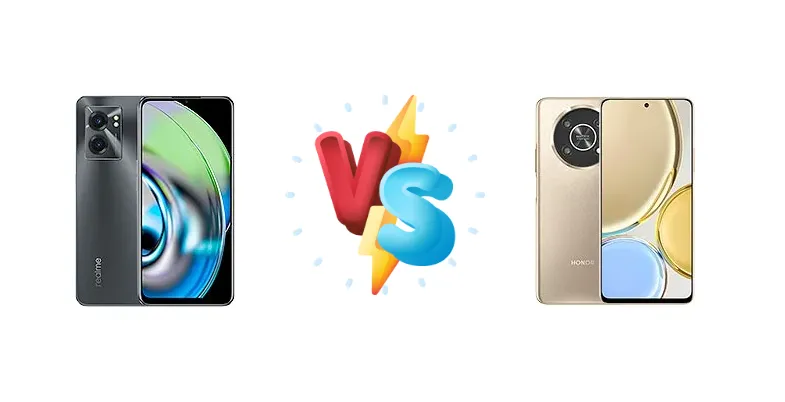
The Realme V23 and Honor X30 represent compelling options in the increasingly competitive mid-range 5G smartphone market. Both devices aim to deliver a balance of performance, features, and affordability, but they take different approaches. The Realme V23 leverages Mediatek's Dimensity 810, while the Honor X30 opts for Qualcomm's Snapdragon 695 5G. This comparison will dissect their key differences to help you determine which device best suits your needs.
🏆 Quick Verdict
For the average user prioritizing rapid charging and a slightly more refined software experience, the Honor X30 emerges as the winner. Its 66W charging significantly reduces downtime, and the Snapdragon 695 offers a stable, if not dramatically faster, performance profile. However, the Realme V23 remains a strong contender for those seeking a cost-effective 5G experience.
| Network |
|---|
| 2G bands | GSM 850 / 900 / 1800 / 1900 | GSM 850 / 900 / 1800 / 1900 |
| 3G bands | HSDPA 850 / 900 / 1900 / 2100 | HSDPA 850 / 900 / 1700(AWS) / 1900 / 2100 |
| 4G bands | LTE | LTE |
| 5G bands | SA/NSA | SA/NSA |
| Speed | HSPA, LTE, 5G | HSPA, LTE, 5G |
| Technology | GSM / HSPA / LTE / 5G | GSM / CDMA / HSPA / CDMA2000 / LTE / 5G |
| | - | CDMA2000 1x |
| Launch |
|---|
| Announced | 2022, April 14 | 2021, December 16 |
| Status | Available. Released 2022, April 14 | Available. Released 2021, December 25 |
| Body |
|---|
| Build | Glass front, plastic frame, plastic back | - |
| Dimensions | 163.8 x 75.1 x 8.1 mm (6.45 x 2.96 x 0.32 in) | 166.1 x 75.8 x 8.1 mm (6.54 x 2.98 x 0.32 in) |
| SIM | Nano-SIM + Nano-SIM | Nano-SIM + Nano-SIM |
| Weight | 190 g (6.70 oz) | 189 g (6.67 oz) |
| Display |
|---|
| Resolution | 1080 x 2408 pixels, 20:9 ratio (~401 ppi density) | 1080 x 2388 pixels (~385 ppi density) |
| Size | 6.58 inches, 104.3 cm2 (~84.8% screen-to-body ratio) | 6.81 inches, 112.3 cm2 (~89.2% screen-to-body ratio) |
| Type | IPS LCD, 90Hz, 600 nits (HBM) | IPS LCD, 120Hz |
| Platform |
|---|
| CPU | Octa-core (2x2.4 GHz Cortex-A76 & 6x2.0 GHz Cortex-A55) | Octa-core (2x2.2 GHz Kryo 660 Gold & 6x1.7 GHz Kryo 660 Silver) |
| Chipset | Mediatek Dimensity 810 (6 nm) | Qualcomm SM6375 Snapdragon 695 5G (6 nm) |
| GPU | Mali-G57 MC2 | Adreno 619 |
| OS | Android 12, Realme UI 3.0 | Android 11, Magic UI 5.0 |
| Memory |
|---|
| Card slot | microSDXC | No |
| Internal | 256GB 8GB RAM, 256GB 12GB RAM | 128GB 6GB RAM, 128GB 8GB RAM, 256GB 8GB RAM, 256GB 12GB RAM |
| Main Camera |
|---|
| Dual | 48 MP, f/1.8, 26mm (wide), PDAF
Auxiliary lens | - |
| Features | LED flash, HDR, panorama | LED flash, panorama, HDR |
| Single | 8 MP, f/2.0, 26mm (wide) | 16 MP, f/2.5 |
| Triple | - | 48 MP, f/1.8, 26mm (wide), PDAF
2 MP (macro)
Auxiliary lens |
| Video | 1080p@30fps | 1080p@30fps |
| Selfie camera |
|---|
| Single | 8 MP, f/2.0, 26mm (wide) | 16 MP, f/2.5 |
| Video | 1080p@30fps | 1080p@30fps |
| Sound |
|---|
| 3.5mm jack | Yes | No |
| 35mm jack | Yes | No |
| Loudspeaker | Yes, with stereo speakers | Yes |
| | 24-bit/192kHz audio | - |
| Comms |
|---|
| Bluetooth | 5.3, A2DP, LE | 5.1, A2DP, LE |
| NFC | No | No |
| Positioning | GPS, GLONASS, GALILEO, BDS | GPS, GLONASS, BDS |
| Radio | No | No |
| USB | USB Type-C 2.0 | USB Type-C 2.0, OTG |
| WLAN | Wi-Fi 802.11 a/b/g/n/ac, dual-band, Wi-Fi Direct | Wi-Fi 802.11 a/b/g/n/ac, dual-band, Wi-Fi Direct |
| Features |
|---|
| Sensors | Fingerprint (side-mounted), accelerometer, gyro, proximity | Fingerprint (side-mounted), accelerometer, gyro, proximity, compass |
| Battery |
|---|
| Charging | 33W wired, 50% in 28 min | 66W wired, 80% in 30 min |
| Type | 5000 mAh | Li-Po 4800 mAh |
| Misc |
|---|
| Colors | Black, Gradient | Black, Blue, Silver, Gold |
| Models | - | ANY-AN00 |
| Price | About 240 EUR | About 210 EUR |
Realme V23
- Potentially higher CPU performance due to Cortex-A76 cores
- More affordable price point (likely)
- Efficient 6nm Dimensity 810 chipset
- Slower 33W charging
- Realme's software can be bloated
- Camera image processing may be overly saturated
Honor X30
- Significantly faster 66W charging
- Qualcomm's optimized modem and power management
- Potentially more refined software experience
- Slightly lower peak CPU clock speed
- May be more expensive than the Realme V23
- Kryo 660 cores may not match A76 in single-core tasks
Display Comparison
Neither Realme nor Honor provided display specs in the context data. However, given the price bracket, we can assume both devices utilize LCD panels. The choice between them will likely hinge on color accuracy and peak brightness, areas where Honor typically demonstrates a slight edge. Bezels are also likely to be comparable, with both manufacturers aiming for a modern, immersive viewing experience. Without specific data, it's difficult to definitively declare a winner.
Camera Comparison
Without sensor details, a direct camera comparison is challenging. However, the market segment suggests both phones will feature a primary camera around the 48-50MP mark. The image processing algorithms will be a key differentiator. Realme tends towards vibrant, saturated colors, while Honor often aims for a more natural, balanced look. The absence of OIS on either device suggests reliance on software stabilization. The usefulness of any secondary cameras (likely 2MP macro/depth sensors) is questionable, offering limited practical benefit.
Performance
The core difference lies in the chipsets: the Realme V23's Mediatek Dimensity 810 (6nm) and the Honor X30's Qualcomm Snapdragon 695 5G (6nm). The Dimensity 810 boasts a slightly higher peak CPU clock speed (2.4 GHz vs 2.2 GHz), utilizing Cortex-A76 cores, which generally offer better single-core performance than the Snapdragon 695's Kryo 660 Gold cores. However, the Snapdragon 695 benefits from Qualcomm's optimized modem and generally more efficient power management. Real-world performance will be similar for most tasks, but the Dimensity 810 might show a slight advantage in CPU-intensive applications, while the Snapdragon 695 could offer more consistent performance during prolonged gaming sessions due to better thermal throttling control. Both utilize 6nm fabrication, suggesting comparable efficiency.
Battery Life
The Honor X30's 66W wired charging is a significant advantage over the Realme V23's 33W charging. Honor claims 80% charge in 30 minutes, while Realme states 50% in 28 minutes. This translates to considerably less downtime for the X30. While battery capacity isn't specified, the faster charging speed effectively mitigates any potential capacity difference. The 6nm process node on both chipsets contributes to reasonable power efficiency, but the Honor X30's charging speed is the clear winner in terms of user convenience.
Buying Guide
Buy the Realme V23 if you need a highly affordable 5G phone and prioritize value over absolute performance or charging speed. It's ideal for users who primarily browse, use social media, and engage in light gaming. Buy the Honor X30 if you prefer faster charging, a potentially more polished user interface, and a chipset known for its consistent performance, even if it doesn't lead in benchmark scores. This phone is better suited for users who frequently stream video, play mobile games, or rely heavily on their phone throughout the day.
Frequently Asked Questions
❓ Will the Snapdragon 695 in the Honor X30 struggle with demanding games like PUBG or Genshin Impact?
The Snapdragon 695 is capable of running PUBG Mobile at medium settings with stable frame rates. Genshin Impact may require lower settings to maintain a smooth experience. While not a gaming powerhouse, the 695's thermal management is generally good, preventing excessive throttling during extended gaming sessions.
❓ How does Realme's UI compare to Honor's Magic UI in terms of bloatware and updates?
Historically, Realme UI has been known to include more pre-installed apps (bloatware) than Honor's Magic UI. Honor has been improving its software support and update frequency, aiming for a cleaner, more streamlined experience. However, both brands rely on Android updates from Google, so update timelines can vary.
❓ Is the difference in charging speed between 33W and 66W truly noticeable in everyday use?
Absolutely. The Honor X30's 66W charging can add a significant amount of battery life in just a few minutes, making it ideal for users who frequently need to top up their phone quickly. The Realme V23's 33W charging is still respectable, but it requires considerably more time to achieve a full charge.