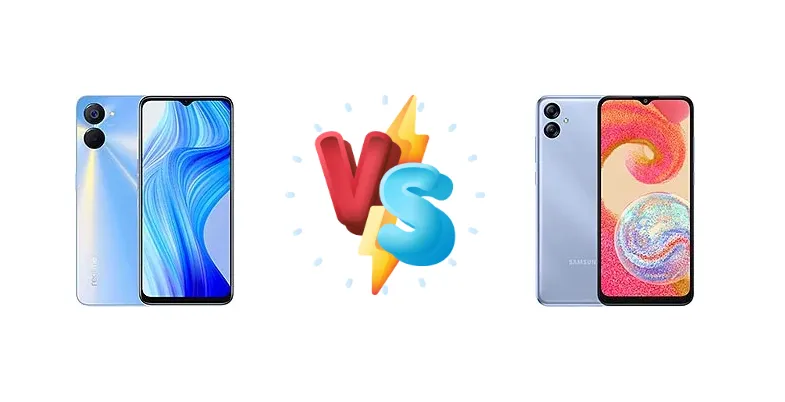
The Realme V20 and Samsung Galaxy A04e represent the extreme end of the budget smartphone spectrum. Both aim to deliver essential smartphone functionality at the lowest possible price, but they take drastically different approaches to achieving this. The V20 prioritizes connectivity with 5G and a more powerful processor, while the A04e focuses on a familiar Samsung experience with a more conservative chipset.
🏆 Quick Verdict
For the average user prioritizing responsiveness and future-proofing, the Realme V20 is the clear winner. Its Mediatek Dimensity 700 chipset provides a substantial performance uplift over the Samsung Galaxy A04e’s Helio P35, making it better suited for multitasking, gaming, and overall daily use. While the A04e benefits from Samsung’s software ecosystem, the V20’s hardware advantage is too significant to ignore.
| Network |
|---|
| 2G bands | GSM 850 / 900 / 1800 / 1900 | GSM 850 / 900 / 1800 / 1900 |
| 3G bands | HSDPA 850 / 900 / 2100 | HSDPA 850 / 900 / 2100 |
| 4G bands | LTE | 1, 3, 5, 7, 8, 20, 28, 38, 40, 41 |
| 5G bands | SA/NSA | - |
| Speed | HSPA, LTE, 5G | HSPA, LTE |
| Technology | GSM / HSPA / LTE / 5G | GSM / HSPA / LTE |
| Launch |
|---|
| Announced | 2022, June 13 | 2022, October 21 |
| Status | Available. Released 2022, June 13 | Available. Released 2022, November 07 |
| Body |
|---|
| Build | Glass front, plastic frame, plastic back | Glass front, plastic back, plastic frame |
| Dimensions | 164.4 x 75.1 x 8.1 mm (6.47 x 2.96 x 0.32 in) | 164.2 x 75.9 x 9.1 mm (6.46 x 2.99 x 0.36 in) |
| SIM | Nano-SIM + Nano-SIM | · Nano-SIM· Nano-SIM + Nano-SIM |
| Weight | 184 g (6.49 oz) | 188 g (6.63 oz) |
| Display |
|---|
| Resolution | 720 x 1600 pixels, 20:9 ratio (~270 ppi density) | 720 x 1600 pixels, 20:9 ratio (~270 ppi density) |
| Size | 6.5 inches, 102.0 cm2 (~82.6% screen-to-body ratio) | 6.5 inches, 102.0 cm2 (~81.8% screen-to-body ratio) |
| Type | IPS LCD, 400 nits (typ) | PLS LCD |
| Platform |
|---|
| CPU | Octa-core (2x2.2 GHz Cortex-A76 & 6x2.0 GHz Cortex-A55) | Octa-core (4x2.3 GHz Cortex-A53 & 4x1.8 GHz Cortex-A53) |
| Chipset | Mediatek Dimensity 700 (7 nm) | Mediatek MT6765 Helio P35 (12 nm) |
| GPU | Mali-G57 MC2 | PowerVR GE8320 |
| OS | Android 12, ColorOS 12 | Android 12, One UI Core 4.1 |
| Memory |
|---|
| Card slot | microSDXC (dedicated slot) | microSDXC (dedicated slot) |
| Internal | 64GB 4GB RAM, 128GB 4GB RAM, 128GB 8GB RAM | 32GB 2GB RAM, 32GB 3GB RAM, 32GB 4GB RAM, 64GB 2GB RAM, 64GB 3GB RAM, 64GB 4GB RAM, 128GB 4GB RAM |
| Main Camera |
|---|
| Dual | 13 MP, (wide), PDAF
Auxiliary lens | 13 MP, f/2.2, (wide), AF
Auxiliary lens |
| Features | LED flash, HDR, panorama | LED flash |
| Single | 5 MP, f/2.2, 27mm (wide), 1/5.0", 1.12µm | 5 MP, f/2.2 |
| Video | 1080p@30fps | 1080p@30fps |
| Selfie camera |
|---|
| Features | HDR | - |
| Single | 5 MP, f/2.2, 27mm (wide), 1/5.0", 1.12µm | 5 MP, f/2.2 |
| Video | 720p@30fps | Yes |
| Sound |
|---|
| 3.5mm jack | Yes | Yes |
| 35mm jack | Yes | Yes |
| Loudspeaker | Yes | Yes |
| Comms |
|---|
| Bluetooth | Yes | 5.0, A2DP, LE |
| NFC | Unspecified | No |
| Positioning | Yes | GPS, GLONASS, GALILEO, BDS |
| Radio | No | Unspecified |
| USB | USB Type-C 2.0 | USB Type-C 2.0, OTG |
| WLAN | Yes | Wi-Fi 802.11 b/g/n, Wi-Fi Direct |
| Features |
|---|
| Sensors | Fingerprint (side-mounted), accelerometer, proximity | Accelerometer, proximity |
| Battery |
|---|
| Charging | 10W wired | - |
| Type | 5000 mAh | Li-Po 5000 mAh |
| Misc |
|---|
| Colors | Black, Blue | Black, Copper, Light Blue |
| Models | RMX3611 | SM-A042F, SM-A042F/DS, SM-A042M, SM-A042M/DS |
| Price | About 160 EUR | ₹ 7,999 |
| SAR EU | - | 0.29 W/kg (head) 1.11 W/kg (body) |
Realme V20
- Significantly faster processor (Dimensity 700)
- 5G connectivity for faster data speeds
- More efficient 7nm chipset for better thermal management
- Slow 10W charging
- Less established brand recognition than Samsung
Samsung Galaxy A04e
- Familiar Samsung One UI experience
- Potentially better software support (Samsung’s update policy)
- Generally lower price point
- Significantly slower processor (Helio P35)
- Limited gaming and multitasking capabilities
- Less future-proof due to older chipset
Display Comparison
Neither device boasts a particularly impressive display. Specifics regarding panel type (IPS vs. TFT) and resolution are missing, but both likely target a 720p+ resolution. The key difference lies in the processing power needed to drive them. The V20’s more capable chipset will handle UI animations and video playback more smoothly. Bezels are expected to be substantial on both, reflecting their budget positioning. Color accuracy is unlikely to be a strong point on either device.
Camera Comparison
Camera performance is likely to be similar in real-world usage, given the expected sensor quality in this price bracket. Both devices likely feature a primary camera around 13MP, supplemented by lower-resolution auxiliary lenses (often 2MP macro or depth sensors). The V20’s more powerful ISP (Image Signal Processor) within the Dimensity 700 chipset *could* offer slightly better image processing, particularly in low-light conditions, but this is heavily dependent on software optimization. The A04e will benefit from Samsung’s established camera algorithms, but the underlying hardware limitations will be a constraint.
Performance
The performance gap is the most significant differentiator. The Realme V20’s Mediatek Dimensity 700, built on a 7nm process, is a substantial upgrade over the Samsung Galaxy A04e’s 12nm Mediatek Helio P35. The Dimensity 700’s Cortex-A76 cores (2x2.2 GHz) offer significantly higher single-core performance than the A04e’s Cortex-A53 cores (4x2.3 GHz). While the A04e has more cores overall, the architectural advantage of the V20’s cores translates to a smoother, more responsive experience. The 7nm process also contributes to better thermal efficiency, reducing the likelihood of throttling during sustained workloads. This means the V20 will maintain higher performance for longer periods.
Battery Life
Both devices likely feature a battery capacity around 5000mAh, providing all-day battery life for moderate usage. However, the Realme V20’s 10W charging is significantly slower than what’s becoming standard, even in this segment. The A04e’s charging speed is not specified, but is likely similar. The Dimensity 700’s improved power efficiency *could* offset the slower charging to some extent, but a full charge will still take a considerable amount of time on the V20.
Buying Guide
Buy the Realme V20 if you need a phone capable of handling more demanding apps, enjoy occasional gaming, or want the benefit of 5G connectivity. This is the choice for users who value performance over brand recognition. Buy the Samsung Galaxy A04e if you prioritize a simple, familiar Android experience with Samsung’s One UI, and your usage is limited to basic tasks like calling, texting, and light social media browsing. It’s a good option for first-time smartphone users or those on a very tight budget.
Frequently Asked Questions
❓ Will the Realme V20 struggle with popular apps like Facebook or Instagram?
While the Realme V20 can run these apps, the Helio P35 in the A04e will likely exhibit more lag and slowdowns when multitasking or scrolling through content-heavy feeds. The V20’s Dimensity 700 provides a smoother experience, especially with multiple apps open.
❓ Is the 5G connectivity on the Realme V20 actually useful if I don't have 5G coverage in my area?
Even without 5G coverage, the V20 will fall back to 4G LTE. The Dimensity 700 chipset also offers improved 4G performance compared to the Helio P35, resulting in faster and more reliable data speeds even on older networks. It also future-proofs the device for when 5G becomes more widely available.
❓ Can I play games like PUBG Mobile or Call of Duty Mobile on either of these phones?
PUBG Mobile and Call of Duty Mobile are playable on both, but with significant compromises. The A04e will require the lowest possible graphics settings and will likely experience noticeable frame drops. The V20 will offer a more playable experience, but still requires reduced graphics settings for smooth gameplay. Don't expect high frame rates on either device.