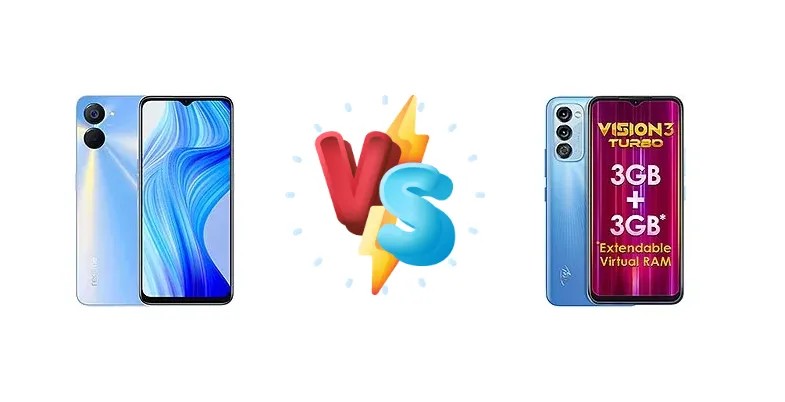
The Realme V20 and itel Vision 3 Turbo represent two distinct approaches to the ultra-budget smartphone market. The V20 leverages a more powerful, though older, Mediatek Dimensity 700 chipset, while the Vision 3 Turbo opts for the Unisoc SC9863A, prioritizing faster charging. This comparison dissects these choices to determine which device delivers the best overall experience for the price-conscious consumer.
🏆 Quick Verdict
For users prioritizing consistent performance in apps and occasional gaming, the Realme V20 is the better choice thanks to its significantly more capable Dimensity 700 chipset. However, the itel Vision 3 Turbo’s 18W charging offers a convenience advantage, making it suitable for users who frequently need a quick power boost.
| Network |
|---|
| 2G bands | GSM 850 / 900 / 1800 / 1900 | GSM 850 / 900 / 1800 / 1900 |
| 3G bands | HSDPA 850 / 900 / 2100 | HSDPA 850 / 900 / 2100 |
| 4G bands | LTE | LTE |
| 5G bands | SA/NSA | - |
| Speed | HSPA, LTE, 5G | HSPA, LTE |
| Technology | GSM / HSPA / LTE / 5G | GSM / HSPA / LTE |
| Launch |
|---|
| Announced | 2022, June 13 | 2022 |
| Status | Available. Released 2022, June 13 | Available. Released 2022 |
| Body |
|---|
| Build | Glass front, plastic frame, plastic back | - |
| Dimensions | 164.4 x 75.1 x 8.1 mm (6.47 x 2.96 x 0.32 in) | - |
| SIM | Nano-SIM + Nano-SIM | Dual SIM |
| Weight | 184 g (6.49 oz) | - |
| Display |
|---|
| Resolution | 720 x 1600 pixels, 20:9 ratio (~270 ppi density) | 720 x 1600 pixels, 20:9 ratio (~266 ppi density) |
| Size | 6.5 inches, 102.0 cm2 (~82.6% screen-to-body ratio) | 6.6 inches, 105.2 cm2 |
| Type | IPS LCD, 400 nits (typ) | IPS LCD |
| Platform |
|---|
| CPU | Octa-core (2x2.2 GHz Cortex-A76 & 6x2.0 GHz Cortex-A55) | Octa-core (4x1.6 GHz Cortex-A55 & 4x1.2 GHz Cortex-A55) |
| Chipset | Mediatek Dimensity 700 (7 nm) | Unisoc SC9863A (28 nm) |
| GPU | Mali-G57 MC2 | IMG8322 |
| OS | Android 12, ColorOS 12 | Android 11 (Go edition) |
| Memory |
|---|
| Card slot | microSDXC (dedicated slot) | microSDXC |
| Internal | 64GB 4GB RAM, 128GB 4GB RAM, 128GB 8GB RAM | 64GB 3GB RAM |
| Main Camera |
|---|
| Dual | 13 MP, (wide), PDAF
Auxiliary lens | - |
| Features | LED flash, HDR, panorama | LED flash |
| Single | 5 MP, f/2.2, 27mm (wide), 1/5.0", 1.12µm | 8 MP (wide)
Auxiliary lens |
| Video | 1080p@30fps | 1080p@30fps |
| Selfie camera |
|---|
| Features | HDR | - |
| Single | 5 MP, f/2.2, 27mm (wide), 1/5.0", 1.12µm | 5 MP |
| Video | 720p@30fps | Yes |
| Sound |
|---|
| 3.5mm jack | Yes | - |
| 35mm jack | Yes | Yes |
| Loudspeaker | Yes | Yes |
| Comms |
|---|
| Bluetooth | Yes | Yes |
| NFC | Unspecified | No |
| Positioning | Yes | GPS |
| Radio | No | Unspecified |
| USB | USB Type-C 2.0 | microUSB |
| WLAN | Yes | Yes |
| Features |
|---|
| Sensors | Fingerprint (side-mounted), accelerometer, proximity | Fingerprint (rear-mounted), accelerometer |
| Battery |
|---|
| Charging | 10W wired | 18W wired |
| Type | 5000 mAh | 5000 mAh |
| Misc |
|---|
| Colors | Black, Blue | Blue |
| Models | RMX3611 | - |
| Price | About 160 EUR | - |
Realme V20
- More powerful Mediatek Dimensity 700 chipset
- Better thermal efficiency due to 7nm process
- Smoother multitasking and app performance
- Slower 10W charging
- Likely basic display quality
itel Vision 3 Turbo
- Faster 18W wired charging
- Potentially lower price point
- Sufficient for basic smartphone tasks
- Significantly weaker Unisoc SC9863A chipset
- Less responsive user experience
- Struggles with demanding applications
Display Comparison
Neither device boasts a standout display. Given the context data focuses on processing power, we can infer both likely utilize LCD panels common in this price bracket. The absence of specifications like resolution or refresh rate suggests a focus on cost reduction. Bezels are likely to be substantial on both, and color accuracy will be basic. The user experience will be similar – functional, but not visually impressive.
Camera Comparison
Without detailed camera specifications, a direct comparison is difficult. However, it's safe to assume both phones feature basic camera setups geared towards social media sharing rather than professional photography. The absence of information regarding sensor size or optical image stabilization suggests neither device will excel in low-light conditions. Image processing will likely be heavily reliant on software algorithms to enhance image quality, and results will vary. The presence of a 2MP macro camera on either device is likely more of a marketing feature than a genuinely useful addition.
Performance
The core difference lies in the chipsets. The Realme V20’s Mediatek Dimensity 700, built on a 7nm process, offers a substantial performance advantage over the itel Vision 3 Turbo’s Unisoc SC9863A, fabricated on a larger 28nm node. The Dimensity 700’s octa-core configuration, featuring two Cortex-A76 cores clocked at 2.2 GHz, provides significantly more processing power than the Vision 3 Turbo’s four Cortex-A55 cores at 1.6 GHz and another four at 1.2 GHz. This translates to faster app loading times, smoother multitasking, and a more responsive user interface on the V20. The 7nm process also contributes to better thermal efficiency, reducing the likelihood of throttling during sustained use. The Unisoc SC9863A is geared towards basic functionality, suitable for light tasks but likely to struggle with demanding applications.
Battery Life
The itel Vision 3 Turbo’s 18W wired charging is a clear advantage over the Realme V20’s 10W charging. While battery capacity isn’t specified, the faster charging speed will allow users to replenish the battery more quickly. This is particularly beneficial for users who frequently find themselves needing to top up their phone throughout the day. The Realme V20’s slower charging will require a longer connection to the charger, even if its battery capacity is slightly larger. The difference in charging speed will be a noticeable daily convenience factor.
Buying Guide
Buy the Realme V20 if you need a phone capable of handling multitasking, streaming, and light gaming without significant lag. It’s ideal for users who value responsiveness over the absolute fastest charging. Buy the itel Vision 3 Turbo if you prioritize quick top-ups and don't heavily rely on demanding applications. This phone is best suited for basic communication, social media, and light web browsing.
Frequently Asked Questions
❓ Will the Unisoc SC9863A in the itel Vision 3 Turbo struggle with popular apps like Facebook or WhatsApp?
While the Unisoc SC9863A can handle basic apps like Facebook and WhatsApp, you may experience occasional lag or slowdowns, especially with multiple apps open simultaneously. It's designed for light usage, and demanding apps will push its limits.
❓ Is the Realme V20 a good choice for playing mobile games like PUBG Mobile or Call of Duty?
The Realme V20’s Dimensity 700 chipset is capable of running PUBG Mobile and Call of Duty, but you’ll likely need to lower the graphics settings to achieve a playable frame rate. Don’t expect a high-end gaming experience, but it’s significantly better than what the itel Vision 3 Turbo can offer.
❓ How long will it take to fully charge the itel Vision 3 Turbo with the 18W charger?
Without knowing the battery capacity, it's difficult to give an exact time. However, with an 18W charger, you can expect a full charge to take between 2 to 3 hours, significantly faster than the Realme V20's 10W charging.