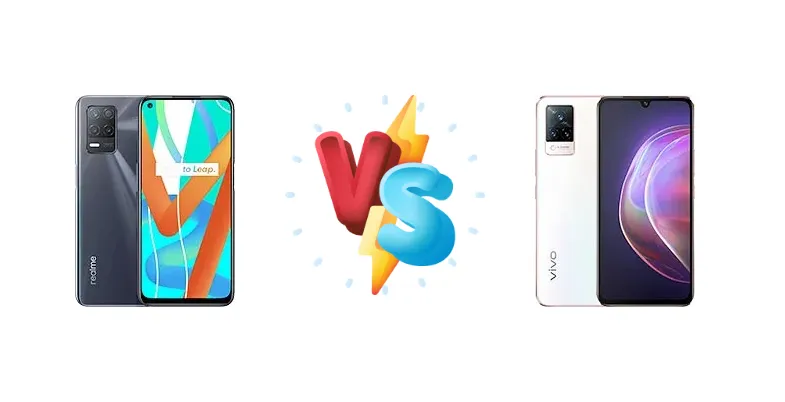
The Realme V13 5G and vivo V21 5G represent compelling options in the increasingly competitive mid-range 5G smartphone market. Both devices aim to deliver 5G connectivity without breaking the bank, but they achieve this with different approaches to chipset selection and feature prioritization. This comparison dives deep into the specifications to determine which phone offers the best value for your money.
🏆 Quick Verdict
For the average user prioritizing faster charging and a slightly brighter display, the vivo V21 5G is the better choice. However, the Realme V13 5G remains a strong contender, especially for those seeking a balance of performance and affordability, and who don't mind slower charging speeds.
| Network |
|---|
| 2G bands | GSM 850 / 900 / 1800 / 1900 | GSM 850 / 900 / 1800 / 1900 |
| 3G bands | HSDPA 800 / 850 / 900 / 1900 / 2100 | HSDPA 850 / 900 / 1700(AWS) / 1900 / 2100 |
| 4G bands | 1, 2, 3, 5, 7, 8, 28, 34, 38, 39, 40, 41 | 1, 2, 3, 4, 5, 8, 34, 38, 40, 41 - India |
| 5G bands | 1, 28, 41, 77, 78 SA/NSA | 78 Sub6 - India |
| Speed | HSPA, LTE, 5G | HSPA, LTE, 5G |
| Technology | GSM / HSPA / LTE / 5G | GSM / HSPA / LTE / 5G |
| Launch |
|---|
| Announced | 2021, March 31 | 2021, April 27 |
| Status | Available. Released 2021, April 02 | Available. Released 2021, May 06 |
| Body |
|---|
| Build | - | Glass front, plastic frame, plastic back |
| Dimensions | 162.5 x 74.8 x 8.5 mm (6.40 x 2.94 x 0.33 in) | 159.7 x 73.9 x 7.3 mm (6.29 x 2.91 x 0.29 in) |
| SIM | Nano-SIM + Nano-SIM | Nano-SIM + Nano-SIM |
| Weight | 185 g (6.53 oz) | 176 g (6.21 oz) |
| Display |
|---|
| Resolution | 1080 x 2400 pixels, 20:9 ratio (~405 ppi density) | 1080 x 2400 pixels, 20:9 ratio (~409 ppi density) |
| Size | 6.5 inches, 102.0 cm2 (~83.9% screen-to-body ratio) | 6.44 inches, 100.1 cm2 (~84.8% screen-to-body ratio) |
| Type | IPS LCD, 90Hz, 480 nits (typ), 600 nits | AMOLED, 90Hz, HDR10+, 500 nits (typ) |
| Platform |
|---|
| CPU | Octa-core (2x2.2 GHz Cortex-A76 & 6x2.0 GHz Cortex-A55) | Octa-core (2x2.4 GHz Cortex-A76 & 6x2.0 GHz Cortex-A55) |
| Chipset | Mediatek Dimensity 700 (7 nm) | Mediatek Dimensity 800U (7 nm) |
| GPU | Mali-G57 MC2 | Mali-G57 MC3 |
| OS | Android 11, Realme UI 2.0 | Android 11, Funtouch 11.1 |
| Memory |
|---|
| Card slot | microSDXC (dedicated slot) | microSDXC (uses shared SIM slot) |
| Internal | 128GB 8GB RAM, 256GB 8GB RAM | 128GB 6GB RAM, 128GB 8GB RAM, 256GB 8GB RAM |
| | UFS 2.1 | UFS 2.2 |
| Main Camera |
|---|
| Features | LED flash, HDR, panorama | LED flash, HDR, panorama |
| Single | - | 44 MP, f/2.0, (wide), AF, OIS |
| Triple | 48 MP, f/1.8, 26mm (wide), PDAF
2 MP (macro)
Auxiliary lens | 64 MP, f/1.8, 26mm (wide), 1/1.72", 0.8µm, PDAF, OIS
8 MP, f/2.2, 120˚, 16mm (ultrawide), 1/4.0", 1.12µm
2 MP (macro) |
| Video | 1080p@30fps | 4K@30fps (no OIS), 1080p@30/60fps |
| Selfie camera |
|---|
| Features | - | Dual-LED flash, HDR |
| Single | 8 MP, f/2.0, 26mm (wide) | 44 MP, f/2.0, (wide), AF, OIS |
| Video | 1080p@30fps | 4K@30fps (no OIS), 1080p@30fps |
| Sound |
|---|
| 3.5mm jack | Yes | No |
| 35mm jack | Yes | No |
| Loudspeaker | Yes | Yes |
| | 24-bit/192kHz audio | - |
| Comms |
|---|
| Bluetooth | 5.1, A2DP, LE | 5.1, A2DP, LE |
| NFC | No | Yes (market/region dependent) |
| Positioning | GPS, GLONASS, BDS, GALILEO, QZSS | GPS, GLONASS, GALILEO, BDS |
| Radio | Unspecified | No |
| USB | USB Type-C 2.0, OTG | USB Type-C 2.0, OTG |
| WLAN | Wi-Fi 802.11 a/b/g/n/ac, dual-band, Wi-Fi Direct | Wi-Fi 802.11 a/b/g/n/ac, dual-band, Wi-Fi Direct |
| Features |
|---|
| Sensors | Fingerprint (side-mounted), accelerometer, gyro, proximity, compass | Fingerprint (under display, optical), accelerometer, gyro, proximity, compass |
| Battery |
|---|
| Charging | 18W wired | 33W wired, 63% in 30 min |
| Type | 5000 mAh | 4000 mAh |
| Misc |
|---|
| Colors | Blue, Gray | Dusk Blue, Sunset Dazzle, Arctic White |
| Models | - | V2050 |
| Price | About 210 EUR | About 190 EUR |
| SAR | - | 1.05 W/kg (head) 0.87 W/kg (body) |
| Tests |
|---|
| Battery life | - |
Endurance rating 123h
|
| Camera | - |
Photo / Video |
| Display | - |
Contrast ratio: Infinite (nominal) |
| Loudspeaker | - |
-28.2 LUFS (Average)
|
| Performance | - |
AnTuTu: 336699 (v8), 365055 (v9)
GeekBench: 6516 (v4.4), 1600 (v5.1)
GFXBench: 17fps (ES 3.1 onscreen) |
Realme V13 5G
- More affordable price point
- Solid 5G performance for everyday tasks
- Comparable battery endurance to the V21 5G
- Slower 18W charging
- Likely lower display brightness
- Potentially less refined camera system
vivo V21 5G
- Faster 33W charging for quick top-ups
- Brighter display for better outdoor visibility
- Slightly more powerful Dimensity 800U chipset
- Generally higher price
- Similar battery endurance to the V13 5G despite faster charging
- May not offer a significant camera advantage
Display Comparison
The vivo V21 5G boasts a significant advantage in display brightness, reaching a measured 761 nits. While the Realme V13 5G’s brightness isn’t specified, the V21’s higher peak brightness translates to better visibility outdoors. Both displays share an 'Infinite' (nominal) contrast ratio, suggesting standard IPS LCD technology. The lack of information on the Realme V13’s panel type prevents a deeper analysis of color accuracy and viewing angles, but the V21’s brightness is a clear win for users who frequently use their phones in bright environments.
Camera Comparison
Both devices are listed as having 'Photo / Video' capabilities, offering minimal insight. Without specific sensor details, it’s difficult to make a definitive judgment. However, the market positioning of the vivo V21 5G suggests a greater emphasis on camera quality, potentially featuring a larger main sensor and more sophisticated image processing algorithms. The absence of details on optical image stabilization (OIS) on either device suggests it’s unlikely to be present, meaning low-light performance will rely heavily on software processing. Ignoring the ubiquitous 2MP macro lenses, the primary camera sensor size and aperture will be the key differentiators, but this information is currently unavailable.
Performance
At the heart of the difference lies the chipset: the Realme V13 5G utilizes the Mediatek Dimensity 700, while the vivo V21 5G steps up to the Dimensity 800U. Both are 7nm chips, but the 800U features slightly faster CPU cores (2x2.4 GHz Cortex-A76 vs 2x2.2 GHz Cortex-A76). This translates to a noticeable, though not massive, performance uplift for the V21 5G in CPU-intensive tasks. Both phones share the same Cortex-A55 efficiency cores, meaning multi-tasking performance will be similar. The GPU performance difference is also present, favoring the V21 5G for gaming, but neither phone is a dedicated gaming powerhouse. RAM configurations are not specified, but LPDDR4X is likely on both, limiting the performance gains from the chipset difference.
Battery Life
Both the Realme V13 5G and vivo V21 5G achieve an endurance rating of 123 hours, indicating similar overall battery life despite differing charging capabilities. However, the vivo V21 5G’s 33W wired charging significantly outperforms the Realme V13 5G’s 18W charging. The V21 5G can reach 63% charge in just 30 minutes, while the V13 5G will take considerably longer. This difference is crucial for users who frequently need to quickly top up their battery throughout the day. While both phones offer comparable battery endurance, the V21 5G’s faster charging provides a more convenient user experience.
Buying Guide
Buy the Realme V13 5G if you need a solid all-around 5G experience with a focus on value and aren't heavily reliant on extremely fast charging. Buy the vivo V21 5G if you prioritize quick top-ups with its 33W charging and appreciate a display that can get noticeably brighter in direct sunlight, even if it means paying a slight premium.
Frequently Asked Questions
❓ Does the Dimensity 800U in the vivo V21 5G offer a noticeable gaming improvement over the Dimensity 700 in the Realme V13 5G?
While the Dimensity 800U is more powerful, the difference isn't massive. You'll see slightly higher frame rates and smoother performance in demanding games on the V21 5G, but neither phone is designed for high-end gaming. Expect to play most games at medium settings for a comfortable experience.
❓ How long does it realistically take to fully charge the Realme V13 5G with its 18W charger?
Given the 18W charging speed, a full charge from 0% on the Realme V13 5G will likely take around 2-2.5 hours. This is significantly slower than the vivo V21 5G's 33W charging, making it less convenient for users who need a quick power boost.
❓ Is the camera on the vivo V21 5G significantly better than the Realme V13 5G, considering both only list 'Photo/Video' capabilities?
Vivo generally prioritizes camera performance in its mid-range devices. While specific sensor details are missing, it's reasonable to expect the V21 5G to have a more refined camera system with potentially better image processing, especially in low-light conditions. However, without concrete specifications, this remains speculative.