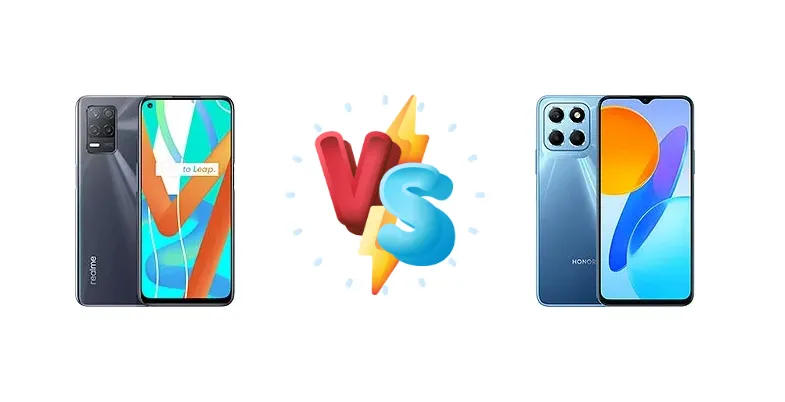
The Realme V13 5G and Honor X8 5G represent compelling options in the increasingly competitive sub-$200 5G smartphone market. Both aim to deliver 5G connectivity without breaking the bank, but they achieve this with different chipsets and charging strategies. This comparison dissects those differences to determine which phone offers the best value for your money.
🏆 Quick Verdict
For most users, the Honor X8 5G emerges as the slightly better choice. Its Snapdragon 480+ chipset, fabricated on an 8nm process, offers a more efficient architecture than the Realme V13 5G’s Dimensity 700 (7nm), and the 22.5W charging provides a noticeable convenience advantage.
| Network |
|---|
| 2G bands | GSM 850 / 900 / 1800 / 1900 | GSM 850 / 900 / 1800 / 1900 |
| 3G bands | HSDPA 800 / 850 / 900 / 1900 / 2100 | HSDPA 850 / 900 / 1900 / 2100 |
| 4G bands | 1, 2, 3, 5, 7, 8, 28, 34, 38, 39, 40, 41 | LTE |
| 5G bands | 1, 28, 41, 77, 78 SA/NSA | SA/NSA |
| Speed | HSPA, LTE, 5G | HSPA, LTE, 5G |
| Technology | GSM / HSPA / LTE / 5G | GSM / HSPA / LTE / 5G |
| Launch |
|---|
| Announced | 2021, March 31 | 2022, July 25 |
| Status | Available. Released 2021, April 02 | Available. Released 2022, August 15 |
| Body |
|---|
| Dimensions | 162.5 x 74.8 x 8.5 mm (6.40 x 2.94 x 0.33 in) | 163.7 x 75.1 x 8.7 mm (6.44 x 2.96 x 0.34 in) |
| SIM | Nano-SIM + Nano-SIM | Nano-SIM + Nano-SIM |
| Weight | 185 g (6.53 oz) | 194 g (6.84 oz) |
| Display |
|---|
| Resolution | 1080 x 2400 pixels, 20:9 ratio (~405 ppi density) | 720 x 1600 pixels, 20:9 ratio (~270 ppi density) |
| Size | 6.5 inches, 102.0 cm2 (~83.9% screen-to-body ratio) | 6.5 inches, 102.0 cm2 (~83.0% screen-to-body ratio) |
| Type | IPS LCD, 90Hz, 480 nits (typ), 600 nits | TFT LCD |
| Platform |
|---|
| CPU | Octa-core (2x2.2 GHz Cortex-A76 & 6x2.0 GHz Cortex-A55) | Octa-core (2x2.2 GHz Kryo 460 & 6x1.9 GHz Kryo 460) |
| Chipset | Mediatek Dimensity 700 (7 nm) | Qualcomm SM4350-AC Snapdragon 480+ 5G (8 nm) |
| GPU | Mali-G57 MC2 | Adreno 619 |
| OS | Android 11, Realme UI 2.0 | Android 11, Magic UI 4.2 |
| Memory |
|---|
| Card slot | microSDXC (dedicated slot) | microSDXC |
| Internal | 128GB 8GB RAM, 256GB 8GB RAM | 128GB 6GB RAM |
| | UFS 2.1 | - |
| Main Camera |
|---|
| Features | LED flash, HDR, panorama | LED flash, HDR, panorama |
| Single | - | 8 MP, f/2.0, (wide) |
| Triple | 48 MP, f/1.8, 26mm (wide), PDAF
2 MP (macro)
Auxiliary lens | 48 MP, f/1.8, (wide), PDAF
2 MP (macro)
Auxiliary lens |
| Video | 1080p@30fps | 1080p@30fps |
| Selfie camera |
|---|
| Single | 8 MP, f/2.0, 26mm (wide) | 8 MP, f/2.0, (wide) |
| Video | 1080p@30fps | 1080p@30fps |
| Sound |
|---|
| 3.5mm jack | Yes | Yes |
| 35mm jack | Yes | Yes |
| Loudspeaker | Yes | Yes |
| | 24-bit/192kHz audio | - |
| Comms |
|---|
| Bluetooth | 5.1, A2DP, LE | 5.1, A2DP, LE |
| NFC | No | Yes (VNE-N41 only) |
| Positioning | GPS, GLONASS, BDS, GALILEO, QZSS | GPS, GLONASS, GALILEO, BDS |
| Radio | Unspecified | Unspecified |
| USB | USB Type-C 2.0, OTG | USB Type-C 2.0 |
| WLAN | Wi-Fi 802.11 a/b/g/n/ac, dual-band, Wi-Fi Direct | Wi-Fi 802.11 a/b/g/n/ac, dual-band, Wi-Fi Direct |
| Features |
|---|
| Sensors | Fingerprint (side-mounted), accelerometer, gyro, proximity, compass | Fingerprint (side-mounted), accelerometer, proximity, compass |
| Battery |
|---|
| Charging | 18W wired | 22.5W wired |
| Type | 5000 mAh | Li-Po 5000 mAh |
| Misc |
|---|
| Colors | Blue, Gray | Midnight Black, Ocean Blue |
| Models | - | VNE-N41 |
| Price | About 210 EUR | About 170 EUR |
Realme V13 5G
- Established Realme software ecosystem
- Potentially lower price point (depending on region)
- Mediatek Dimensity 700 offers solid 5G connectivity
- Slower 18W charging
- Dimensity 700's 7nm process may lead to more throttling
- Limited information on display quality
Honor X8 5G
- Faster 22.5W charging
- Snapdragon 480+’s 8nm process offers better efficiency
- Potentially better sustained performance
- Honor's software update history is less consistent
- May be slightly more expensive than the Realme V13 5G
- Limited information on display quality
Display Comparison
Neither Realme nor Honor provide display specifications beyond the basic 'LCD' type. Given the price point, expect 60Hz refresh rates and 1080p+ resolutions on both. The lack of detailed specs makes a direct comparison difficult, but the focus here will be on performance, not visual fidelity. Bezels are likely comparable, and color accuracy will be standard for this segment.
Camera Comparison
Detailed camera specs are absent, making a thorough comparison impossible. However, both phones likely feature a primary camera paired with depth and macro sensors. The absence of OIS on either device suggests reliance on software stabilization. Image processing will likely differ, with Realme often favoring vibrant, saturated colors and Honor leaning towards a more natural look. Without sensor size or aperture information, it’s difficult to declare a clear winner; the primary sensor resolution will be the deciding factor, if available.
Performance
The core difference lies in the chipsets. The Realme V13 5G utilizes the Mediatek Dimensity 700, a 7nm chip with a dual-core Cortex-A76 setup for performance and a hexa-core Cortex-A55 cluster for efficiency. The Honor X8 5G counters with the Qualcomm Snapdragon 480+ 5G, built on a more advanced 8nm process. While both feature octa-core CPUs with similar peak clock speeds (2.2 GHz), the Snapdragon 480+’s Kryo 460 cores and the 8nm node suggest better thermal management and sustained performance under load. This translates to potentially less throttling during extended gaming or demanding app usage. The 8nm process generally leads to lower power consumption at similar performance levels.
Battery Life
Battery capacity is not specified for either device. However, the Honor X8 5G’s 22.5W wired charging is a significant advantage over the Realme V13 5G’s 18W charging. This faster charging speed will translate to quicker top-ups, reducing downtime. Even with a similar battery capacity, the Honor X8 5G will likely offer a more convenient charging experience. The Snapdragon 480+'s 8nm process may also contribute to slightly better battery life due to improved efficiency.
Buying Guide
Buy the Realme V13 5G if you prioritize a brand with a proven track record of software updates and a slightly more established ecosystem. Buy the Honor X8 5G if you value faster charging speeds and a potentially more efficient chipset for sustained performance, especially during longer gaming sessions or multitasking.
Frequently Asked Questions
❓ Will the Snapdragon 480+ in the Honor X8 5G struggle with graphically intensive games like PUBG Mobile?
While not a flagship chipset, the Snapdragon 480+ is capable of running PUBG Mobile at medium settings with reasonable frame rates. The 8nm process helps mitigate throttling, allowing for more sustained performance compared to the Dimensity 700, though demanding titles may require reduced graphics settings.
❓ Is the 18W charging on the Realme V13 5G noticeably slower than the 22.5W charging on the Honor X8 5G in real-world use?
Yes, the difference is noticeable. 22.5W charging will typically add a significantly larger percentage of battery life in the same amount of time compared to 18W. Expect a 30-60 minute difference for a full charge, depending on battery capacity.
❓ Which phone is likely to receive more software updates and security patches?
Realme generally has a better track record for providing consistent software updates and security patches compared to Honor, particularly in the budget segment. However, this can vary by region and model.
❓ Does either phone support VoWiFi (Wi-Fi Calling)?
Support for VoWiFi is carrier-dependent and not explicitly stated for either device. Check with your mobile carrier to confirm compatibility before purchasing.